
跨文化交际之中西方饮食文化差异
- 格式:pptx
- 大小:8.94 MB
- 文档页数:11
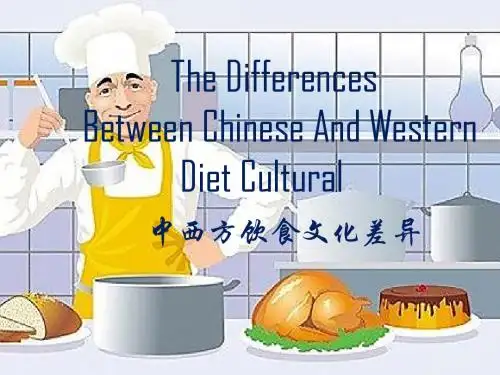


Differences of Table Manners between China and WestChapter 1 IntroductionAs the economy and culture developing rapidly, having dinner is not only for people basic physical need, but also the important skill in social communication. Good manners and courtesy have become increasingly common understanding of the public. With the deepening of reform and opening up policy in China and the strengthening of communication between China and West, people have a great number of opportunities to have dinner with foreigners. A lot of table manners, such as arriving time, seat arrangement, and order of serving dishes, tableware, behaviour and communication, reflect different culture and life-style in nations or countries. There are many differences of table manners between China and western countries.It is extremely important for people to understand these differences to avoid making mistakes and promote the development of humanity culture and achieve interpersonal harmony in both countries.1Differences of Table Manners between China and WestChapter 2 Literature ReviewIt is a common sense that different countries have different cultures. Table manners, as a kind of social customs, are deeply influenced by culture and vary in many different kinds of areas. China has characteristic table manners with a long history, and western countries also have their own table manners. To some degree, having good table manners is a symbol of a nation’s civilization and an expression of a person’s moral cultivation.2Differences of Table Manners between China and WestChapter 3 Cultural Differences of Table Manners3.1 Arriving TimeAs we all know that Chinese people often arrive half an hour later than the predicted time and the host also seems to have prepares for that. When they are waiting for other guests, the host always arranges some games so that the guests who come earlier would not feel boring. While in western countries, people do things strictly and all the activities begin on time. People should arrive at the party on time especially the formal banquets. It is considered as impolite and contempt for the host and other guests if one arrives 10 minutes later.3.2 Seat ArrangementIn Chinese table manners, seating arrangement is the most important part. The seat of honor, reserved for the banquet’s master or the highest status’s guest, is in the center facing east or facing the door. And the other higher position guests sit closer tothe master of the banquet. The lowest position guests sit furthest from the seat of honor. If it is a round table, the one facing the door is the guest of honor. The seats on the left hand are second, and then in turn fourth and sixth and so on. The guests on the right hand are the same.While in western countries, it is different. When the hostess announced dinner is ready, male host will lead guests to the table in turn, and the hostess walks behind them. Some host will also place name card on the table to show the seat.3.3 Order of Serving DishesChinese meals usually begin with appetizers. There are often four or five kinds of appetizers, such as, cold meats, preserved eggs, smoked fish and vegetable relishes. All these food are arranged beautifully on separate dishes or on one large platter. Then the hot food should be served. There is an important rule to serve the whole duck, chicken and fish, which is don’t put the head and tail to the major seat. After the hot dishes, then comes the main course, rice. At last, desserts and fruits are provided to help digestion.In western countries, the first dish is appetizer as well. The second dish is soup. The third dish is fish dish. Meat and poultry dishes is the fourth dish, which also known as the main course. And the most representative is beef and steak. Salad can be a kind of side dish, which can be arranged either after or with the meat dish. The sixth dish is dessert, such as pudding, ice cream, cheese, fruit and so on. The final drink is coffee with cream or tea with sugar.3Differences of Table Manners between China and West3.4 TablewareChinese people mainly use bowl, chopsticks and spoons. Chopsticks are the most important tableware in China. While in serving English meals, they use so much tablewares with different kinds and sizes. There are different kinds of glasses, spoons, plates, bowls and knives. The main tablewares in western are knives, forks, spoons, glass and napkin.3.5 Behaviour and CommunicationWhen on the dinner table, Chinese people talked a lot and enjoy the delicious food at the same time, which means the hospitality and sincere of hostess. Because they believe that the lively atmosphere on the dinner table reflects the cheerful of guests and the warmth of family. While in western, during the dinner, people talked little and cut their own food in the plate quietly.4Differences of Table Manners between China and WestChapter 4 Main Factors Causing the Differences4.1 GeographyThe geographical location and the environment lead to the differences between Chinese and western cultures. People in different places will have differentbehaviours and cultures.4.2 TraditionWith thousands of years of Chinese traditional culture, we believe that we should take care of others and cooperate with others. Chinese people use cheap chopsticks as tableware which can reflect Chinese collective consciousness. In the book Culture on Dinner Table, Mr. Yi Zhongtian said that the core thought of Chinese culture is group consciousness while the western core thought is individual consciousness. The western culture, to be self-centered, the boundary between people is very clear and they usually do not allow mutual interference. That makes western table manners without sharing a plate of food. Knife and fork also can reflect individual consciousness, and noble west of life.4.3 CustomPeople from different countries have different cultures and customs, especially in the aspects such as greeting, thanks, apology, flattery, and making telephone calls. When Chinese invited guests to have dinner, the host always picks food for guests and tries his best to make guests eat and drink more. While in western countries, the host would just let their guests help themselves and they would never carry food to their guest’s bowl.5Differences of Table Manners between China and WestChapter 5 Trend of SyncretismNowadays, an increasing number of western restaurants appear in many cities in China and an increasing number of people like to have meals in it. People have gradually learned western table manners in their daily life. It is obvious that the Chinese diet conception is sensible, and the western diet idea is rational. Now, the difference seems to become blurred with the strengthening of communication between China and West and the development of science. Instead of paying attention to the color, flavor and taste of the food, Chinese people, like the westerners, pay more attention to its health and nutrition. This dissemination and development of western style food has unavoidably made great influence on Chinese food and beverage industry, which made Chinese style food trade change in the aspects of managing concept, management mode, productive means, personnel cultivation and so on.6Differences of Table Manners between China and WestChapter 6 ConclusionSocial background, historical and cultural differences lead to the differences between Chinese and Western table manners. To some extent, table manner is a reflection of the kind of lifestyle, and the formation of habits which can not be obtained in a short period of time. It is actually a kind of historical and cultural sedimentation and extension. Knowing the differences, people can easily understandthe culture of each other. In face of these differences, we should comprehend and respect their habits and culture and remember that every culture is equal to the other. Only recognizing cultural differences between China and West and making a reasonable and effective integration, can we establish a social cultural etiquette system of contemporary China and reach the ideal harmonious society.7Differences of Table Manners between China and WestReferences[1] 易中天. 餐桌上的文化[J]. 当代学生, 2004(10).[2] 杨柳,田丹丹,苑富山. 中美餐桌礼仪刍议[J]. 从餐桌礼仪看中西文化差异[J]. 硅谷, 2008(18).8。
跨文化交际中的饮食文化差异饮食文化是各种文化之间最具代表性和最明显的差异之一,跨文化交际过程中,饮食文化的差异不仅仅是在菜品口味上的差异,更是代表了对生活方式、价值观和社会文化的态度和反应。
饮食文化差异的了解和尊重,是跨文化交际沟通成功的关键之一。
饮食文化差异的表现食材差异不同国家和地区的饮食文化最明显的差异是食材的选择和使用。
例如,中国人喜欢食用大量的蔬菜、米饭和豆腐,在日本饮食文化中,则通常将寿司、海鲜和苹果等食材作为主打,而美国人则较喜欢炸薯条、汉堡等快餐食品。
甚至在同一国家的不同地方,饮食差异也非常显著。
烹调方式差异不同饮食文化还表现在烹调方式上。
例如,中国饮食文化以炒、煮、爆、烤等方式烹饪,而印度饮食文化则偏好使用香料和辣椒,烧烤和高压锅等方式。
虽然方法不同,但都在追求最佳的口感、健康和美味。
餐食组合方式差异餐食组合方式也是饮食文化差异的表现之一。
例如,中国人传统上喜欢在一顿饭中搭配有汤、菜、米饭等,而在美国,人们喜欢往披萨上加很多配料和酱汁,还有浓重的奶油汁和牛排等。
这些都是不同地区人们将食材和菜肴组合起来的不同方式。
餐桌礼仪方式差异不同的餐桌礼仪同样代表着对文化差异的尊重。
例如,在中国,人们传统上认为用筷子吃饭是更卫生、更好的食用方式,在东南亚地区,则偏向使用汤匙和叉子;在欧洲,使用餐刀与叉子吃饭是非常流行的。
跨文化交际中的饮食文化差异应对方法尊重差异在跨文化交际过程中,应该尊重不同地区的食材选择、烹调方式和餐食组合方式等文化差异,以及对餐桌礼仪的不同看法。
这将有助于避免不必要的争吵和误解,促进友好的交流氛围,同时消除陌生感和不必要的不适感。
学习差异了解和学习不同饮食文化差异,是更好地理解对方文化的关键。
可以通过学习文化、旅游、交流等途径,了解文化历史、习俗、礼仪和文化差异,从而更好地与当地人沟通交流。
适应差异适应不同地区的饮食差异是跨文化交际中的一部分。
这可能需要你尝试一些你原本不喜欢的菜肴或烹调方式,尤其是在商务或社交场合,也表明了对文化差异的一种尊重。
