
Unit 11 将来完成时,将来进行时与过去将来时,will have to
- 格式:ppt
- 大小:1.16 MB
- 文档页数:45

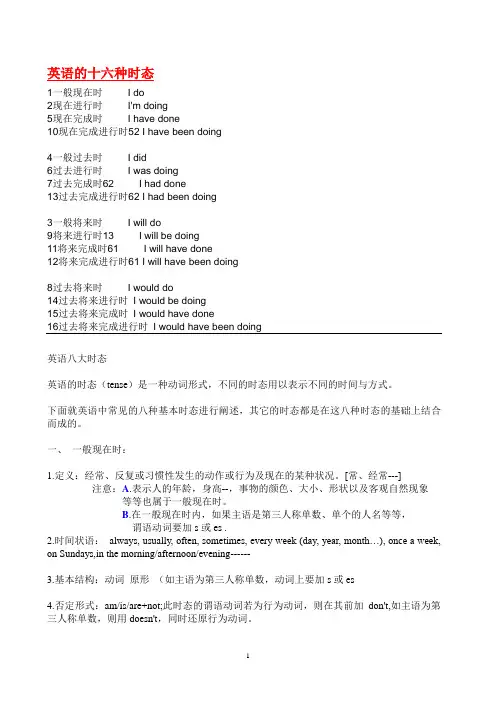
英语的十六种时态1一般现在时I do2现在进行时I'm doing5现在完成时I have done10现在完成进行时52 I have been doing4一般过去时I did6过去进行时I was doing7过去完成时62 I had done13过去完成进行时62 I had been doing3一般将来时I will do9将来进行时13 I will be doing11将来完成时61 I will have done12将来完成进行时61 I will have been doing8过去将来时I would do14过去将来进行时I would be doing15过去将来完成时I would have done16过去将来完成进行时I would have been doing英语八大时态英语的时态(tense)是一种动词形式,不同的时态用以表示不同的时间与方式。
下面就英语中常见的八种基本时态进行阐述,其它的时态都是在这八种时态的基础上结合而成的。
一、一般现在时:1.定义:经常、反复或习惯性发生的动作或行为及现在的某种状况。
[常、经常---]注意:A.表示人的年龄,身高--,事物的颜色、大小、形状以及客观自然现象等等也属于一般现在时。
B.在一般现在时内,如果主语是第三人称单数、单个的人名等等,谓语动词要加s或es .2.时间状语:always, usually, often, sometimes, every week (day, year, month…), once a week, on Sundays,in the morning/afternoon/evening------3.基本结构:动词原形(如主语为第三人称单数,动词上要加s或es4.否定形式:am/is/are+not;此时态的谓语动词若为行为动词,则在其前加don't,如主语为第三人称单数,则用doesn't,同时还原行为动词。

英语的16种时态及其被动语态例句英语的16种时态,及其动语态(be + V过去分词)。
第一句是主动语态,第二三句是被动。
1 一般现在时用动词原形I often watch TV.TV is often watched by me.2 一般过去时用动词过去时I watched TV just now.TV was watched by me just now.3 现在进行时be + vingI am watching TV.TV is being watched by me.4 过去进行时was/were + vingI was watching TV when you came in.TV was being watched by me when you came in. (注意点跟第3句相同)5 一般将来时will + 动词原形或be going to + 动词原形I will go to the zoo on Sunday.The zoo will be visited by me on Sunday.(注意这里will可以用is going to代替)6 过去将来时would + 动词原形或was/were going to + 动词原形Yesterday he told me he would go to the zoo next Sunday.Yesterday he told me the zoo would be visited by him next Sunday. (单被动)Yesterday I was told by him the zoo would be visited by him next Sunday. (双被动)(注意,这里的would可以用was going to 代替)7 现在完成时have/has + v过去分词I have finished my homework.My homework has been finished by me. (注意这里,have变成has因为第三人称单数。
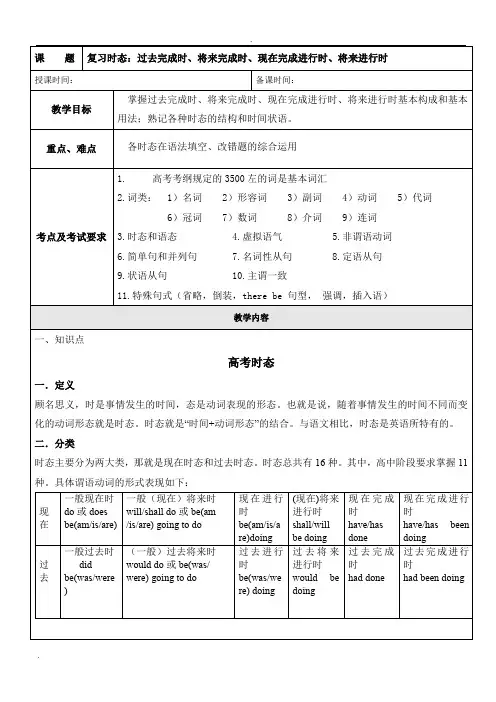
课后作业一、真题演练:单句语法1. When I die, I ____________(give) everything to you.2. That was definitely not an attractive idea, so I politely declined her invitation, .____________(close) m y book and walked away.3. His fear of failure __________(keep) him from classroom games that other students played with joyousabandon.4. _______________(speak) out your inner feeling won’t make you feel ashamed, on the contrary,5. _____________(complete) the project as planned, we’ll have to work two more hours a day.6.It was raining lightly when I___61___ (arrive) in Yangshuo just before dawn.7. This cycle 48 (go) day after day:The walls warm up during the day and cool off during the night and are thus always a timely offset(抵消) for the outside temperatures.8. In 1969,the pollution was terrible along the Cuyahoga River near Cleveland,Ohio.It 61 (be) unimaginable that it could ever be cleaned up.9. Be patient!Tai Chi 66 (call) “shadow boxing” in English.It asks you to act like water:10.Unless some extra money (find),the theatre will close11.When a new day breaks,the walls have given up their heat and are now cold enough 46 (cool) the house during the hot day;at the same time,they warm up again for the night.12. In addition to their simple beauty,what makes the adobe dwellings admirable is their ability to “air condition” a house wi thout 44 (use) electric equipment.13. The adobe dwellings(土坯房) 41 (build) by the Pueblo Indians of the American Southwest are admired by even the most modern of architects and engineers.二、单选题1. When I was young, I ________ with my grandma in the countryside, which is unforgettable.A. livedB. have livedC. was livedD. had lived2. –Excuse me, is the book Gone with the Wind by Margaret Mitchell available now?-Sorry, but it _________ so well that we don’t have any in store.A. sellsB. is soldC. has soldD. has been sold3. The tourism of Linyi _________ rapid growth over the last decade. Now it’s the second most visited city in Shandong Province.A. sawB. had seenC. is seeingD. has seen4. Great changes _____place in my hometown during the past three decades.A. tookB. have takenC. were takenD. have been taken5.Leave me alone. I ________ an article all the afternoon and haven’t finished yet.A. writeB. have been writingC. have writtenD. wrote6. When the power of love _______ the love of power, the world will likely be in peace.A. overcomesB. will overcomeC. is overcomingD. overcame7. Mr. Black ________ Shanghai in a few days. Shall we have a party?A. leavesB. is leavingC. leftD. has left8. –Look, it _________ again.–Yeah. This is the third snow we __________ this spring.A. will snow, are havingB. has snowed, had hadC. is snowing, have hadD. snows, have had9. Mr. White ____ in our school for nearly forty years before he retired last month.A. workedB. has workedC. had workedD. would work10. The project ________ to developing the economy and reducing poverty when it is completed.A. has contributedB. had been contributedC. will contributeD. is contributed11. Nelson Mandela __________ peacefully at his Johannesburg home on Thursday, President Jacob Zuma said.A. diesB. diedC. has diedD. was died12. –I thought you _____________ for vacation tomorrow.-I had planned, but I have a very important meeting to attend tomorrow.A. will leaveB. are leavingC. have leftD. were leaving13. Our manager ________for Shanghai in a few days and he has asked me to find out when the earliest plane ________ next Wednesday.A. is leaving, takes offB. will leave, is taking offC. leaves, will take offD. is to leave, is going to take off14. I’m calling about the apartment you ______the other day .Could you tell me more about it?A .advertised B. had advertised C. were advertising D. will advertise15. Whenever you______a present, you should think about it from the receiver’s point of view.A. boughtB. have boughtC. will buyD. buy16. I walked slowly through the market, where people ______ all kinds of fruits and vegetables. I studied the prices carefully and bought what I needed.A. sellB. were sellingC. had soldD. have sold17. The twins, who _______ their homework, were allowed to play badminton on the playground.A. will finishB. finishC. have finishedD. had finished18. The journey was tiring! All the seats in the train _______. I had to stand all the way.A. were occupiedB. would be occupiedC. would occupyD. had occupied19. Yesterday afternoon, I ______my homework when Mary called.A. had doneB. was doingC. would doD. am doing20. Close the door of fear behind you, and you ______ the door of faith open before you.A. sawB. have seenC. will seeD. are seeing21. Tommy is planning to buy a car. By next month ,he____ enough for a used one.A. saves B .saved C. will save D. will have saved22. She was surprised to find the fridge empty; the child _____ everything!A. had been eatingB. had eatenC. have eatenD. have been eating23. Despite the previous rounds of talks, no agreement______ so far by the two sides.A. has been reachedB. was reachedC. will reachD. will have reached24. More expressways _______in Sichuan soon to promote the local economy.A. are being builtB. will be builtC. have been builtD. had been built25 After school we went to the reading-room to do some reading, only to be told that it _____.A. was decoratedB. had decoratedC. had been decoratingD. was being decorated三、语法填空(共10小题;每小题1.5分,满分15分)阅读下面短文,在空白处填入1个适当的单词或括号内单词的正确形式。

将来时的结构的形式将来时是英语中表示将来发生的动作、状态或事件的一种时态。
它在句子中起着非常重要的作用,因此在学习英语时,掌握将来时的结构形式是非常基础且必要的。
本文将详细介绍将来时的各种形式,包括一般将来时、进行将来时、完成将来时和将来完成进行时。
一般将来时(Simple Future Tense)的结构形式是:“will/shall+ 动词原形”。
其中,will通常用于表示第一人称和第三人称的主语,而shall主要用于表示第二人称的主语或者是第二和第三人称的问句中。
例如:- I will go to school tomorrow.(我明天将去学校。
)- He will cook dinner tonight.(他今晚将做饭。
)- Will you visit your grandparents this weekend?(你这个周末会去看望你的祖父母吗?)进行将来时(Future Continuous Tense)用于表示将来一些时间正在进行的动作或状态。
其结构形式是:“will/shall + be + 动词-ing”。
例如:- She will be studying abroad next semester. (她下个学期将会在国外学习。
)完成将来时(Future Perfect Tense)用于表示将来其中一时刻之前已经完成的动作或状态。
其结构形式是:“will/shall + have + 过去分词”。
例如:- They will have lived in this city for ten years next month.(下个月,他们将已经在这个城市住了十年。
)将来完成进行时(Future Perfect Continuous Tense)表示在将来其中一时刻之前已经持续了一段时间的动作或状态。
其结构形式是:“will/shall + have + been + 动词-ing”。