
华南理工大学语言学和英美文学基础知识2006年考研专业课初试真题
- 格式:pdf
- 大小:2.31 MB
- 文档页数:7


2016年华南理工大学870语言学和英美文学基础知识考研真题(总分240, 做题时间180分钟)Part One术语解释Fundamentals of Linguistics and Literature(外国语言学及应用语言学和英语语言文学考生共答部分)Define the following terms in your own words(每题必答,共20分)1.ArbitrarinessSSS_TEXT_QUSTI该问题分值: 2答案:Arbitrariness is one of the design features of language. It refers to the fact that there is no logical or intrinsic connection between a particular sound and the meaning it is associated with. There is no reason, for example, why English should use the sounds /dɒg/ to refer to the animal dog, or why Chinese should use “gou” to refer to the same animal. The relationship between the sounds and their meaning is quite accidental.2.Phatic function of languageSSS_TEXT_QUSTI该问题分值: 2答案:Language is used to establish an atmosphere or maintain social contact between the speaker and the hearer. Greetings, farewells,**ments on the weather serve this function. For example, the expressions such as “How do you do?”and “Ah, here you are” do not convey any meaning, but are used to establish a common sentiment between the speaker and the hearer.3.Field of discourseSSS_TEXT_QUSTI该问题分值: 2答案:Field of discourse is one of the social variables that determine the register. Field of discourse refers to what is going on: to the area of operation of the language activity. It is concerned with the purpose and subject matter of communication. It answers the questions of “why” and “about what” communication takes place. Field of discourse may be non-technical or technical: shopping, game playing, and a personal letter are instances of nontechnical fields. Technical fields refer to the specialized fields such as a linguist giving a lecture in class and meteorologists talking about the weather. The field of a register determines to a great extent the vocabulary to be used in communication and it also determines the phonological and grammatical features of the language.4.Immediate constituentSSS_TEXT_QUSTI该问题分值: 2答案:Linguistic units can be parts of larger constructions and may themselves also be **posed of smaller parts. Using the distribution of components and constructions, we can analyze a sentence considered to be the maximum construction in syntax-into a series ofconstituents-units that make up their larger units next to them. The technique of this approach is to show how small constituents or components in sentences go together to form larger constituents. The constituents could be the subject and the predicate or noun phrases and verb phrases, for example, depending on the theory we use. These constituents can in turn be further analyzed into smaller constituents, such as noun phrases analyzed into an article and anoun. This process continues until no further divisions are possible. The first divisions or cuts are known as the immediate constituents.5.Code-switchingSSS_TEXT_QUSTI该问题分值: 2答案:Bilinguals often switch between their two languages or language varieties in the middle of a conversation. This phenomenon is called code-switching. It can take place between or even within sentences, involving phrases or words, or even part of words. A speaker does not necessarily have to follow a particular variety or dialect all the time in the course of communication. He may change from a standard dialect to a nonstandard dialect; he may shift to a subject which requires the occurrence of some special items; he may move from one degree of formality to another. All these linguistic behaviors belong to code switching. There are two kinds of code-switching: situational code-switching and metaphorical code-switching. Situational code-switching occurs when the language used changes according to the situation in which the participants find themselves; they speak one language in one situation and another in a different one. No topic change is involved. When a change in topic requires a change in the language used we have metaphorical code-switching. It has been found speakers bilingual in Swahili and English would use Swahili when talking about education and English when talking about prejudice. The interesting point here is that some topics may be discussed in either code, but the choice of code adds a distinct flavor to what is said about the topic. The choice itself encodes certain social values.6.Carpe DiemSSS_TEXT_QUSTI该问题分值: 2答案:Latin for “Seize the day”: take full advantage of present opportunities. A sentiment can be found, for example, in Andrew Marvell's “To His Coy Mistress”, “Had we but world enough, and time, This coyness, lady, were no crime.”7.ProtagonistSSS_TEXT_QUSTI该问题分值: 2答案:Protagonist, (Greek “first actor”) refers to the hero or heroine of a drama or narrative.8.HyperboleSSS_TEXT_QUSTI该问题分值: 2答案:Hyperbole is overstatement or exaggeration; a typical hyperbole can be seen in Marvell’s “To his Coy Mistress,” line 11-12: “My vegetable love would grow/ Vaster than empires, and more slow” and in Auden, “As I walked Out One Evening,” lines 9-12: “I’ll love you, dear, I’ll love you/ Till China and Africa meet/ And the river jumps ov er the mountain/ And the salmon sing in the street”9.CanonSSS_TEXT_QUSTI该问题分值: 2答案:(Greek “a measuring rod, standard”) The books, music and art that have been the most influential in shaping a culture, belong to canon. The western canon is the body of western literature that represents the high culture of Europe and North America, an intellectual tradition ranges from Homer to James Joyce in literature.10.AlliterationSSS_TEXT_QUSTI该问题分值: 2答案:Alliteration (from Latin “litera,” alphabetic letter), means the repetition of an initial consonant sound or consonant cluster in consecutive or closely positioned words. This pattern is often an inseparable part of the meter in Germanic languages, where the tonic, or accented syllable, is usually the first syllable. Thus allOld English poetry and some varieties of Middle English poetry use alliteration as part of their basic metrical practice. Sir Gawain and the Green Knight, “Sithen the sege and the assaut was sesed at Troye”.问题简答Answer the following questions(每题必答,共40分)11.Do you think animals have language?SSS_TEXT_QUSTI该问题分值: 10答案:Animals do not have language. Language is a system of arbitrary vocal symbols used for **munication. Language is human-specific. All human languages have certain characteristics in common and linguists have identified these characteristics as defining features of human language. These features, now called design features, are found utterly lacking in **munication and thus set human language apart from animal cry systems. The following five design features of human language have been identified by the eminent American linguist Hockett: arbitrariness, duality, productivity, displacement and cultural transmission. Human language is arbitrary. This refers to the fact that there is no logical or intrinsic connection between a particular sound and the meaning it is associated with. There is no reason, for example, why English should use the sounds /dɒg/ to refer to the animal dog, or why Chinese should use “gou” to refer to the same animal. The relationship between the sounds and their meaning is quite accidental. By duality is meant the property of having two levels of structures, such that units of the primary level **posed of elements of the secondary level and each of the two levels has itso wn principles of organization. Productivity refers to man’s linguistic ability which enables him to produce and understand an infinitely large number of sentences in our native language,including the sentences which were never heard before. This feature equips human beings with the ability to **pletely new utterances and ideas. There is no productivity to speak of in animals’ cries. Displacement is a property of language enabling people to talk about things remote either in space or in time. Most animals can **municate about things in the immediate situation, but human beings **municate about things that are absent as easily as about things that are present. Besides, language is culturally transmitted. It cannot be transmitted through heredity. A human being brought up in isolation simply doesn’t acquire language, as is demonstrated by the studies of children brought up by animals without human contact. Animals transmit their cries through heredity, that is, simply from parent to child. The above features are adequate to show that human language is sharply distinguished from **munication systems.12.What is the difference between sentence meaning and utterance meaning?SSS_TEXT_QUSTI该问题分值: 10答案:A sentence is a grammatical concept, and the meaning of a sentence is often studied as the abstract, intrinsic property of the sentence itself in terms of predication. But if we think of a sentence as what people actually utter in the course of communication, it becomes an utterance, and it should be considered in the situation in which itis actually uttered (or used). So it is impossible to tell if “The dog is barking” is a sentence or an utterance. It can be either. It all depends on how we look at it and how we are going to analyze it. If we take it as a grammatical unit and consider it as a self-constrained unit in isolation from context, then we are treating it as a sentence. If we take it as something a speaker utters in a certain situation with a certain purpose, then we are treating it as an utterance. Therefore, while the meaning of a sentence is abstract, and decontextualized, that of an utterance is concrete and context-dependent. The meaning of an utterance is based on sentence meaning; it is the realization of the abstract meaning of a sentence in a real situation of communication, or simply in the context.13.What does “Art for Art's Sake” usually refer to?SSS_TEXT_QUSTI该问题分值: 10答案:The philosophy of “art for art's sake,” insists on art being judged by the beauty of artifice rather than that of morality or reason. Beauty is irrational and amoral, and the aestheticist who worships beauty indulges in excess and exaggeration to flout his age's standards of respectability. The artists and writers of Aesthetic style tended to profess that the Arts should provide refined sensuous pleasure, rather than convey moral or sentimental messages. Predecessors of the Aesthetics included John Keats and Percy Bysshe Shelly, and some of the PreRaphaelites who themselves were a legacy of the Romantic spirit. There are a few significant continuities between the Pre-Raphaelite philosophy and that of Aesthetes:Dedication to the idea of “Art for Art's sake”; admiration of, and constant striving for, beauty; escapism through visual and literary arts; craftsmanship that is both careful and self-conscious; mutual interest merging the arts of various media. In Britain the best representatives were Oscar Wilde and Alger one Charles Swineburne.14.What does the Metaphysical School refer to in English literary history?SSS_TEXT_QUSTI该问题分值: 10答案:Leading by John Donne, a poet in seventeenth century, whose style is demanding, characterized by learned terms, audaciously far-fetched analogies, and an intellectually sophisticated play of ironies, critics have regarded Donne as the founder of the Metaphysical school, grouped with other poets like Herbert, Crashaw, Marvell, and Cowley. The expression was first employed by critics like Samuel Johnson and William Hazlitt, who found the intricate conceits and self-conscious learning of these poets incompatible with poetic beauty and sincerity. Early in the twentieth century, T. S. Eliot sought to restore their reputation, attributing to them a unity of thought and feeling that had since their time been lost. There was, however, no formal “school” of Metaphys ical poetry, and the characteristics ascribed to it by later critics pertain chiefly to Donne. Like Ben Jonson, John Donne had a large influence on the succeeding generation, but remains a singularity.Part Two专题简评Test for Students of Linguistics and Applied Linguistics(外国语言学及应用语言学考生必答部分)Discuss **ment on the following topics(每题必答,共40分)1.Language is the dress of thought.SSS_TEXT_QUSTI该问题分值: 10答案:This is the remark from Dr. Samuel Johnson in his book Lives of the Poets. The relationship between language and thought has long been a subject of discussion. There are a wide range of opinions about the general nature of the relationship. It is probably true to say that every possible relation between the two has been proposed by some theorists. To classical theorists like Plato and Aristotle, language is the only outward form or expression of thought. An opposing viewis that language determines thought. According to this view, the categories of thought are determined by linguistic categories. Theorists within this group can be roughly divided into two groups: those who believe that language determines thought and those whothink that thought determines language. Given this, the remark “language is the dress of thought” is not accurate because language to some extent influences thought. There are dramatic vocabulary differences from language to language. In some languages, there may be only a single word for a certain object, creature or concept, whereas in another language, there may be several words, even quite a large number. And the child’s cognitive system is determined by the structure of the language he acquires. Learning a language changes the way a person thinks.2.Ferdinand de Saussure and his contribution to linguisticsSSS_TEXT_QUSTI该问题分值: 10答案:Ferdi nand de Saussure is the “father of modern linguistics” and “a master of a discipline which he made modern”. Saussure's ideas were developed along three lines: linguistics, sociology and psychology. In linguistics, he was greatly influenced by the American linguist W.D. Whitney, who was working within essentially the Neogrammarian tradition but raised the question of the sign. By insisting on the arbitrariness of the sign to emphasize that language is an institution, Whitney brought linguistics onto the right track.Following the French sociologist E. Durkheim, Saussure held that language is one of the “social facts”, which are ideas in the “collective mind” of a society and radically distinct from individual psychological acts. In psychology, Saussure was influenced by the Austrian psychiatrist S. Freud, who hypothesized thecontinuity of a collective psyche, called the unconscious.Saussure saw human language as an **plex and heterogeneous phenomenon. Confronted with various aspects of language and different perspectives from which one might approach them, the linguist must ask himself what he is trying to describe. Saussure believed that language is a system of signs. Sounds count as language only when they serve to express or communicate ideas; otherwise they are nothing but noise. To communicate ideas, they must be part of a system of conventions, part of a system of signs. This sign is the union of a form and an idea, which Saussure called the signifier and the signified. Though we may speak of the signifier and signified as they are separate entities, they exist only as components of the sign. The sign is the central fact of language.Saussure exerted two kinds of influence on modern linguistics. First, he provided a general orientation, a sense of the task of linguistics which had seldom been questioned. Second, he influenced modern linguistics in the specific concepts. Many of the developments of modern linguistics can be described as his concepts, i.e. his idea of the arbitrary nature of the sign, langue vs. parole, synchrony vs. diachrony, syntagmatic and paradigmatic relations, etc. Saussure’s fundamental perception is of revolutionary significance, and it is he that pushed linguistics into a brand new stage and all linguistic in the twentieth century are Saussurean linguistics.3.The differences between traditional grammar and modern linguistics.SSS_TEXT_QUSTI该问题分值: 10答案:Traditional grammar is usually based on earlier grammars of Latin or Greek and applied to some other languages, often inappropriately. For example, some grammarians stated that English had six cases becauseLatin had six cases. Traditional grammar emphasizes such matters as correctness, linguistic purism, literally excellence, the use of Latin models and the priority of the written language. Although there has been a trend towards using grammars which incorporate more modern approaches to language descriptions and language teaching, some schools still use traditional grammars.Modern linguistics differs from traditional grammar at least in three basic ways. First, linguistics describes language and does not lay down rules of correctness. Linguists are interested in what is said, not what they think ought to be said. So they are often said to be descriptive, not prescriptive. A second important way in which linguistics differs from traditional grammar is that linguists regard the spoken language as primacy, not the written. It is believed that speech came into being first for any human language and the writing system came along much later. Thirdly, traditional grammar is based on Latin and it tries to impose the Latin categories and structures on other languages, while modern linguistics describes each language on its own merits.4.Context and meaning in pragmaticsSSS_TEXT_QUSTI该问题分值: 10答案:The notion of context is essential to the pragmatic study of language. It is generally considered as constituted by the knowledge shared by the speaker and the hearer. **ponents of shared knowledge have been identified, e.g. knowledge of the language they use, knowledge of what has been said before, knowledge about the world in general, knowledge about the specific situation in which **munication is taking place, and knowledge about each other. Context determines the speaker’s use of language and also the hearer’s interpretation of what is said to him. Without such knowledge, **munication would not be possible, and without considering such knowledge, **munication cannot be satisfactorily accounted for in a pragmatic sense. The meaning in pragmatics is concrete and context-dependent. It is the realization of the abstract meaning of a sentence in a creation situation of communication, or simply in a context.分析评论Analyze the language data according to the requirements(每题必答,共50分)Explain the rules and principles underlying the ungrammaticality or inappropriateness involved in the following sentences.SSS_TEXT_QUSTIIt was not until they got accepted into the Project that we found the growing corruption emerged in the past few years.该问题分值: 20答案:There is something grammatically wrong in this sentence. The object clause “the growing corruption emerged in the past few years” should be in past perfect tense. The whole sentence is an emphasizing structure of “not…until” sentence pattern. The meaning o f this sentence is that we didn’t find the growing corruption had emerged in the past few years until they got accepted into the Project. The growing corruption has already occurred at the time when we find, therefore, the clause should be in perfect tense. And because the time when we find was a past point and the time adverbial “in the past few years” is also a clue, the correct form should be past perfect tense. So the sentence should be corrected as “It was not until they got accepted into the Project that we found the growing corruption had emerged in the past few years”.SSS_TEXT_QUSTIRailway officials, like their political bosses in Moscow, were apt to muse at the brilliant future in order to escape from pressing current problems.该问题分值: 0答案:There is something wrong with the sequence of adjectives in this sentence. When there are more than one adjective to modify a noun, the adjectives are not arranged randomly. In this sentence, pressing and current are both used to modify the noun “problems”. The w ord “pressing” means needing to be dealt with immediately. It describes the nature of problems. The word “current” means happening at the present time. It serves as a time adverbial to add supplementary information to the noun “problems”. Hence, we can see, “pressing” has closer relationship than “current” with the noun “problems”, so it should be put directly in front of “problems”. And thecorrect sentence should be “Railway officials, like their political bosses in Moscow, were apt to muse at the brilliant future in orderto escape from current pressing problems”.7.Analyze the following extract of a dialogue in terms of the related semantic and pragmatic theories.“Hush, hush! He's a human being,” I said. “Be more charitable; there are worse men than he is yet!”“He's not a human being,” she retorted, “and he has no claim on my charity. I gave him my heart, and he took and pinched it to death, and flung it back to me.”(Emily Bronte, Wuthering Heights)SSS_TEXT_QUSTI该问题分值: 15答案:This dialogue violates the quality maxim of cooperative principle proposed by Grice. The main content of cooperative principle is the following: make your conversational contribution such as is required, at the stage at which it occurs, by the accepted purpose or direction of the talk exchange in which you are engaged. And it contains four maxims.Quantity(1) Make your contribution as informative as is required (for the current purposes of the exchange).(2) Do not make your contribution more informative than is required. QualityTry to make your contribution one that is true.(1) Do not say what you believe to be false.(2) Do not say that for which you lack adequate evidence.RelationBe relevantMannerBe perspicuous.(1) Avoid obscurity of expression.(2) Avoid ambiguity.(3) Be brief.(4) Be orderly.Apparently, this dialogue violates the quality maxim when the girl retorted that he is not a human being which is obviously false statement. Here the word “human being” is not used in its semantic meaning-a kind of creature that is biped, featherless, rational, etc. Instead, its meaning should be interpreted in context. And conversational implicature arise as the maxim is flouted. Conversational implicature is a kind of implied meaning, which is deduced on the basis of the conventional meaning of words together with the context, under the guidance of the CP and its maxims. Reading the whole dialogue, we can find the girl does not really mean he is an animal or other thing else. The remark here is to show he does not take her feeling seriously.8.Analyze the following passage in terms of the related stylistic theory.My souls, how the wind did scream along! And every second or two there's come a glare that lit up the whitecaps for a half a mile around, and you’d see the islands lookin g dusty through the rain, and the trees thrashing around in the wind; **es a h-whack—bum! Bum!Bumble-um-ble-umbum-bum-bum-bum—and the thunder would go rumbling and grumbling away, and quit—and then **es another flash and anothersockdolager. (Mark Twain, The Adventures of Huckleberry Finn)SSS_TEXT_QUSTI该问题分值: 15答案:Stylistics is a branch of linguistics which studies the features of situationally distinctive uses (varieties) of language, and tries to establish principles capable of accounting for the particular choices made by individual and social groups in their use of language. This passage shows the stylistic features at the phonological level-onomatopoeia. Onomatopoeia refers to the use of the sounds which are imitative of their senses. For example, the cow mooed; the chicken cheeped; the bull bellowed; the dog barked; the duck quacked. In this passage, there are a lot of onomatopoeic words such as “h-whack--bum! Bum! Bumble-um-ble-umbum-bum-bum-bum—” and “rumbling and grumbling”. Mark Twain uses different o nomatopoeic words to describe the sounds of thunder, showing the readers a vivid picture of thunder storm. This is the charm of stylistic.Part Three论述题Test for Students of English Language and Literature(英语语言文学考生必答部分)Discuss **ment on the following topics(每题必答,共40分)1.Comment on the Bloomsbury Group in English literary history.SSS_TEXT_QUSTI该问题分值: 10答案:“Bloomsbury” was never a formal grouping. Its origins lay in male friendships in late nineteenth century Cambridge; in the early 1900s it found a focus in the Gordon Square house of the children of Leslie Stephan in unfashionable Bloomsbury; it was only with the formation of the ‘Memoir Club’ in 1920 that it loosely defined the limits of its friendships, relationships, and sympathies. The ‘Memoir Club’ or iginally centered on Leslie Stephen’s two daughters Virginia and Venessa, their husbands Leonard Woolf and Clive Bell, and their friends and neighbors Desmond and Molly McCarthy, Duncan Grant, E.M. Foster, Roger Fry, and John Maynard Keynes. The group was linked bywhat Clive Bell later called ‘a taste for discussion in pursuit of truth and a contempt for conventional ways of thinking and feeling, contempt for conventional morals if you will’. Their **binedtolerant agnosticism with cultural dogmatism, progressive rationality with social snobbery, practical jokes with refined self-advertisement. When in 1928 Bell attempted to define ‘Civilization’ in a book named the same, he identified an aggrandized Bloomsbury ideal in the douceur de vivre and witty iconoclasm of the France of the Enlightenment (though, as Virginia **mented, ‘in the end it turns out that civilization is a lunch party at No. 50 Gordon Square’). To its friends ‘Bloomsbury’ offered a prevision of a relaxed, permissive, and elitist future; to its enemies, like the once patronized and later estranged D. H. Lawrence, it was a tight little world people by upper-middle-class ‘black beetle’.2.Comment on the Renaissance.SSS_TEXT_QUSTI该问题分值: 10答案:In the Europe-centered Renaissance period, England had been greatly influenced by it, from 16th century to early 17th . The renaissance did not only brought nationhood to Britain, but also its literature. The English Renaissance, which had begun as an opening up to new European learning and to new European styles, ended as a restrictive puritanical assertion of national independence from European norms of government and aesthetics. The English Reformation, which had begun as an assertion of English nationhood under a monarch who saw himself as head, protector, and arbiter of a national Church, ended as a challenge to the idea of monarchy itself. In England the principles on which the Renaissance and the Reformation were based, and by means of which both developed, were, as its literature serves to demonstrate, inextricably intertwined.3.Comment on the Classicism.SSS_TEXT_QUSTI该问题分值: 10答案:In English literature discourse, “Classicism” denotes the practice of art forms inspired by classical antiquity, in particular the observance of rhetorical norms of decorum and balance, as opposed to following the dictates of untutored inspiration, as in Romanticism. It is often related with “classical” and “classic”. “Classical” primarily describes the works of either Greek or Roman antiquity. “Classic” denotes an especially fam ous work within a given canon. Classicism is **pared with Romanticism as its contrary. Classicism arose from the Enlightenment thinkers’ condemnation of the Middle Ages as “Dark Ages”, a period of ignorance and irrationality, appealing to Greek and Roman philosophies. However, as latercriticized by Romanticists, logic is insufficient to answer all questions.4.Comment on the Theatre of the Absurd.SSS_TEXT_QUSTI该问题分值: 10答案:Its leading figure Samuel Beckett, after the war experience and at home again, had experienced a great artistic revelation. The nature of this revelation, articulated by Beckett, concerned the bankruptcy of **mon organizing principles of life and of work and, consequently, awareness not of personal or national identities or the informing truths of theologies or philosophies of life, would henceforth be open to skeptical examination. Corresponding to this revelation, in his literary work every artistic or theatrical principle, such as characterization, resolution or specificity of scene, would be broken. Much later, and in large part because of Beckett’s work, Martin Esslin would invent the term “Theatre of the Absurd” to describe this kind of drama. Famous playwrights of this theatre, such as Samuel Beckett, deploys characters far from familiarization to emphasize humanity’s helplessness and alienation within a meaningless universe. A Godless universe in which there are no transcendent values and human beings have little control over their。

2015年华南理工大学870语言学和英美文学基础知识考研真题(总分:240.00,做题时间:180分钟)一、Part One(总题数:0,分数:0.00)二、术语解释(总题数:10,分数:20.00)1.fossilization(分数:2.00)__________________________________________________________________________________________ 2.parole(分数:2.00)__________________________________________________________________________________________ 3.universal grammar(分数:2.00)__________________________________________________________________________________________ 4.paradigmatic relation(分数:2.00)__________________________________________________________________________________________ 5.ditransitive verb(分数:2.00)__________________________________________________________________________________________ 6.allegory(分数:2.00)__________________________________________________________________________________________ 7.ode(分数:2.00)__________________________________________________________________________________________ 8.stanza(分数:2.00)__________________________________________________________________________________________ 9.farce(分数:2.00)__________________________________________________________________________________________ 10.folklore(分数:2.00)__________________________________________________________________________________________ 三、问题简答(总题数:4,分数:40.00)11.What are linguistic determinism and linguistic relativity?(分数:10.00)__________________________________________________________________________________________12.What are cross-section method and longitudinal method? Can you give an example to each method?(分数:10.00)__________________________________________________________________________________________ 13.What is Gothic Fiction?(分数:10.00)__________________________________________________________________________________________ 14.What accounts for the Greatness of Lyrical Ballads?(分数:10.00)__________________________________________________________________________________________ 四、Part Two(总题数:0,分数:0.00)五、专题简评(总题数:4,分数:40.00)nguage is human-specific.(分数:10.00)__________________________________________________________________________________________ ngue, competence and linguistic potential(分数:10.00)__________________________________________________________________________________________ 17.The differences between grammatical analysis and pragmatics(分数:10.00)__________________________________________________________________________________________ 18.The relationship between linguistics and foreign language teaching(分数:10.00)__________________________________________________________________________________________ 六、分析评论(总题数:3,分数:50.00)Explain the rules and principles underlying the ungrammaticality or inappropriateness involved in the following sentences.(分数:20)(1).It was not until they got accepted into the Project that we found the growing corruption emerged in the past few years.(分数:10)__________________________________________________________________________________________(2).Railway officials, like their political bosses in Moscow, were apt to muse at the brilliant future in order to escape from pressing current problems.(分数:10)__________________________________________________________________________________________19.Analyze the following extract of a dialogue in terms of the related semantic and pragmatic theories.“How goes it?” asked Captain Cuttle.“All well,” said Mr. Gills, pushing the bottle towards him. He took it up, and having surveyed and smelt it, said with extraordinary expression:“The?”“The,” returned the instrument maker.(Charles Dickens, Dombey and Son)(分数:15.00)__________________________________________________________________________________________20.Analyze the following passage in terms of the related stylistic theory.Life’s but a walking shadow, a poor playerThat struts and frets his hour upon the stage,And then it heard no more; it is a taleTold by an idiot, full of sound and fury,Signifying nothing.(William Shakespeare, Macbeth, V.v)(分数:15.00)__________________________________________________________________________________________七、Part Three(总题数:0,分数:0.00)八、论述题(总题数:4,分数:40.00)21.Give your own definition of Poetry and comment on it.(分数:10.00)__________________________________________________________________________________________ment on Transcendentalism.(分数:10.00)__________________________________________________________________________________________ment on Charlotte Bronte’s book Jane Eyre.(分数:10.00)__________________________________________________________________________________________ment on the novel The Great Gatsby.(分数:10.00)__________________________________________________________________________________________九、作品分析(总题数:2,分数:50.00)25.The following are the opening lines from a novel, Tess of the D’Urbervlles, written by Thomas Hardy (1840 —1928). Write an analytic essay on it in about 250 words.On an evening in the latter part of May a middle-aged man was walking homeward from Shaston to the village of Marlott, in the adjoining Vale of Blakemore or Blackmoor. The pair of legs that carried him were rickety, and there was a bias in his gait which inclined him somewhat to the left of a straight line. He occasionally gave a smart nod, as if in confirmation of some opinion, though he was not thinking of anything in particular. An empty egg-basket was slung upon his arm, the nap of his hat was ruffled, a patch being quite worn away at its brim where his thumb came in taking it off. Presently He was met by an elderly parson astride on a gray mare, who, as he rode, hummed a wandering tune. “Good night tee,” said the man with the basket.“Good night, Sir John,” said the parson.The pedestrian, after another pace or two, halted, and turned round.“Now, sir, begging your pardon; we met last market-day on this road about this time, and I said ‘Good-night ’ , and you made reply ‘Good night, Sir John’, as now”“I did,” said the parson.“And once before that…near a month ago.”“I may have.”“Then what might your meaning be in calling me ‘Sir John’ these different times, when I be plain Jack Durbeyfield, the haggler?”(分数:25.00)__________________________________________________________________________________________26.Read the following lines from T. S. Eliot ’s The Waste Land. Analyze it in a 200-word essay.April is the crullest month, breedingLilacs out of the dead land, mixingMemory and desire, stiringDull roots with spring rains.Winter kept us warm, coveringEarth in forgetful snow, feedingA little life with dried tubers.(分数:25.00)__________________________________________________________________________________________。
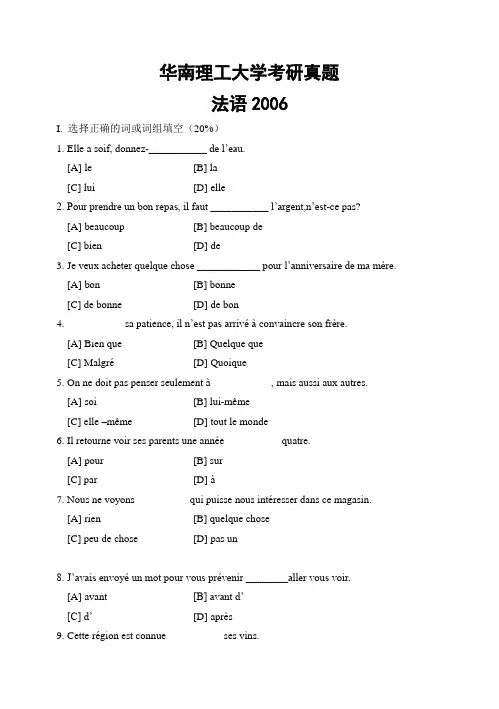
华南理工大学考研真题法语2006I. 选择正确的词或词组填空(20%)1. Elle a soif, donnez-___________ de l’eau.[A] le [B] la[C] lui [D] elle2. Pour prendre un bon repas, il faut ___________ l’argent,n’est-ce pas?[A] beaucoup [B] beaucoup de[C] bien [D] de3. Je veux achet er quelque chose ____________ pour l’anniversaire de ma mère.[A] bon [B] bonne[C] de bonne [D] de bon4. ___________sa patience, il n’est pas arrivé à convaincre son frère.[A] Bien que [B] Quelque que[C] Malgré[D] Quoique5. On ne doit pas penser seulement à ___________, mais aussi aux autres.[A] soi [B] lui-même[C] elle –même [D] tout le monde6. Il retourne voir ses parents une année __________ quatre.[A] pour [B] sur[C] par [D] à7. Nous ne voyons __________qui puisse nous intéresser dans ce magasin.[A] rien [B] quelque chose[C] peu de chose [D] pas un8. J’avais envoyé un mot pour vous prévenir ________aller vous voir.[A] avant [B] avant d’[C] d’[D] après9. Cette région est connue __________ ses vins.[A] pour [B] par[C] grâce à[D] à cause de10. Il considère ces travaux _____________ parfaitement terminés.[A] pour [B] comme[C] en [D] par11. Je préfère lire ________ de perdre mon temps au cinéma.[A] mieux [B] plutôt que[C] plus que [D] au lieu12. Ce bateau sert _________ traverser la rivière.[A] pour [B] de[C] en [D] à13. Il a fini __________ se décider à nous rejoindre.[A] de [B] par[C] à[D] pour14. Très pressé, il a pris le dictionnaire de son voisin _____________le sien.[A] au lieu de [B] avec[C] sans [D] par15. Elle sera la première __________ atteindre le sommet.[A] pour [B] à[C] de [D] par16. Les Français veulent vivre à la campagne pour échapper _________la pollution.[A] de [B] par[C] contre [D] à17. C’est______ le Parti communiste chinois que l’on doit son bonheur.[A] grâce à[B] en[C] avec [D] à18. ___________ difficile que paraisse cette tâche, il nous faut l’accomplir à temps.[A] Quelque [B] Quelle que[C] Quelle [D] Bien que19. __________ il arrive, je dois rester calme.[A] où[B] quel que[C] quoi que [D] quoique20. Je ne veux pas sortir avec vous ________ je ne me sens pas bien.[A] bien que [B] comme[C] depuis que [D] parce queII. 选择适当的动词形式:(15 %)1. ___________ du sport régulièrement, il aurait une santé solide.[A] faisant [B] ayant fait[C] après avoir fait [D] en faisant2. Si j’avais suivi vos conseils, je n’____________ aux examens.[A] n’aie pas échoué[B] n’échouerais pas[C] n’aurais pas échoué[D] n’ai pas échoué3. Nous sommes sûrs que notre avenir ____________ radieux.[A] soit [B] sera[C] serait [D] est4. Il me semble que tu ___________ raison.[A] aies [B] as[C] aurais [D] auras5. Je ne sais pas pourquoi il __________ à la soirée.[A] n’est pas venu [B] ne vienne pas[C] ne soit pas venu [D] n’était pas venu6. Dès qu’ils eurent déjeuné, ils _________ la discussion.[A] ont repris [B] reprenaient[C] avaient repris [D] reprirent7. Aussitôt qu’il __________ la nouvelle de sa réussite, i l lui envoya une lettre de félicitations.[A] a appris [B] avait appris[C] eut appris [D] apprenait8. M Dupont __________ se mettre à table lorsqu’on frappa à la porte.[A] ira [B] irai[C] va [D] allait9. Dans quelques jours, mon ami __________me voir à l’hôpital.[A] est venu [B] viendra[C] vient [D] sera venu10. Elle a promis qu’elle __________ là à l’heure dite.[A] serait [B] sera[C] est [D] était11. En ce moment ils ___________ de ce qui s’est passé hier.[A] parlaient [B] viennent de parler[C] parlent [D] ont parlé12. S’il ____________ chez lui hier soir, il aurait déjà fini son travail.[A] était resté[B] avait resté[C] reste [D] restait13. Il est encore temps de partir pour la gare à condition que vous _______un taxi.[A] ayez pris [B] avez pris[C] prenez [D] preniez14. Il a beaucoup travaillé de sorte qu’il ______________.[A] avait réussi [B] aura réussi[C] a réussi [D] réussisse15. V ous ne croyez pas qu’il ____________ vous aider, vous vous trompez.[A] puisse [B] pourraC: peut [D] pûtIII. 填合适的介词:(19%)1. Ce texte est assez facile ___________ comprendre, mais il est bien difficile _______le traduire en chinois.2. Nous avons décidé __________ouvrir une discussion du texte.3. Il s’agit _________une position de classe.4. Les vives répliques de Cosette obligèrent sa copine ___________ se taire.5. Il est obligé _______ déjeuner sans boire.6. Les capitalistes vivent _______ la sueur des ouvriers.7. L’enfant aide la vieille femme ________ se déc harger de son panier.8. V oulez-vous prévenir mon oncle ________mon arrivée prochaine dans la capitale ?9. C’est moi qui les ai invités _________venir ici.10. Je posai une question _________ l’ouvrier qui me répondit _______ lever les yeux.11. La nourrice promit _______la mère ______ prendre soin du bébé.12. Qui a téléphoné _________ le clerc du notaire ?13. Il arrive _________tout le monde ________ commettre des erreurs. .14. Dites ________ votre frère _______ vous conduire _________l’hôpital.15. La jeune fille servait _________cet homme _______ secrétaire et ________interprète.16. Ma tante ne tardera pas _________ rentrer.17. A-t-il accepté l’invitation? Oui, il a accepté __________venir _______six heures.18. J’ai passé toute la journée _____ dim anche ________corriger mes devoirs.19. Je vais __________ l’épicière, allez chercher du pain __________la boulangerie.20. Ils ont beaucoup _________ se dire.IV.用适当的代词填空:(10%)1. Tu connais Venise? ----- Non, je n’__________ suis jamais allé.2. Tu voulais parler au directeur? Justement, _________voilà: c’est le moment, profites- ______!3. Ce manteau ne me plaît pas, mais regarde, _______ est très bien.4. Ta voiture est différente de __________: elle n’a que deux portes.5. La mode actuelle est plus pratique que _________ nos grands-mères.6. C’est le garçon ________le père est professeur de mathématiques.7. Les enfants _______tu vois jouer dans le jardin sont ceux du voisin.8. Il a rencontré une difficulté à __________ il n’avait pas pensé.9. Je me demande ___________ Jacques peut bien faire en ce moment.10. __________pour soi et Dieu pour tous.V. 中译法:(20 %)1.北京的春天很短,而且经常刮风。
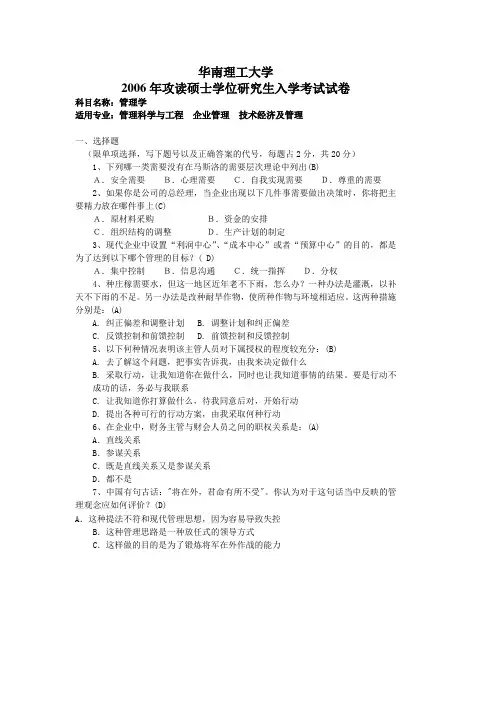
华南理工大学2006年攻读硕士学位研究生入学考试试卷科目名称:管理学适用专业:管理科学与工程企业管理技术经济及管理一、选择题(限单项选择,写下题号以及正确答案的代号,每题占2分,共20分)1、下列哪一类需要没有在马斯洛的需要层次理论中列出(B)A.安全需要B.心理需要C.自我实现需要D.尊重的需要2、如果你是公司的总经理,当企业出现以下几件事需要做出决策时,你将把主要精力放在哪件事上(C)A.原材料采购B.资金的安排C.组织结构的调整D.生产计划的制定3、现代企业中设置“利润中心”、“成本中心”或者“预算中心”的目的,都是为了达到以下哪个管理的目标?( D)A.集中控制B.信息沟通C.统一指挥D.分权4、种庄稼需要水,但这一地区近年老不下雨,怎么办?一种办法是灌溉,以补天不下雨的不足。
另一办法是改种耐旱作物,使所种作物与环境相适应。
这两种措施分别是:(A)A. 纠正偏差和调整计划B. 调整计划和纠正偏差C. 反馈控制和前馈控制D. 前馈控制和反馈控制5、以下何种情况表明该主管人员对下属授权的程度较充分:(B)A. 去了解这个问题,把事实告诉我,由我来决定做什么B. 采取行动,让我知道你在做什么,同时也让我知道事情的结果。
要是行动不成功的话,务必与我联系C. 让我知道你打算做什么,待我同意后对,开始行动D. 提出各种可行的行动方案,由我采取何种行动6、在企业中,财务主管与财会人员之间的职权关系是:(A)A.直线关系B.参谋关系C.既是直线关系又是参谋关系D.都不是7、中国有句古话:"将在外,君命有所不受"。
你认为对于这句话当中反映的管理观念应如何评价?(D)A.这种提法不符和现代管理思想,因为容易导致失控B.这种管理思路是一种放任式的领导方式C.这样做的目的是为了锻炼将军在外作战的能力D.这种提法反映了集权和分权的一个正确的观念8、控制就是事情按计划进行。
为此需要在企业中建立信息反馈机制,监控是否存在偏差。