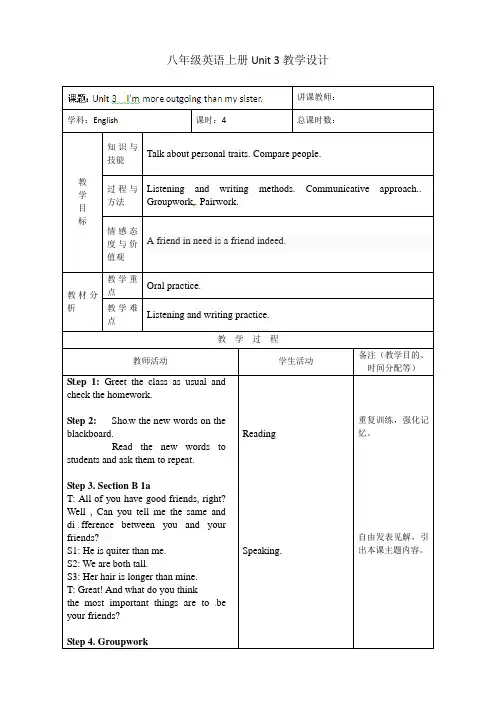
八年级上册英语unit3知识点
- 格式:docx
- 大小:37.15 KB
- 文档页数:3
八年级上册英语unit3知识点
Unit 3 Knowledge Point for the Eighth Graders
The third unit of the eighth-grade English textbook covers a wide
range of topics, including "Why do you like koalas?", "What do you
think of game shows?", "What does he/she look like?", etc. To better
prepare for the unit, let's take a closer look at some key knowledge
points.
1. Adjectives of appearance
In this unit, students will be introduced to various adjectives of
appearance, such as tall, short, slim, fat, curly, straight, etc. These
adjectives are frequently used to describe people's physical features,
and it's essential for students to have a good understanding of them.
Teachers can use pictures or videos to illustrate the meaning of these
adjectives to make the learning process more lively and engaging.
2. Comparative and superlative forms
Another important focus of this unit is comparative and superlative
forms, which are used to compare two or more things. Students will
learn how to form and use these structures, such as adding "er" or "est"
for short adjectives and using "more" or "most" for long adjectives. Teachers can provide plenty of examples and encourage students to
practice using these structures in real-life situations.
3. Opinion expressions
The unit also emphasizes the importance of expressing opinions in
English. Students will learn a variety of opinion expressions, such as "I
think...", "In my opinion...", "As far as I'm concerned...". These
expressions can help students express their thoughts and ideas more
effectively and confidently. Teachers can encourage students to share
their opinions on different topics and provide feedback or corrections to
help them improve.
4. Vocabulary building
Vocabulary building is always an essential part of language learning,
and this unit is no exception. Students will encounter a variety of new
words, such as "koala", "game show", "curly hair", "subjective", etc.
Teachers can use various techniques, such as context clues, visuals, and
games, to help students remember and use these words correctly.
5. Listening and speaking skills
In this unit, students will have ample opportunities to practice their
listening and speaking skills. They will listen to different dialogues and monologues and learn how to understand and respond appropriately.
Teachers can provide plenty of listening and speaking practice
activities, such as role-plays, debates, and discussions, to help students
develop their communication skills.
In conclusion, the third unit of the eighth-grade English textbook
covers a variety of topics and language skills, including adjectives of
appearance, comparative and superlative forms, opinion expressions,
vocabulary building, and listening and speaking skills. Teachers can
use different teaching strategies to make the learning process more
interactive and fun, such as games, visuals, role-plays, and discussions.
With sufficient practice and guidance, students can master these
knowledge points and become more confident and proficient English
users.