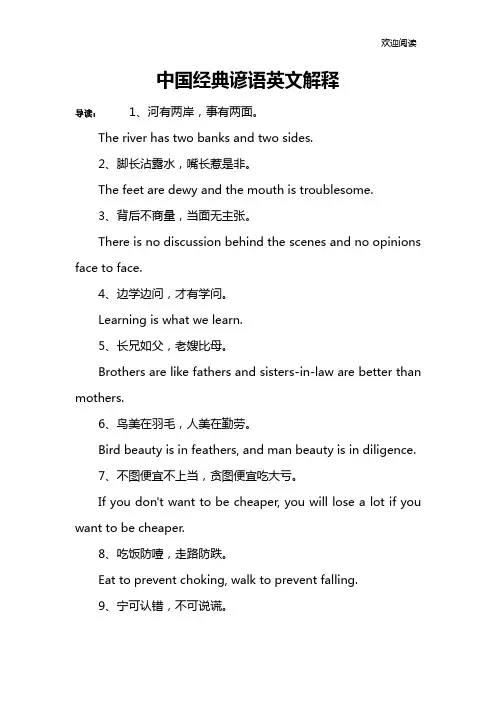
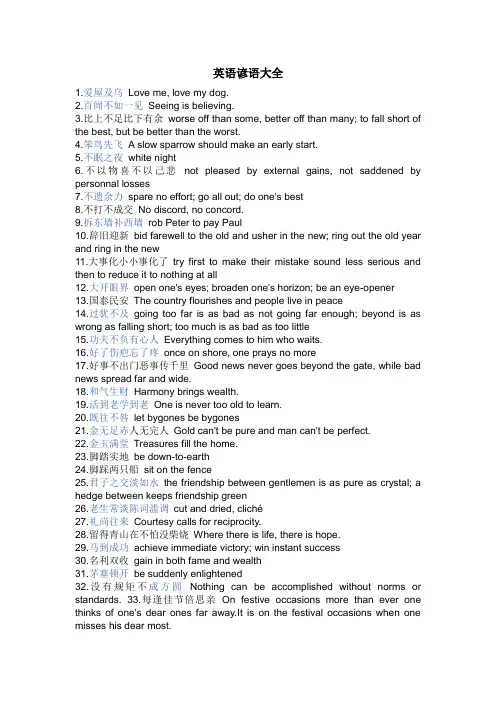
中国经典谚语英文解释
- 格式:docx
- 大小:39.56 KB
- 文档页数:7
中国经典谚语英文解释
Chinese Idioms: A Window into the Chinese Culture
China, a country with a long history and rich cultural heritage, is
known for its numerous idioms that have been passed down
through generations. These idioms, commonly referred to as
"chengyu," are an integral part of the Chinese language and
provide unique insights into Chinese wisdom, philosophy, and way
of life. In this article, we will explore some of the most well-known Chinese idioms and provide English explanations to help
non-Chinese speakers better understand their profound meaning.
1. 一日千里 (yì rì qiān lǐ) - "Cover a thousand miles in a single
day"
This idiom is used to describe rapid progress or an advanced
development. It originated from the story of a legendary creature
called "peng," which was said to have the ability to fly long
distances in a short time. Therefore, when someone achieves a
significant accomplishment or progresses rapidly, this idiom is
used to depict their remarkable speed.
2. 画龙点睛 (huà lóng diǎn jīng) - "Highlighting the dragon's
eyes"
This idiom refers to adding a vital touch or providing a crucial
detail to make something perfect. The dragon is an important
symbol in Chinese culture, and its eyes are believed to be the most
important part of its body. Thus, when someone adds the finishing
touch or makes a crucial contribution that greatly improves the
outcome, this idiom is used.
3. 杯弓蛇影 (bēi gōng shé yǐng) - "Seeing a bow reflected in a cup
as if it were a snake"
This idiom is used to describe someone who is overly suspicious or
sees imaginary dangers. It originated from a story where a person,
seeing a bow reflected in a cup of wine, mistook it for a snake and
became frightened. Therefore, when someone reads too much into
a situation or interprets innocent actions as something harmful, this
idiom is used to depict their excessive paranoia.
4. 纸上谈兵 (zhǐ shàng tán bīng) - "Armchair strategizing"
This idiom refers to discussing military tactics without any
practical experience or understanding of the situation at hand. It
implies that merely talking about something without real-life
experience or knowledge is ineffective. It originated from ancient
times when military strategies were drawn on paper, but their
effectiveness was uncertain until they were tested on the battlefield.
5. 车水马龙 (chē shuǐ mǎ lóng) - "A sea of vehicles and a dragon
of horses"
This idiom is used to describe heavy traffic or crowded streets. It
paints a vivid picture of a chaotic scene where vehicles and horses
are moving in all directions. It originated from the bustling streets
of ancient times, which were filled with carriages and horses. This
idiom is commonly used in modern China to depict crowded and
congested urban areas.
6. 亡羊补牢 (wáng yáng bǔ láo) - "Mend the sheep pen after the
sheep are gone"
This idiom encourages taking preventive measures and being prepared beforehand. It tells the story of a shepherd who only
realizes the importance of repairing the sheep pen after losing
some sheep. Therefore, it is used to remind people to take action
before it's too late and to rectify problems when they are still
manageable.
7. 自相矛盾 (zì xiāng máo dùn) - "To contradict oneself"
This idiom describes a situation where someone's own words or
actions contradict each other. It originated from the concept of two
warriors fighting each other with spears, but their weapons get
entangled and become useless. Thus, when someone says or does
something that conflicts with their previous statements or actions,
this idiom is used to point out the contradiction.
8. 守株待兔 (shǒu zhū dài tù) - "To guard a tree stump, waiting for
rabbits"
This idiom refers to waiting for opportunities to come without
taking any proactive action. It originated from a story where a
farmer accidentally killed a rabbit while chopping wood. He then
decided to wait for more rabbits to come by, foolishly expecting
them to jump into his arms. Therefore, this idiom is used to
criticize someone who relies solely on luck without making an
effort to achieve their goals.
9. 一箭双雕 (yī jiàn shuāng diāo) - "To shoot two hawks with one
arrow"
This idiom describes achieving two goals with a single action or
solving two problems simultaneously. It originated from the
skillful archery of ancient hunters, who were able to kill two hawks
with a single arrow. Therefore, when someone manages to