基于proteus的数据采集系统设计
- 格式:doc
- 大小:1.27 MB
- 文档页数:62
东北石油大学
毕业设计(论文)任务书
题目 基于proteus的数据采集处理系统
专业 学号 姓名
主要内容:
1、针对基于单片机的温度的数据采集系统进行深入的研究,分析其硬件结构和优缺点;
2、选择温度传感器和单片机、应用PROTEUS软件设计系统电路图和Keil软件设计系统程序;
3、应用PROTEUS软件仿真实现数据采集系统。
基本要求:
1、设计完善的硬件电路图;
2、应用Proteus软件仿真实现
3、提交规范的论文。
主要参考资料:
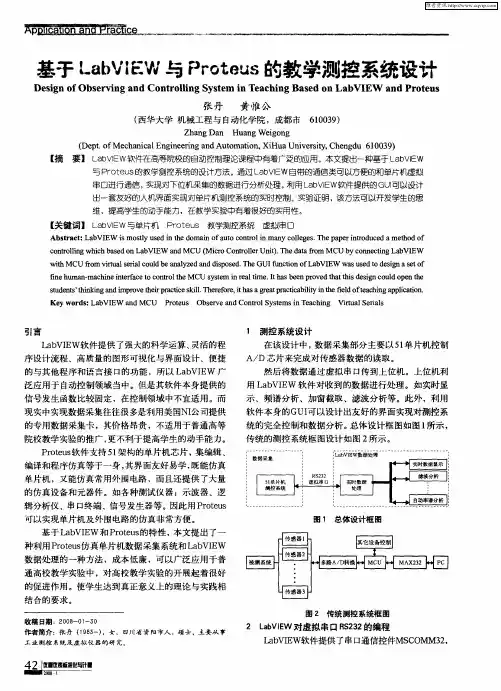
[1] 张丹,费陆公.基于proteus和labview的教学监控系统的设计[J].仪器仪表标准化与测量,2008(1):42-44
[2] 周润景. 基于DS18B20的温度测量模块设计[M].机械工业出版社,2011.13-43.
[3] 张福学.传感器应用及其电路精选[M].高等教育出版社,2004:58-67
[4] 林祝亮,武林,杨金华.基于双单片机的多路数据采集系统设计.仪器仪表学报,2006,No.6
完成期限:
指导教师签名:
专业负责人签名:
年 月
日东北石油大学本科毕业设计(论文)
I 摘 要
随着微型计算机技术的飞速发展和普及,数据采集监测已成为日益重要的检测技术,广泛应用于工农业等需要同时监控温度、湿度和压力的场合。本设计以温室环境作为研究对象,主要研究了温度数据采集系统的设计过程与仿真的实现方法。针对该系统设计了基于单片机的温度数据采集系统的各部分电路并利用汇编语言设计了针对该系统的各个环节的子程序。同时在Proteus环境下结合Keil
uVision 2成功实现了基于单片机的温度数据采集系统的仿真调试。该系统实现了温度数据的采集、处理、实时显示、开关量的控制输出、超限报警及系统键盘设置等功能。此外,该系统可手动调节报警上下限,控制方便,操作简单。本设计的仿真方法提高了系统的开发效率、缩短周期和降低成本,为单片机系统的开发提供了手段。
关键词:AT89C51;温度;proteus
东北石油大学本科毕业设计(论文)
II Abstract
With the rapid development and popularization of micro-computer technology,data acquisition monitoring has become an increasingly important detection techniques
are widely used in industry and agriculture need to monitor such as temperature,
humidity and pressure of the occasion. The design and simulation implementation
methods of temperature data acquisition system are introduced in this paper, which
takes a green house as the research object. Each part of the circuit based on the MCU
temperature data acquisition system is designed for the system and the use of assembly
language to design subroutine of each link for the system. At the same time, in the
Proteus environment combined with Keil uVision 2 realized the virtual simulation
debugging process based on MCU temperature data acquisition system. The system
verify that it is possible to realize many functions, such as temperature data acquisition,
data processing , displaying on real time,the output of switching value , alarm, and the
keyboard operation and so on . In addition, the system can manually adjust the alarm
range, convenient control and simple operation. This design of the simulation method
is proved to be an effective means which raised the development efficiency, reduced
the cycle time and saved costs .
Key words : AT89C51 ; temperature ; Proteus
东北石油大学本科毕业设计(论文)
III 目 录
第1章 绪论 .................................................................................................................... 1
1.1 研究背景及其目的意义 .................................................................................... 1
1.2 国内外研究现状 ................................................................................................ 2
1.3 该课题研究的主要内容 .................................................................................... 2
1.4 本章小结 ............................................................................................................ 3
第2章 数据采集系统方案论证 .................................................................................... 4
2.1 数据采集系统 .................................................................................................... 4
2.2 方案论证 ............................................................................................................ 4
2.3 系统的元件介绍 ................................................................................................ 8
2.4 本章小结 .......................................................................................................... 18
第3章 数据采集系统原理及分析 .............................................................................. 19
3.1 系统总体流程图 .............................................................................................. 19
3.2 系统各部分电路设计 ...................................................................................... 20
3.3 本章小结 .......................................................................................................... 30
第4章 软件部分 .......................................................................................................... 30
4.1 仿真软件 .......................................................................................................... 30
4.2 主程序设计 ...................................................................................................... 35
4.3 仿真结果 .......................................................................................................... 40
4.4 功能模块的调试 .............................................................................................. 43
4.5 本章小结 .......................................................................................................... 43