第三章 虚拟语气
- 格式:doc
- 大小:57.00 KB
- 文档页数:3
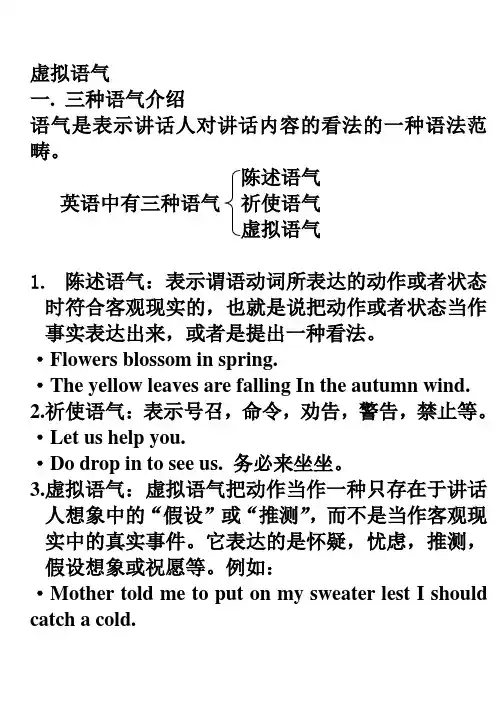
第三章虚拟语气1.语气1)定义: 在英语中,根据说话人意图的不同, 动词需用不同的形式,称为语气。
2)分类①陈述语气:用于陈述事实;②祈使语气:用于提出请求、命令、劝告等;③虚拟语气:用于表示主观愿望和假想虚拟的情况。
2. 虚拟语气的应用◆虚拟语气的应用可分为三大类,即虚拟语气在条件句中的应用,在某些从句中的应用,以及在其他情况下的应用。
1) 虚拟语气在条件句中的应用◆包含条件从句的句子称为条件句,通常由if 引出。
条件句有两类。
真实条件句,表示假设的情况是有可能发生的,条件句中谓语要用陈述语气;虚拟条件句,表示纯然假设的情况或是发生的可能性不大的情况,其中谓语要用虚拟语气。
If he has time, he will come. If he had time, he would come.If he really tried, he could easily win the prize.If Peter were a bird, the cat would eat him.If she could help you, she would help you.If I had left a bit earlier, I would have caught the train.If he were to be 200 years old, we could change everything.②要注意的问题A. 主句、从句可交换位置。
He could easily win the prize if he really tried.B.“从句用动词过去式(be动词用were),主句用would/ could/ might/ should + 动词原形”这个形式既能表示与现在事实相反,也能表示与将来事实相反,此时,可从上下文来分辨其用法;若要明确表示所涉及的时间,可以加进时间副词,则一目了然。
If you were happy today, you’d make others happy.If you were happy next week, you’d make others happy.C. If 的省略:若if条件从句中包含有were, had或should时,可省略if,但必须把were, had或should放到从句的主语前面。
Had you ask ed me, I could have told you. (= If you had asked me…)Were John here now, he would explain it.F. suppose, supposing, provided引起的条件状语从句,可以用真实条件句,也可以用虚拟条件句,这主要根据主句的语气来确定,即与主句的语气保持一致。
Suppose your mother saw you now, what would she say?Supposing he never came! What would happen then?Supposing this is the right way to the station, what shall we do?Provided that you co-operate with us, the police will not prosecute you.2) 虚拟语气在某些从句中的应用①wish;would rather/sooner/just as soon, had rather/sooner;as if/though后的从句需要用虚拟语气,分别表示“愿望”;“宁愿”、“希望”;“好象”、“仿佛”的意思。
其从句的结构为:动词过去式/ were (表示与现在事实相反)主语+ had + 动词的过去分词(表示与过去事实相反)助动词过去式+ 动词原形(表示与将来事实相反)I wish he would try again.I would rather you stayed at home. ( I’d rather stay at home.)He acts as if he were crazy. He acts as if he had been crazy.◆wish后的从句还可以用could/should/would + have + done的形式表示与过去事实相反I wish I could have solved the problem.◆as if 引起的从句中,也可以用陈述语气,表示发生的可能性很大。
He looks as if he is from Guangdong.He walks as if he is drunk. ( He walks as if he were drunk. )②It’s (high/about) time (that) 后的定语从句通常也需要用虚拟语气,其结构为:从句主语+动词过去式, 表示“是…时候了”。
相当于“It’s (high) time (for sb.) to do sth.”。
It is (high) time that we went to bed.③以lest <非常正式>, for fear (that) < 正式用法>, in case <英国英语>引起的从句通常也用虚拟语气,其结构为:从句主语+ should + 动词原形, 表示“以防”之意。
She put the coat over her son for fear that / lest he should catch a cold.I packed a swimsuit in case I should have time to go to the beach.④表示愿望、建议、命令、要求等意义的动词后的宾语从句,需用虚拟语气,其结构为:从句主语+ (should) +动词原形。
常见的这类动词有:suggest 建议, advise劝告, vote 建议, move 提议, propose 提议; request, require,ask要求, desire渴望, plead 恳求, demand要求; order, direct, command命令; insist坚持, urge 极力主张, maintain 坚持, recommend 推荐; prefer 宁愿;object 反对; decide 决定; etc.He insisted that my father be present at the meeting.She urged that he write and accept the post.I propose that we (should) set a deadline for handing in the plans.They requested that we (should) send a delegation to their country.◆suggest表示“暗示说”、“委婉地说”时,后用陈述语气。
Are you suggesting (that) I am not suited for the job? 你是在暗示说我不适合那件工作吗?⑤表示愿望、建议、命令、要求等意义的名词后的表语从句、同位语从句或主语从句,需用虚拟语气,其结构为:从句主语+ (should) + 动词原形。
常见的这类名词有:suggestion, advice, idea, motion, proposal; request, requirement, desire, demand; order, command; insistence, recommendation; preference; decision; importance, significance重要性, necessity必要性, understanding理解, plan计划; pity, shame, etc.He made the suggestion that they (should) be set free.= His suggestion was that we (should) set them free.My idea is that we (should) challenge the other groups to a friendly competition.The orders were that we stay where we were.It is a great pity that he should be so conceited.⑥It is/was + adj./p.p. + that结构后的主语从句需用虚拟语气, 其结构为:从句主语+ (should) +动词原形。
A. 常见的表示愿望、建议、命令、要求等意义的这类动词过去分词有:suggested 建议,proposed 提议; requested, required, asked 要求; desired希望; directed, ordered, commanded 命令; insisted 坚持; recommended; preferred 更喜欢; decided 觉得; etc.B.常见的这类形容词有: important, necessary, possible, advisable 适当的, vital 非常重要的, desirable 渴望的, essential 必要的, better, urgent, imperative 迫切的, appropriate 恰当的, keen 渴望的, probable, preferable 更可取的, imperative必要的;急需的, strange;etc.It is requested that Miss Wang (should) give a performance at the party.It is desired that we (should) get everything ready by tonight.It is important that you (should) follow directions.3) 虚拟语气在其他情况下的应用①某些表示祝愿等的句子中需要用虚拟语气,常有以下两种结构:A.用动词原形Long live world peace! God bless you. Heaven help us.So be it then!那就这样吧!God damn it! The devil take you!B.用may + 名词/代词+ 动词原形May our friendship last forever.May you be happy all your life.②在非常正式的语言中(如法律文件),在if, whether, whatever后面有时可用be表虚拟语气。