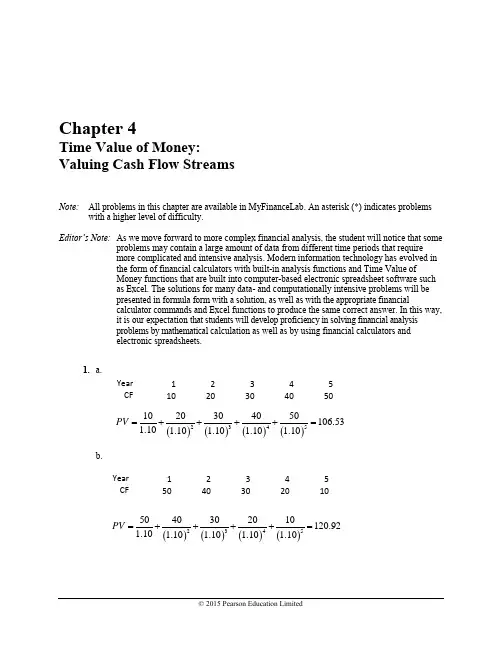
Chapter 4Time Value of Money:Valuing Cash Flow StreamsNote: All problems in this chapter are available in MyFinanceLab. An asterisk (*) indicates problemswith a higher level of difficulty. Editor’s Note: As we move forward to more complex financial analysis, the student will notice that someproblems may contain a large amount of data from different time periods that require more complicated and intensive analysis. Modern information technology has evolved in the form of financial calculators with built-in analysis functions and Time Value ofMoney functions that are built into computer-based electronic spreadsheet software such as Excel. The solutions for many data- and computationally intensive problems will be presented in formula form with a solution, as well as with the appropriate financialcalculator commands and Excel functions to produce the same correct answer. In this way, it is our expectation that students will develop proficiency in solving financial analysis problems by mathematical calculation as well as by using financial calculators and electronic spreadsheets.1. a.Year 1 2 3 4 5 CF1020304050()()()()23451020304050106.531.10 1.10 1.10 1.10 1.10PV =++++= b.()()()()23455040302010120.921.10 1.10 1.10 1.10 1.10PV =++++= Year 1 2 3 4 5 CF5040302010Chapter 4 Time Value of Money: Valuing Cash Flow Streams 27c. The present value is different because the timing of the cash flows is different. In the secondset, you get the larger cash flows earlier, so it is more valuable to you and shows up as a higher PV.2.Year 1 2 3 4 CF100-100200-200()()()23410010020020028.491.15 1.15 1.15 1.15PV =-+-=3.Year 1 2 3 4 5 CF10000-2000-3000-3500-3975()()()2342,0003,0003,5003,97510,000.121.085 1.085 1.085 1.085PV =+++=, so yes, the PV of your payments would just cover the loan amount (actually exceeding it by 12 cents). Thus, the maximum you could borrow would be 10,000.124. Month1 2 3 4 5 6 7 8 CF500 550 600 650 700 750 800 850()()()()()()()23456785005506006507007508008505,023.751.015 1.015 1.015 1.015 1.015 1.015 1.015 1.015PV =+++++++=So, the PV of your payments will exceed the loan balance. This means that your planned payments will be enough to payoff your credit card.5.From the bank’s perspective, the timeline is the same except all the signs are reversed.28 Berk/DeMarzo/Harford •Fundamentals of Corporate Finance, Third Edition, Global Edition6.0 1 2 3 4 48–300 –300 –300 –300 –300From the bank’s perspective, the timeline would be identical except with opposite signs.7. Plan: Draw the timeline and then compute the FV of these two cash flows.Execute:Timeline (because we are computing the future value of the account, we will treat the cashflows as positive—going into the account):800 600FV = ?FV = 800(1.05) + 600 = 1,440Evaluate:The timeline helps us organize our work so that we get the number of periods of compoundingcorrect. The first cash flow will have 1 year of compounding, but the second cash flow will bedeposited at the end of period 1, so it receives no compounding.8. Editor’s Note: In several previous problems, we used a financial calculator to solve a timevalue of money problem. Problems could be solved quickly and easily by manipulating the N,I/Y, PV, PMT, and FV keys. In each of these problems, there was a series of payments of equal amount over time, i.e., an annuity. All you had to do to input this series was enter the payment(PMT) and the number of payment (N).Many financial analysis problems involve a series of equal payments, but others involve aseries of unequal payments. A financial calculator can be used to evaluate an unequal series ofcash flows (using the cash flow (CF) key), but the process is cumbersome because each cashflow must be entered individually. I urge each student to study the Chapter 4 Appendix: “Usinga Financial Calculator,” as well as instructional materials that are prod uced by themanufacturers of the financial calculator.Here we will solve a problem with uneven cash flows mathematically and with a financialcalculator.Plan: It is wonderful that you will receive this windfall from your investment in your friend’sbusiness. Because the cash flow payments to you are of different amounts and paid over threeyears, there are different ways in which you can think about how much money you arereceiving.Chapter 4 Time Value of Money: Valuing Cash Flow Streams 29Execute:a. 2310,00020,00030,000PV 1.035 1.035 1.0359,66218,67027,05855,390=++=++=The Texas Instrument BA II PLUS calculator has a cash flow worksheet accessed with the CF key. To clear all previous values that might be stored in the calculator, press the CF, second, and CE/C buttons. The screen should show CF 0 = asking for the cash flow at time 0, which in this problem is 0. Press 0, then press enter, and then the down key button. Thescreen should show CO1 asking for the cash flow at time 1, which in this problem is 10,000. Input 10,000 followed by the enter key, followed by the down button. The screen should show FO1 = 1.0 asking for the frequency of this cash flow. Because it occurs only once, it is correct, and we press the down key. The screen now has CO2 asking for the time 2 cash flow, which is 20,000, which we input, followed by the enter key and the down key. The screen now has FO2 = 1.0, which is correct. Enter the down key, which asks for the third cash flow, which is 30,000. Input 30,000, followed by the enter and down keys. Now press the NPV key, and the calculator will display I = asking for the interest rate, which is 3.5. Input 3.5, press the enter key, and press the down key, and the screen will display NPV =. Then press the CPT button, and the screen should display 55,390.33, the Net Present Value.b. 3FV 55,390 1.03561,412=⨯=Evaluate: You may ask: “How much better off am I because of this windfall?” There are several answers to this question. The value today (i.e., the present value) of the cash you will receive over three years is $55,390. If you decide to reinvest the cash flows as you receive them, then in three years you will have $61,412 (i.e., future value) from your windfall.9. Plan: Use Eq. 4.3 to compute the PV of this stream of cash flows and then use Eq. 4.1 to compute the FV of that present value. To answer part (c), you need to track the new deposit made each year along with the interest on the deposits already in the bank.Execute: a. and b.233100100100257.71(1.08)(1.08)(1.08)257.71(1.08)324.64PV FV =++===30 Berk/DeMarzo/Harford • Fundamentals of Corporate Finance, Third Edition, Global Editionc. ()11Year 1: 100Year 2: 1001.08100208Year 3: 208(1.08)100324.64+=+=Evaluate:By using the PV and FV tools, we are able to keep track of our balance as well as quicklycalculate the balance at the end. Whether we compute it step by step as in part (c) or directly as in part (b), the answer is the same.10. Plan: First, create a timeline to understand when the cash flows are occurring.Second, calculate the present value of the cash flows.Once you know the present value of the cash flows, compute the future value (of this present value) at date 3.Execute: 231,0001,0001,000PV 1.05 1.05 1.0595********,723=++=++=NI/Y PV PMT FV Excel FormulaGiven: 35.00% -1,000 0Solve for PV:2,723.25=PV(0.05,3,-1,000,0)33FV 2,723 1.053,152=⨯=NI/Y PV PMT FV Excel FormulaGiven: 35.00% -2,723.43Solve for FV:3,152.71=FV(0.05,3,0,-2,723.43)Evaluate: Because of the bank’s offer, you now hav e two choices as to how you will repay this loan. Either you will pay the bank $1,000 per year for the next three years as originallypromised, or you can decide to skip the three annual payments of $1,000 and pay $3,152 in year three.You now have the information to make your decision.11. a. The FV of 100,000 invested for 35 years at 9% is 100,000 × (1.09)35 = 2,041,397b. The FV of 100,000 invested for 25 years at 9% is 100,000 × (1.09)25 = 862,308Chapter 4 Time Value of Money: Valuing Cash Flow Streams 31c. The difference is so large because of the effect of compounding, which is exponential. Inthe scenario where you invest earlier, those 10 years are critical to the compound growthyou achieve on your investment.12. Plan: This scholarship is a perpetuity. The cash flow is $5,000 and the discount rate is 6%.Execute:Timeline:5,000 5,000 …PV 5,000/0.06 = 83,333.33Evaluate:With a donation of $83,333.33 today and 6% interest, the university can withdraw the interest every year ($5,000) and leave the endowment intact to generate the next year’s $5,000. It can keep doing this forever.13. P lan: This is a deferred perpetuity. Here is the timeline:Do this in two steps:1. Calculate the value of the perpetuity in year 9, when it will start in only one year(we already did this in problem 12).2. Discount that value back to the present.Execute:The value in year 9 is 5,000/0.06 = 83,333.33.The value today is 83,333.33/1.069 = 49,324.87Evaluate:Because your endowment will have 10 years to earn interest before making its first payment, you can endow the scholarship for much less. The value of your endowment must reach$83,333.33 the year before it starts (in 9 years). If you donate $49,324.87 today, it will grow at 6% interest for 9 years, just reaching $83,333.33, one year before the first payment.32 Berk/DeMarzo/Harford • Fundamentals of Corporate Finance, Third Edition, Global Edition14. The timeline for this investment is:a. The value of the bond is equal to the present value of the cash flows. By the perpetuity formula, which assumes the first payment is at period 1, the value of the bond is:PV = 1,000 /0.08 = £12,500 b. The value of the bond is equal to the present value of the cash flows. The first payment will be received at time zero. The cash flows are the perpetuity plus the payment that will be received immediately.PV = 1,000 /0.08 + 1,000 = £13,50015. Plan: Draw the timeline of the cash flows for the investment opportunity. Compute the NPV ofthe investment opportunity at 7% interest per year to determine its value.Execute: The cash flows are a 100-year annuity, so by the annuity formula:1001,0001PV 10.07 1.0714,269.25⎛⎫=- ⎪⎝⎭=NI/Y PV PMT FV Excel FormulaGiven: 1007.00% 1,000 0Solve for PV:(14,269.25)=PV(0.07,100,1000,0)Evaluate: The PV of $1,000 to be paid every year for 100 years discount to the present at 7% is $14,269.25.16. Plan: Prepare a timeline of your grandmother’s deposits.The deposits are an 18-year annuity. Use Eq. 4.6 to calculate the future value of the deposits.Execute: 1811(1)11,000(1.03)123,414.430.03N FV C r r =⨯+-=-=⎡⎤⎡⎤⎣⎦⎣⎦Chapter 4 Time Value of Money: Valuing Cash Flow Streams 33NI/Y PV PMT FV Excel FormulaGiven: 183.00% 0 1,000Solve for FV:(23,414.43)=FV(0.03,18,1000,0)At age 18, you will have $23,414.43 in your account.Evaluate:The interest on the deposits and interest on that interest adds more than $5,414 to the account.17. a.First, we need to calculate the PV of $160,000 in 18 years.18160,000PV (1.08)40,039.84==NI/Y PV PMT FV Excel FormulaGiven: 188.00% 0 160,000Solve for PV:(40,039.84)=PV(0.08,18,0,160000)In order for the parents to have $160,000 in your college account by your 18th birthday, the 18-year annuity must have a PV of $40,039.84. Solving for the annuity payments:1840,039.841110.08 1.08$4,272.33C =⎛⎫- ⎪⎝⎭=which must be saved each year to reach the goal.NI/Y PV PMT FV Excel FormulaGiven: 188.00% 40,039.84Solve for PMT:(4,272)=PMT(0.08,18,40039.84,0)b. First, we need to calculate the PV of $200,000 in 18 years.18200,000PV (1.08)50,049.81==34 Berk/DeMarzo/Harford • Fundamentals of Corporate Finance, Third Edition, Global EditionNI/Y PV PMT FV Excel FormulaGiven: 188.00% 0 200,000Solve for PV:(50,049.81)=PV(0.08,18,0,200000)In order for the parents to have $200,000 in your college account by your 18th birthday, the 18-year annuity must have a PV of $50,049.81. Solving for the annuity payments:18$50,049.811110.08 1.08$5340.42C =⎛⎫- ⎪⎝⎭=which must be saved each year to reach the goal.N I/Y PV PMT FV Excel FormulaGiven: 18.00 0.08 50,049.810.00Solve for PMT:-5340.42=PMT(0.08,18,50049.81,0)*18. Plan:a. Draw the timeline of the cash flows for the loan.1 2 3 4 5To pay off the loan, you must repay the remaining balance. The remaining balance is equal to the present value of the remaining payments. The remaining payments are a four-year annuity, so:b.4 5Execute:a. 45,0001PV 10.06 1.0617,325.53⎛⎫=- ⎪⎝⎭=N I/Y PV PMT FV Excel FormulaGiven: 4 6.00% 5000 0Solve for PV:(17,325.53)=PV(0.06,4,5000,0)Chapter 4 Time Value of Money: Valuing Cash Flow Streams 35b. 5,000PV 1.064,716.98==Evaluate: To pay off the loan after owning the vehicle for one year will require $17,325.53. To pay off the loan after owning the vehicle for four years will require $4,716.98.19. Plan: This is a deferred annuity. The cash flow timeline is:Calculate the value of the annuity in year 17, one period before it starts using Eq. 4.5 and then discount that value back to the present using Eq. 4.2.The value of the annuity in year 17, one period before it is to start is:41100,000111331,212.68(1)0.08(1.08)n CF PV r r ⎡⎤⎡⎤=-=-=⎢⎥⎢⎥+⎣⎦⎣⎦To get its value today, we need to discount that lump sum amount back 17 years to the present:17331,212.68$89,516.50(1.08)=Evaluate:Even though the cash flows are a little unusual (an annuity starting well into the future), we can still value them by combining the PV of annuity and PV of a FV tool. If we invest $89,516.50 today at an interest rate of 8%, it will grow to be enough to fund an annuity of $100,000 per year by the time it is needed for college expenses.20. Plan: This is a deferred annuity. The cash flow timeline is:Calculate the value of the annuity in year 44, one period before it starts using Eq. 4.5 and then discount that value back to the present using Eq. 4.2.Execute:The value of the annuity in year 44, one period before it is to start is:16140,000111377,865.94(1)0.07(1.07)n CF PV r r r ⎡⎤⎡⎤=-=-=⎢⎥⎢⎥+⎣⎦⎣⎦To get its value today, we need to discount that lump sum amount back 44 years to the present:44377,865.94$19,250.92(1.07)=Evaluate:Even though the cash flows are a little unusual (an annuity starting well into the future), we can still value them by combining the PV of annuity and PV of a FV tool. The total value to you today of Social Security’s promise is less than $20,000.*21. Plan: Clearly, Mr. Rodriguez’s contract is complex, calling for payments over many years.Assume that an appropriate discount rate for A-Rod to apply to the contract payments is 7% per year.a. Calculate the true promised payments under this contract, including the deferred payments with interest.b. Draw a timeline of all of the payments.c. Calculate the present value of the contract.d. Compare the present value of the contract to the quoted value of $252 million. What explains the difference?Execute: Determine the PV of each of the promised payments discounted to the present at 7%.2001 2002 2003 2004 2005 2006 2007 2008 2009 2010 $18M 19M19M19M21M19M23M27M27M27M20112012 2013 2014 2015 2016 2017 2018 2019 2020 6.7196M 5.3757M 4.0317M 4.0317M 4.0317M 4.0317M 4.0317M 4.0317M 4.0317M 4.0317MThe PV of the promised cash flows is $165.77 million.Evaluate: The PV of the contract is much less than $252 million. The $252 million value does not discount the future cash flows or adjust deferred payments for accrued interest. *22. a.0 1 2343The amount in the retirement account in 43 years would be:43435,000FV (1.10)10.10$2,962,003.46=-⎡⎤⎣⎦=NI/Y PV PMT FV Excel FormulaGiven: 4310.00%0.00 -5,000Solve for FV:2,962,003.46=FV(0.1,43,-5000,0)b. To solve for the lump sum amount today, find the PV of the $2,962,003.46.432,962,003.46PV (1.10)$49,169.99==N I/Y PV PMT FV Excel FormulaGiven: 43 10.00%0 2,962,003Solve for PV:(49,169.99) =PV(0.1,43,0,2962003.46) c.Solve for the annuity cash flow that, after 20 years, exactly equals the starting value of the account.202,962,003.461110.10 1.10347,915.81C =⎛⎫-⎪⎝⎭=N I/Y PV PMT FV Excel FormulaGiven: 20.00 0.10 2,962,003.460.00Solve for PMT:-347,915.81=PMT(0.1,20,2962003.46,0)d.We want to solve for N , which is the length of time in which the PV of annual payments of $300,000 will equal $2,962,003.46. Setting up the PV of an annuity formula and solving for N :300,000112,962,003.460.10 1.1012,962,003.460.1010.98733451.10300,000110.98733450.01266551.101.1078.95456Log(78.95456)45.84Log(1.10)N N NN N ⎛⎫-= ⎪⎝⎭⨯⎛⎫-== ⎪⎝⎭=-==== e. If we can only invest $1,000 per year, then set up the PV formula using $1 million as the FV and $1,000 as the annuity payment. 431,000111,000,000(1)r r ⎛⎫-= ⎪+⎝⎭To solve for r , we can either guess or use the annuity calculator. You can check and see that r = 11.74291% solves this equation. So the required rate of return must be 11.74291%.N I/Y PV PMT FV Excel FormulaGiven: 43 0.00 -1,000 1,000,000Solve for Rate: 11.74291%=RATE(43,-1000,0,1000000)23. Plan: The bequest is a perpetuity growing at a constant rate. The bequest is identical to a firmthat pays a dividend that grows forever at a constant rate. We can use the constant dividend growth model to determine the value of the bequest.Execute: a.Using the formula for the PV of a growing perpetuity gives1,000PV 0.120.0825,000⎛⎫= ⎪-⎝⎭=which is the value today of the bequest.b.1 2 3 4Using the formula for the PV of a growing perpetuity gives:1,000(1.08)PV 0.120.0827,000=-=which is the value of the bequest after the first payment is made.Evaluate: The bequest is worth $25,000 today and will be worth $27,000 in 1 year’s time. *24. Plan: The machine will produce a series of savings that are growing at a constant rate. The rateof growth is negative, but the constant growth model can still be used.Execute:The timeline for the saving would look as follows:We must value a growing perpetuity with a negative growth rate of – 0.03:2,000PV 0.08(0.03)$18,181.82=--= Evaluate: The value of the savings produced by the machine is worth $18,181.82 today.25. Plan: Nobel’s bequest is a perpetu ity. The total amount is 5 ⨯ $45,000 = $225,000. With a cashflow of $225,000 and an interest rate of 7% per year, we can use Eq. 4.4 to solve for the total amount he would need to use to endow the prizes. In part (b), we will need to use the formula for a growing perpetuity (Eq. 4.7) to find the new value he would need to leave. Finally, in part (c), we can use the FV equation (Eq. 4.1) to solve for the future value his descendants would have had if they had kept the money and invested it at 7% per year.a. In order to endow a perpetuity of $225,000 per year with a 7% interest rate per year, he would need to leave $225,000/0.07 = $3,214,285.71.b. In order to endow a growing perpetuity with an interest rate of 7% and a growth rate of 4% and an initial cash flow of $225,000, he would have to leave:1225,0007,500,0000.070.04CF PV r g ===-- c. FV = PV (1 + r )n = 7,500,000(1.07)118 = $ 21,996,168,112Evaluate:The prizes that bear Nobel’s name were very expensive to endow—$3 million was an enormous sum in 1896. However, Nobel’s endowment has been able to generate enough interest each year to fund the prizes, which now have a cash award of approximately $1,500,000 each!26. Plan: The drug will produce 17 years of cash flows that will grow at 5% annually. The value ofthis stream of cash flows today must be determined. We can use the formula for a growing annuity (Eq. 4.8) or Excel to solve this. C = 2, r = 0.10, g = 0.05, N = 17Execute: 171 1.052121.860.100.05 1.10PV ⎛⎫⎛⎫⎛⎫=-= ⎪ ⎪ ⎪ ⎪-⎝⎭⎝⎭⎝⎭Because the cash flows from this investment will continue for 17 years, we decided to solve for the Net Present Value by using the NPV function in Excel. This is shown on the next page. The 17 cash flows are presented in columns C, D,…S. The initial cash flow of $2M is presented in cell C8, and each subsequent cash flow grows at 5% until $4.365749M is presented in year 17 in cell S8. (Note that columns G through Q are not presented.) The NPV of the project is calculated using the NPV formula = NPV(C3,C8:S8) in cell B10. The NPV of the future cash flows is $21.86M.ABCDEFR S 1 2 1+g 1.05 3 r 0.1 4 5 6 T 0 1 2 3 4 16 17 7 8 2 2.1 2.205 2.31525 4.1578564.3657499 10 NPV $21.86 11 12 EXCEL NPV FORMULA =NPV(C3,C8:S8) 13Evaluate: The value today of the cash flows produced by the drug over the next 17 years is $21.86 million. Because the cash flows are expected to grow at a constant rate, we can use the growing annuity formula as a shortcut.27. Plan: Your rich aunt is promising you a series of cash flows over the next 20 years. You mustdetermine the value of those cash flows today. This is a growing annuity and we can use Eq.4.8 to solve it, or we can also solve it in Excel. C= 5, r= 0.03, g= 0.05 and N= 20Execute:201 1.035179.820.050.03 1.05PV⎛⎫⎛⎫⎛⎫=-=⎪⎪ ⎪⎪-⎝⎭⎝⎭⎝⎭Because the cash flows from this investment will continue for 20 years, we decided to solve for the Net Present Value by using the NPV function in Excel. This is shown on the next page. The 20 cash flows are presented in columns C, D,…V. The initial cash flow of $5,000 is presented in cell C8, and each subsequent cash flow grows at 3% until $8,767.53 is presented in year 20 in cell V8. (Note that columns G through R are not presented.) The NPV of the project is calculated using the NPV formula =NPV(C3,C8:V8) in cell B10. The NPV of the future cash flows is $79,824.A B C D E …S T U V12 1 + g 1.033 r 0.05456 T 0 1 2 3 17 18 19 2078 5 5.15 5.3045 8.023532 8.264238 8.512165 8.76753910 NPV $79.821112 EXCEL NPV FORMULA =NPV(C3,C8:V8)13Evaluate: Because your aunt will be increasing what she gives each year at a constant rate, we can use the growing perpetuity formula as a shortcut to value the stream of cash flows. Her gift is quite generous: It is equivalent to giving you almost $80,000 today!28. Plan: This problem is asking us to solve for the rate of return (r). Because there are norecurring payments, we can use Eq. 4.1 to represent the problem and then just solvealgebraically for r. We have FV = 200, PV = 100, n = 10.Execute:FV = PV(1 +r)n200 = 100(1 +r)10, so r = (200/100) 1/10– 1 = 0.072 or 7.2%Evaluate:The implicit return we earned on the savings bond was 7.2%. Our money doubled in 10 years, which by the rule of 72 meant that we earned about 72/10 = 7.2% and our calculationconfirmed that.29. Plan: This problem is again asking us to solve for r. We will represent the investment with Eq.4.1 and solve for r. We have PV = 2,000, FV = 10,000, n = 10. The second part of the problemasks us to change the rate of return going forward and calculate the FV in another 10 years.Execute:a. FV= PV(1 + r)n10,000 = 2,000(1 +r)10, so r = (10,000/2,000) 1/10– 1 = 0.1746, or 17.46%b.FV = 10,000(1.12)10= $31,058.4830. Plan: Draw a timeline and determine the IRR of the investment.Execute:–IRR is the r that solves:15,000 = 20,000/(1 +r), so r = (20,000/15,000) – 1 = 33.33%Evaluate: You are making a 33.33% IRR on this investment.31. Plan: Draw a timeline to demonstrate when the cash flows will occur. Then solve the problemto determine the payments you will receive.Execute:–P = C/r,So, C = P × r= 500 × 0.08= $40Evaluate: You will receive $40 per year into perpetuity.32. Plan: Draw a timeline to determine when the cash flows occur. Solve the problem to determinethe annual payments. Timeline (from the perspective of the bank):Execute:–203,000,000$240,727.761110.05 1.05==⎛⎫- ⎪⎝⎭Cwhich is the annual payment.NI/YPVPMTFVExcel FormulaGiven: 205.00% -3000000Solve for PMT:$240727.76=PMT(0.05,20,-3000000,0)Evaluate: You will have to pay the bank $240,727.76 per year for 20 years in mortgage payments.*33. Plan: Draw a timeline to demonstrate when the cash flows will occur. Determine the annualpayments.Execute:0 2 4 6 20–This cash flow stream is an annuity. First, calculate the two-year interest rate: The one-year rate is 4%, and $1 today will be worth (1.04)2 = 1.0816 in two years, so the two-year interest rate is 8.16%. Using the equation for an annuity payment:1050,0001110.0816(1.0816)$7,505.34C =⎛⎫- ⎪⎝⎭=which is the payment you must make every two years.N I/Y PV PMT FV Excel Formula Given: 10 8.16% -50,000.00Solve for PMT: $7,505.34=PMT(0.0816,10,-50000,0)Evaluate: You must pay the art dealer $7505.34 every two years for 20 years.*34. Plan: Draw a timeline to determine when the cash flows occur. Timeline (where X is the balloon payment):0 1 2330–+ X Note that the PV of the loan payments must be equal to the amount borrowed.Execute:303023,5001300,00010.07 1.07(1.07)X⎛⎫=-+ ⎪⎝⎭ Solving for X :303023,5001300,0001(1.07)0.07 1.07$63,848X ⎡⎛⎫⎤=-- ⎪⎢⎥⎣⎝⎭⎦= NI/Y PV PMT FV Excel Formula Given: 307.00%-23,500Solve for PV:291,612.47=PV(0.07,30,-23500,0)The present value of the annuity is $291,612.47, which is $8,387.53 less than the $300,000.00. To make up for this shortfall with a balloon payment in year 30 would require a payment of $63,848.02.N I/YPVPMT FVExcel FormulaGiven: 30 7.00% 8,387.53 0Solve for FV:(63,848.02) =FV(0.07,30,0,8387.53)Evaluate: At the end of 30 years you would have to make a $63,848 single (balloon) payment to the bank.*35. Plan: Draw a timeline to demonstrate when the cash flows occur. We know that you intend tofund your retirement with a series of annuity payments and the future value of that annuity is $2 million.22 23 24 25 65 0 1 2343CC CCCExecute: FV = $2 million.The PV of the cash flows must equal the PV of $2 million in 43 years. The cash flows consist of a 43-year annuity, plus the contribution today, so the PV is:()431PV 10.05 1.05C C ⎛⎫=-+ ⎪⎝⎭The PV of $2 million in 43 years is:432,000,000$245,408.80(1.05)=N I/Y PV PMT FV Excel Formula Given: 43 5.00% 0 2,000,000Solve for PV: (245,408.80)=PV(0.05,43,0,2000000)Setting these equal gives434311245,408.800.05(1.05)245,408.80$13,232.5011110.05(1.05)C C C ⎛⎫-+= ⎪⎝⎭⇒==⎛⎫-+ ⎪⎝⎭We need $245,408.80 today to have $2,000,000 in 43 years. If we do not have $245,408.80 today, but wish to make 44 equal payments (the first payment is today, making the payments an annuity due) then the relevant Excel command is:=PMT(rate,nper,pv,(fv),type =PMT(.05,44,245,408.80,0,1) = 13,232.50Type is set equal to 1 for an annuity due as opposed to an ordinary annuity.Evaluate: You would have to put aside $13,232.50 annually to have the $2 million you wish to have in retirement.36. Plan: This problem is asking you to solve for n . You can do this mathematically using logs, orwith a financial calculator or Excel. Because the problem happens to be asking how long it will。