
2011年考研英语二真题及答案
- 格式:doc
- 大小:431.00 KB
- 文档页数:12
2011年研究生入学考试英语二真题
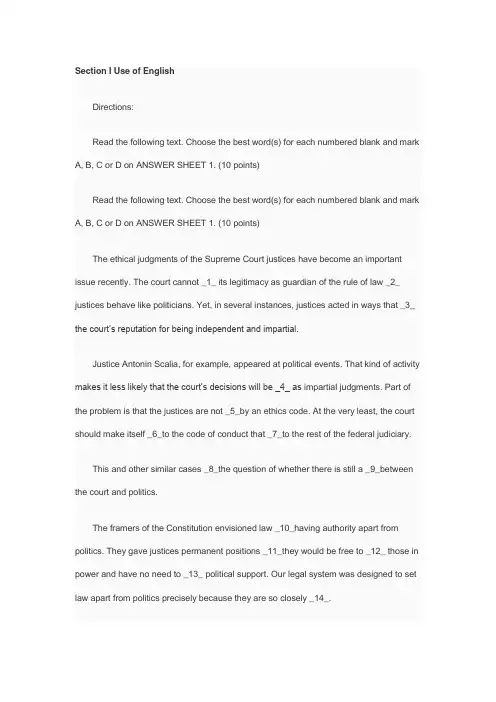
Section I Use of English
Directions:Read the following text。 Choose the best word(s) for each numbered black and
mark A, B, C or D on ANSWER SHEET 1。 (10 points)
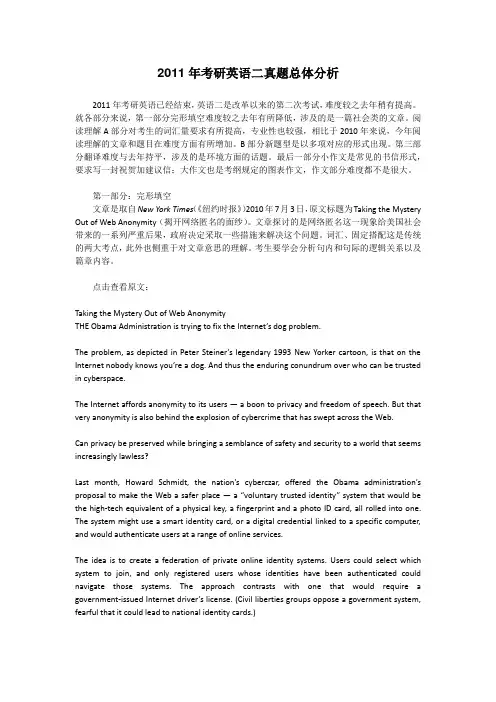
”The Internet affords anonymity to its users — a boon to privacy and freedom of speech。
But that very anonymity is also behind the explosion of cybercrime that has 1 across the
Web.
Can privacy be preserved 2 bringing a semblance of safety and security to a world that seems
increasingly 3 ?
Last month, Howard Schmidt, the nation's cyberczar, offered the Obama government a
4 to make the Web a safer place — a “voluntary identify” system that would be the
high—tech 5 of a physical key, fingerprint and a photo ID card, all rolled 6 one。 The
system might use a smart identity card, or a digital credential 7 to a specific computer, and
would authenticate users at a range of online services.
The idea is to 8 a federation of private online identify systems。 Users
could 9 which system to join, and only registered users whose identities have been
authenticated could navigate those systems. The approach contrasts with one that would require an
Internet driver’s license 10 by the government.
Google and Microsoft are among companies that already have sign-on" systems that make it
possible for users to 11 just once but use many different services.
12 , the approach would create a “walled garden” in safe “neighborhoods” and
bright
“streetlights” to establish a sense of 13 community。
Mr. Schmidt described it as a “voluntary ecosystem” in which individuals and organizations
can complete online transactions with 14 ,trusting the identities of the infrastructure that the
transaction runs 15 。'”
Still, the administration’s plan has 16 privacy rights activists. Some applaud the approach;
others are concerned。 It seems clear that such an initiative push toward what would 17 be a
license" mentality.
The plan has also been greeted with 18 by some experts, who worry that the “voluntary
ecosystem” would still leave much of the Internet 19 .They argue that should be 20 to
register and identify themselves, in drivers must be licensed to drive on public roads.
1. A。swept B。skipped C.walked D.ridden
2. A。for B.within C。while D.though
3. A。careless wless C.pointless D.helpless
4. A。reason B。reminder C。compromise D。proposal
5. rmation B.interference C.entertainment D。equivalent
6. A。by B。into C.from D.over 7. A.linked B。directed C.chained pared
8. A。dismiss B。discover C.create D。improve
9. A。recall B.suggest C.select D。realize
10. A。relcased B。issued C.distributed D。delivered
11. A.carry on B.linger on C。set in D.log in
12. A。In vain B。In effect C。In return D.In contrast
13. A.trusted B.modernized C。thriving D。competing
14. A.caution B。delight C.confidence D.patience
15. A.on B。after C.beyond D。across
16. A。divided B。disappointed C。protected D。united
17. A.frequestly B。incidentally C.occasionally D。eventually
18. A。skepticism B.relerance C。indifference D.enthusiasm
19. A.manageable B.defendable C。vulnerable D。invisible
20. A.invited B。appointed C。allowed D.forced
Section II Reading Comprehension
Part A
Directions:
Read the following four texts。 Answer the questions after each text by choosing A, B, C or D.
Mark your answers on ANSWER SHEET 1. (40points)
Text 1
Ruth Simmons joined Goldman Sachs’s board as an outside director in January 2000: a year
later she became president of Brown University. For the rest of the decade she apparently
managed both roles without attracting much eroticism。 But by the end of 2009 Ms。 Simmons
was under fire for having sat on Goldman's compensation committee; how could she have let
those enormous bonus payouts pass unremarked? By February the next year Ms。 Simmons had
left the board。 The position was just taking up too much time, she said.
Outside directors are supposed to serve as helpful, yet less biased, advisers on a firm’s
board。 Having made their wealth and their reputations elsewhere, they presumably have enough
independence to disagree with the chief executive’s proposals。 If the sky, and the share price is
falling, outside directors should be able to give advice based on having weathered their own
crises.
The researchers from Ohio University used a database hat covered more than 10,000 firms
and more than 64,000 different directors between 1989 and 2004。 Then they simply checked
which directors stayed from one proxy statement to the next。 The most likely reason for
departing a board was age, so the researchers concentrated on those “surprise” disappearances by
directors under the age of 70. They fount that after a surprise departure, the probability that the
![2011考研英语二真题及答案解析[完整版]](https://imgs-1438308264.cos.ap-hongkong.myqcloud.com/c1f6ddd33086bceb19e8b8f67c1cfad6195fe968.webp)
