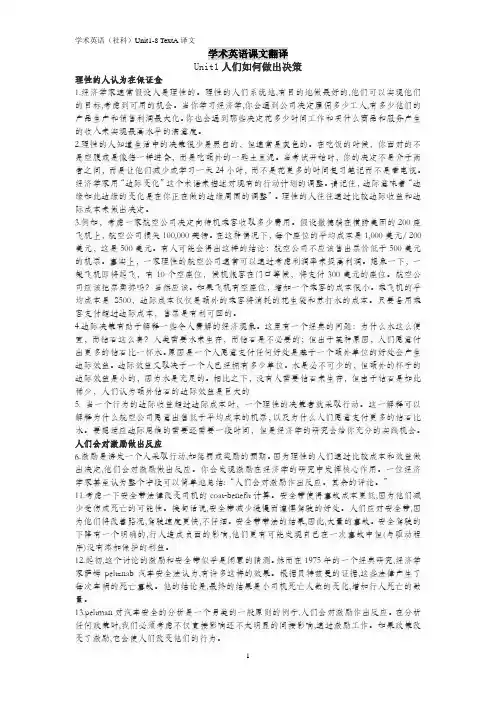
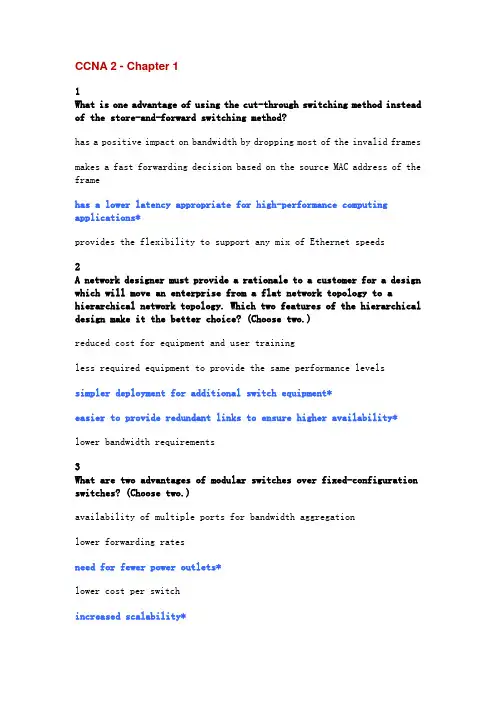
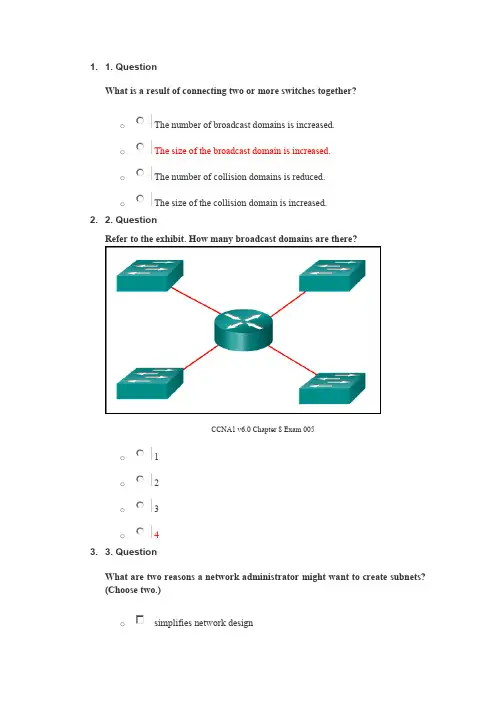
CCNA 2 - Chapter 11What is one advantage of using the cut-through switching method instead of the store-and-forward switching method?has a positive impact on bandwidth by dropping most of the invalid framesmakes a fast forwarding decision based on the source MAC address of the framehas a lower latency appropriate for high-performance computing applications*provides the flexibility to support any mix of Ethernet speeds2A network designer must provide a rationale to a customer for a design which will move an enterprise from a flat network topology to a hierarchical network topology. Which two features of the hierarchical design make it the better choice? (Choose two.)reduced cost for equipment and user trainingless required equipment to provide the same performance levelssimpler deployment for additional switch equipment*easier to provide redundant links to ensure higher availability*lower bandwidth requirements3What are two advantages of modular switches over fixed-configuration switches? (Choose two.)availability of multiple ports for bandwidth aggregationlower forwarding ratesneed for fewer power outlets*lower cost per switchincreased scalability*4Refer to the exhibit. Consider that the main power has just been restored. PC1 asks the DHCP server for IPv4 addressing. The DHCP server sends it an IPv4 address. While PC2 is still booting up, PC3 issues a broadcast IPv4 DHCP request. To which port will SW1 forward this request?to Fa0/1, Fa0/2, and Fa0/4 onlyto Fa0/1, Fa0/2, Fa0/3, and Fa0/4to Fa0/1 and Fa0/2 onlyto Fa0/1, Fa0/2, and Fa0/3 only*to Fa0/1 only5What is one function of a Layer 2 switch?forwards data based on logical addressinglearns the port assigned to a host by examining the destination MAC addressduplicates the electrical signal of each frame to every portdetermines which interface is used to forward a frame based on the destination MAC address*6Refer to the exhibit. Fill in the blank.There are ” 12” collision domains in the topology.7What is a collapsed core in a network design?a combination of the functionality of the access, distribution, and core layersa combination of the functionality of the access and core layersa combination of the functionality of the distribution and core layers*a combination of the functionality of the access and distribution layers 8What are two reasons a network administrator would segment a network with a Layer 2 switch? (Choose two.)to enhance user bandwidth*to eliminate virtual circuitsto create more broadcast domainsto isolate traffic between segments*to isolate ARP request messages from the rest of the networkto create fewer collision domains9Refer to the exhibit.How is a frame sent from PCA forwarded to PCC if the MAC address table on switch SW1 is empty?SW1 forwards the frame directly to SW2. SW2 floods the frame to all ports connected to SW2, excluding the port through which the frame entered the switch.SW1 floods the frame on all ports on the switch, excluding the interconnected port to switch SW2 and the port through which the frame entered the switch.SW1 floods the frame on all ports on SW1, excluding the port through which the frame entered the switch.*SW1 drops the frame because it does not know the destination MAC address.10Place the options in the following order:[+] appropriate for high performance computing applications[+] forwarding process can begin after receiving the destination address [+] may forward invalid frames[#] error checking before forwarding[#] forwarding process only begin after receiving the entire frame [#] only forward valid frames[+] Order does not matter within this group.[#] Order does not matter within this group.11What is a basic function of the Cisco Borderless Architecture distribution layer?aggregating Layer 3 routing boundaries*aggregating all the campus blocksacting as a backboneproviding access to the user12ABC, Inc. has about fifty hosts in one LAN. The administrator would like to increase the throughput of that LAN. Which device will increase the number of collision domains and thereby increase the throughput of the LAN?hubhostNICswitch*13What does the term “port density” represent for an Ethernet switch?the numbers of hosts that are connected to each switch portthe speed of each portthe memory space that is allocated to each switch portthe number of available ports*14Which type of transmission does a switch use when the destination MAC address is not contained in the MAC address table?anycastunicastbroadcast*multicast15What is a basic function of the Cisco Borderless Architecture access layer?aggregates Layer 3 routing boundariesprovides high availabilityaggregates Layer 2 broadcast domainsprovides access to the user*16What information is added to the switch table from incoming frames?source MAC address and incoming port number*destination MAC address and incoming port numberdestination IP address and incoming port numbersource IP address and incoming port number17Fill in the blank.A “converged” network is one that uses the same infrastructure to carry voice, data, and video signals.18An administrator purchases new Cisco switches that have a feature called StackPower. What is the purpose of this feature?It enables many switches to be connected with a special fiber-optic power cable to provide higher bandwidth.It enables the sharing of power among multiple stackable switches.*It enables many switches to be connected to increase port density.It enables many switches to be physically stacked in an equipment rack.It enables AC power for a switch to be provided from a powered patch panel.19Which switch form factor should be used when large port density, fault tolerance, and low price are important factors?fixed-configuration switchmodular switchstackable switch*rackable 1U switch20Refer to the exhibit. Fill in the blank.There are ” 5 ”CCNA 2 - Chapter 2Posted by beotron at 8:59 PM1. A static route that points to the next hop IP will have what administrative distance and metric in the routing table?• administrative distance of 0 and metric of 0• administrative distance of 0 and metric of 1• administrative distance of 1 and metric of 0• administrative distance of 1 and metric of 12. What address can be used to summarize networks 172.16.1.0/24, 172.16.2.0/24, 172.16.3.0/24, and 172.16.4.0/24?• 172.16.0.0/21• 172.16.1.0/22• 172.16.0.0 255.255.255.248• 172.16.0.0 255.255.252.03. The routers in the diagram use the subnet assignments shown. What is the most efficient route summary that can be configured on Router3 to advertise the internal networks to the cloud?• 192.1.1.0/26 and 192.1.1.64/27• 192.1.1.128/25• 192.1.1.0/23 and 192.1.1.64/23• 192.1.1.0/24• 192.1.1.0/25• 192.1.1.0/24 and 192.1.1.64/244. Refer to the exhibit. What is the significance of the /8 in the route to the 10.0.0.0 network?• It indicates that there are 8 hops between this router and the 10.0.0.0 network.• It represents the time, in milliseconds, it takes for a ping to reply when sent to the 10.0.0.0 network.• It indicates that there are 8 subnets in the destination network to which the router can forward packets.• It indicates the number of consecutive bits, from the left, in the destination IP address of a packet that must match 10.0.0.0 to use that route.5. Refer to the exhibit. How will packets destined to the 172.16.0.0 network be forwarded?• Router1 will perform recursive lookup and packet will exit S0/0.• Router1 will perform recursive lookup and packet will exit S0/1.• There is no matching interface associated with network 172.16.0.0 so packets will be dropped.• There is no matching interface associated with network 172.16.0.0 so packets will take gateway of last resort and exit out S0/2.6. A network administrator enters the following command into Router1: ip route 192.168.0.0255.255.255.0 S0/1/0. Router1 then receives a packet that is destined for 192.168.0.22/24. After finding the recently configured static route in the routing table, what does Router1 do next to process the packet? • drops the packet because the destination host is not listed in the routing table• looks up the MAC address of the S0/1/0 interface to determine the destination MAC address of the new frame• performs a recursive lookup for the IP address of the S0/1/0 interface before forwarding the packet• encapsulates the packet into a frame for the WAN link and forwards the packet out the S0/1/0 interface7. Refer to the exhibit. Given the output in the exhibit, how would a clock rate be determined for this link? • The rate would be negotiated by both routers.• A rate would not be selected due to the DCE/DTE connection mismatch.• The rate configured on the DTE determines the clock rate.• The rate configured on the DCE determines the clock rate.8. Refer to the exhibit. Which set of commands will configure static routes that will allow the WinterPark and the Altamonte routers to deliver packets from each LAN and direct all other traffic to the Internet? • WinterPark(config)# ip route 0.0.0.0 0.0.0.0 192.168.146.1Altamonte(config)# ip route 10.0.234.0 255.255.255.0 192.168.146.2Altamonte(config)# ip route 0.0.0.0 0.0.0.0 s0/1• WinterPark(config)# ip route 0.0.0.0 0.0.0.0 192.168.146.1Altamonte(config)# ip route 10.0.234.0 255.255.255.0 192.168.146.2Altamonte(config)# ip route 198.18.222.0 255.255.255.255 s0/1• WinterPark(config)# ip route 172.191.67.0 255.255.255.0 192.168.146.1• WinterPark(config)# ip route 0.0.0.0 0.0.0.0 192.168.146.1Altamonte(config)# ip route 10.0.234.0 255.255.255.0 192.168.146.2• WinterPark(config)# ip route 172.191.67.0 255.255.255.0 192.168.146.1Altamonte(config)# ip route 10.0.234.0 255.255.255.0 192.168.146.2Altamonte(config)# ip route 0.0.0.0 0.0.0.0 s0/09. Hosts on two separate subnets cannot communicate. The network administrator suspects a missing route in one of the routing tables. Which three commands can be used to help troubleshoot Layer 3 connectivity issues? (Choose three.)• ping• show arp• traceroute• show ip route• show interface• show cdp neighbor d etail10. Refer to the exhibit. A company network engineer is assigned to establish connectivity between the two Ethernet networks so that hosts on the 10.1.1.0/24 subnet can contact hosts on the 10.1.2.0/24 subnet. The engineer has been told to use only static routing for these company routers. Which set of commands will establish connectivity between the two Ethernet networks?• R1(config)# ip route 10.1.2.0 255.255.255.0 192.168.0.1R2(config)# ip route 10.1.1.0 255.255.255.0 192.168.0.2• R1(config)# ip route 10.1.2.0 255.255.255.0 192.168.0.2R2(config)# ip route 10.1.1.0 255.255.255.0 192.168.0.1• R1(config)# ip route 10.1.1.0 255.255.255.0 192.168.0.2R2(config)# ip route 10.1.2.0 255.255.255.0 192.168.0.1• R1(config)# ip route 10.1.1.0 255.255.255.0 192.168.0.1R2(config)# ip route 10.1.2.0 255.255.255.0 192.168.0.2• R1(config)# ip route 0.0.0.0 0.0.0.0 10.1.2.1R2(config)# ip route 0.0.0.0 0.0.0.0 10.1.1.111. Which of the following are displayed by the Router# show cdp neighbors command? (Choose three.) • load• platform• reliability• holdtime• local interface12. Refer to the exhibit. What two commands are required to provide connectivity between the192.168.1.0 and 10.0.0.0 networks without requiring recursive lookup? (Choose two.)• A(config)# ip route 10.0.0.0 255.0.0.0 s 0/1/0• A(config)# ip route 10.0.0.0 255.0.0.0 172.16.40.2• A (config)# ip route 10.0.0.0 255.0.0.0 s 0/0/0• B(config)# ip route 192.168.1.0 255.255.255.0 s 0/0/0• B (config)# ip route 192.168.1.0 255.255.255.0 172.16.40.1• B(config)# ip route 192.168.1.0 255.255.255.0 s 0/1/013. Refer to the exhibit. What two commands will change the next-hop address for the 10.0.0.0/8 network from 172.16.40.2 to 192.168.1.2? (Choose two.)• A(config)# no network 10.0.0.0 255.0.0.0 172.16.40.2• A(config)# no ip address 10.0.0.1 255.0.0.0 172.16.40.2• A(config)# no ip route 10.0.0.0 255.0.0.0 172.16.40.2• A(config)# ip route 10.0.0.0 255.0.0.0 s0/0/0• A(config)# ip route 10.0.0.0 255.0.0.0 192.168.1.214. What happens to a static route entry in a routing table when the outgoing interface is not available? • The route is removed from the table.• The router polls neighbors for a replacement route.• The route remains in the table because it was defined as static.• The router redirects the static route to compensate for the loss of the next hop device.15. A router has one static route to each destination network. Which two scenarios would require an administrator to alter the static routes that are configured on that router? (Choose two.)• The destination network no longer exists.• The destination network is moved to a different interface on the same router.• The path between the source and destination is upgraded with a higher bandwidth link.• A topology change occurs where the exi sting next-hop address or exit interface is not accessible.• The remote destination network interface has to be down for 15 minutes of maintenance.16. Why is it advisable to enter a next-hop IP address when creating a static route whose exit interface is an Ethernet network?• Adding the next-hop address eliminates the need for the router to do any lookups in the routing table before forwarding a packet.• In a multi-access network, the router cannot determine the next-hop MAC address for the Ethernet frame without a next-hop address.• Using a next-hop address in a static route provides a route with a lower metric.• In multi-access networks, using a next-hop address in a static route makes that route a candidate default route.17. The output of the Router# show interfaces serial 0/1 command displays the following:• Serial0/1 is up, line protocol is down.• What is the most likely cause for the line protocol being down?• Serial0/1 is shutdown.• There is no cable connecting the routers.• The remote rout er is using serial 0/0.• No clock rate has been set.18. Refer to the exhibit. Which static route should be configured on Router1 so that host A will be able to reach host B on the 172.16.0.0 network?• ip route 192.168.0.0 172.16.0.0 255.255.0.0• ip rou te 172.16.0.0 255.255.0.0 192.168.0.1• ip route 172.16.0.0 255.255.0.0 S0/0/1• ip route 172.16.0.0 255.255.0.0 S0/0/019. What two devices are responsible for converting the data from the WAN service provider into a form acceptable by the router? (Choose two).• the serial port of the router• a modem• a switch• the ethernet port of the router• a CSU/DSU device• a DTE device20. Which of the following is true regarding CDP and the graphic shown?• CDP running on Router D will gather information about routers A, B, C, and E.• By default, Router A will receive CDP advertisements from routers B and C.• If routers D and E are running different routing protocols, they will not exchange CDP information.• Router E can use CDP to identify the IOS running on Router B.21. Which two statements describe functions or characteristics of CDP? (Choose two.)• It starts up automatically and allows the device to detect directly connected neighbor devices that use CDP.• It operates at the network layer and allows two systems to learn about each other.• It creates a topology map of the entire network.• It allows systems to learn about each other even if different network layer protocols are configured.• It forwards advertisements about routes for faster convergence.22. Which piece of information is available from examining the output of the command show ip interface brief?• Interface speed and duplex• Interface MTU• Errors• Interface MAC address• Interface IP addressCCNA 2 - Chapter 31A network administrator is determining the best placement of VLAN trunklinks. Which two types of point-to-point connections utilize VLAN trunking? (Choose two.)between two switches that share a common VLANbetween a switch and a server that has an 802.1Q NIC*between a switch and a client PCbetween a switch and a network printerbetween two switches that utilize multiple VLANs*2What happens to a port that is associated with VLAN 10 when the administrator deletes VLAN 10 from the switch?The port automatically associates itself with the native VLAN. The port creates the VLAN again.The port goes back to the default VLAN.The port becomes inactive.*3Refer to the exhibit. Interface Fa0/1 is connected to a PC. Fa0/2 is a trunk link to another switch. All other ports are unused. Which security best practice did the administrator forget to configure?Configure all unused ports to a ‘black-hole’ VLAN that is not used f or anything on the network.Disable autonegotiation and set ports to either static access or static trunk.Change the native VLAN to a fixed VLAN that is distinct from all user VLANs and to a VLAN number that is not VLAN 1.All user ports are associated with VLANs distinct from VLAN 1 and distinct from the ‘black-hole’ VLAN.*4Which command is used to remove only VLAN 20 from a switch?no switchport access vlan 20delete flash:vlan.datno vlan 20*delete vlan.dat5A Cisco Catalyst switch has been added to support the use of multiple VLANs as part of an enterprise network. The network technician finds it necessary to clear all VLAN information from the switch in order to incorporate a new network design. What should the technician do to accomplish this task?Erase the startup configuration and reboot the switch.Erase the running configuration and reboot the switch.Delete the startup configuration and the vlan.dat file in the flash memory of the switch and reboot the switch.*Delete the IP address that is assigned to the management VLAN and reboot the switch.6What is the effect of issuing a switchport access vlan 20 command on the Fa0/18 port of a switch that does not have this VLAN in the VLAN database?VLAN 20 will be created automatically.*The command will have no effect on the switch.Port Fa0/18 will be shut down.An error stating that VLAN 20 does not exist will be displayed and VLAN 20 is not created.Which command displays the encapsulation type, the voice VLAN ID, and the access mode VLAN for the Fa0/1 interface?show mac address-table interface Fa0/1show interfaces Fa0/1 switchport*show interfaces trunkshow vlan brief8Place the options in the following order:- not scored -dynamic autononegotiatedynamic desirabletrunk9Port Fa0/11 on a switch is assigned to VLAN 30. If the command no switchport access vlan 30 is entered on the Fa0/11 interface, what will happen?Port Fa0/11 will be returned to VLAN 1.*VLAN 30 will be deleted.An error message would be displayed.Port Fa0/11 will be shutdown.What must the network administrator do to remove Fast Ethernet port fa0/1 from VLAN 2 and assign it to VLAN 3?Enter the no vlan 2 and the vlan 3 commands in global configuration mode. Enter the switchport trunk native vlan 3 command in interface configuration mode.Enter the switchport access vlan 3 command in interface configuration mode.*Enter the no shutdown in interface configuration mode to return it to the default configuration and then configure the port for VLAN 3.11Which two Layer 2 security best practices would help prevent VLAN hopping attacks? (Choose two.)Disable DTP autonegotiation on end-user ports.*Change the management VLAN to a distinct VLAN that is not accessible by regular users.Statically configure all ports that connect to end-user host devices to be in trunk mode.Change the native VLAN number to one that is distinct from all user VLANs and is not VLAN 1.*Use SSH for all remote management access.12In a basic VLAN hopping attack, which switch feature do attackers take advantage of?automatic encapsulation negotiationthe default automatic trunking configuration*an open Telnet connectionforwarding of broadcasts13A Cisco switch currently allows traffic tagged with VLANs 10 and 20 across trunk port Fa0/5. What is the effect of issuing a switchport trunk allowed vlan 30 command on Fa0/5?It allows only VLAN 30 on Fa0/5.*It allows a native VLAN of 30 to be implemented on Fa0/5.It allows VLANs 1 to 30 on Fa0/5.It allows VLANs 10, 20, and 30 on Fa0/5.14Refer to the exhibit. A frame is traveling between PC-A and PC-B through the switch. Which statement is true concerning VLAN tagging of the frame?No VLAN tag is added to the frame.*A VLAN tag is added when the frame is accepted by the switch.A VLAN tag is added when the frame is forwarded out the port to PC-B.A VLAN tag is added when the frame leaves PC-A.15Refer to the exhibit. PC-A and PC-B are both in VLAN 60. PC-A is unable to communicate with PC-B. What is the problem?The native VLAN is being pruned from the link.The VLAN that is used by PC-A is not in the list of allowed VLANs on the trunk.*The trunk has been configured with the switchport nonegotiate command. The native VLAN should be VLAN 60.16What VLANs are allowed across a trunk when the range of allowed VLANs is set to the default value?All VLANs will be allowed across the trunk.*Only the native VLAN will be allowed across the trunk.The switches will negotiate via VTP which VLANs to allow across the trunk. Only VLAN 1 will be allowed across the trunk.17Under which two occasions should an administrator disable DTP while managing a local area network? (Choose two.)on links that should not be trunking*when connecting a Cisco switch to a non-Cisco switch*on links that should dynamically attempt trunkingwhen a neighbor switch uses a DTP mode of dynamic autowhen a neighbor switch uses a DTP mode of dynamic desirable18Open the PT Activity. Perform the tasks in the activity instructions and then answer the question.Which PCs will receive the broadcast sent by PC-C?PC-D, PC-E*PC-A, PC-B, PC-D, PC-EPC-A, PC-BPC-A, PC-B, PC-D, PC-E, PC-FPC-A, PC-B, PC-E19Which two statements are true about VLAN implementation? (Choose two.)The network load increases significantly because of added trunking information.Devices in one VLAN do not hear the broadcasts from devices in another VLAN.*The size of the collision domain is reduced.VLANs logically group hosts, regardless of physical location.*The number of required switches in a network decreases.20Refer to the exhibit. DLS1 is connected to another switch, DLS2, via a trunk link. A host that is connected to DLS1 is not able to communicate to a host that is connected to DLS2, even though they are both in VLAN 99. Which command should be added to Fa0/1 on DLS1 to correct the problem?switchport trunk allowed vlan add 99switchport trunk native vlan 66*switchport mode dynamic autoswitchport nonegotiate21Which switch feature ensures that no unicast, multicast, or broadcast traffic is passed between ports that are configured with this feature?switch port securityPVLAN protected port*ACLVLAN22Fill in the blank. Use the full command syntax.The ” show vlan brief” command displays the VLAN assignment for all ports as well as the existing VLANs on the switch.23Which three statements accurately describe VLAN types? (Choose three).An 802.1Q trunk port, with a native VLAN assigned, supports both tagged and untagged traffic.*A management VLAN is any VLAN that is configured to access management features of the switch.*A data VLAN is used to carry VLAN management data and user-generated traffic.Voice VLANs are used to support user phone and e-mail traffic on a network. VLAN 1 is always used as the management VLAN.After the initial boot of an unconfigured switch, all ports are members of the default VLAN.*24Which command should the network administrator implement to prevent the transfer of DTP frames between a Cisco switch and a non-Cisco switch?S1(config-if)# switchport mode trunkS1(config-if)# switchport mode accessS1(config-if)# switchport nonegotiate*S1(config-if)# switchport mode dynamic desirableS1(config-if)# switchport trunk allowed vlan noneCCNA 2 - Chapter 41What type of IPv6 address is required as a minimum on IPv6 enabled interfaces?staticglobal unicastlink-local*loopbackunique local2In order for packets to be sent to a remote destination, what three pieces of information must be configured on a host? (Choose three.)default gateway*hostnameDNS server addressDHCP server addressIP address*subnet mask*3What two pieces of information are displayed in the output of the show ip interface brief command? (Choose two.)MAC addressesLayer 1 statuses*IP addresses*next-hop addressesinterface descriptionsspeed and duplex settings4Place the options in the following order:next hopdestination networkmetric- not scored -administrative distanceroute timestamproute source protocol- not scored -5Which two items are used by a host device when performing an ANDing operation to determine if a destination address is on the same local network? (Choose two.)destination MAC addressnetwork numberdestination IP address*source MAC addresssubnet mask*6Refer to the exhibit. A network administrator issues the show ipv6 route command on R1. What two conclusions can be drawn from the routing table? (Choose two.)Packets that are destined for the network 2001:DB8:ACAD:2::/64 will be forwarded through Fa0/1.R1 does not know a route to any remote networks.*The interface Fa0/1 is configured with IPv6 address2001:DB8:ACAD:A::12.*Packets that are destined for the network 2001:DB8:ACAD:2::54/128 will be forwarded through Fa0/0.The network FF00::/8 is installed through a static route command.7Refer to the exhibit. What is the purpose of the highlighted field in the line that is displayed from the show ip route command?It indicates that this is a directly connected route.It indicates that this route has been deleted from the routing table. It indicates that this route was learned via EIGRP.*It indicates that this is a default route.8Which two statements correctly describe the concepts of administrative distance and metric? (Choose two.)The metric varies depending which Layer 3 protocol is being routed, such as IP.A router first installs routes with higher administrative distances. The value of the administrative distance can not be altered by the network administrator.Routes with the smallest metric to a destination indicate the best path.* Administrative distance refers to the trustworthiness of a particular route.*The metric is always determined based on hop count.9What are two functions of a router? (Choose two.)It manages the VLAN database.It increases the size of the broadcast domain.It controls the flow of data via the use of Layer 2 addresses.It determines the best path to send packets.*It connects multiple IP networks.*10A packet moves from a host on one network to a device on a remote network within the same company. If NAT is not performed on the packet, which two items remain unchanged during the transfer of the packet from source to destination? (Choose two.)destination MAC addresssource ARP tablesource IP address*destination IP address*source MAC addressLayer 2 header11。