动词第三人称单数变化规则如下
- 格式:doc
- 大小:57.50 KB
- 文档页数:16
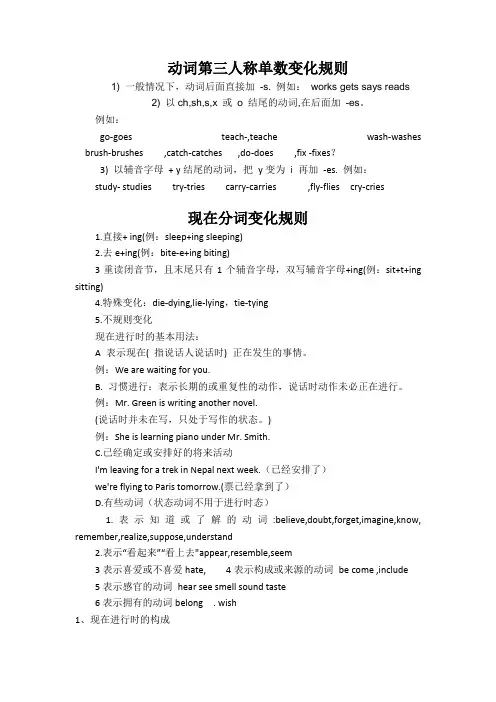
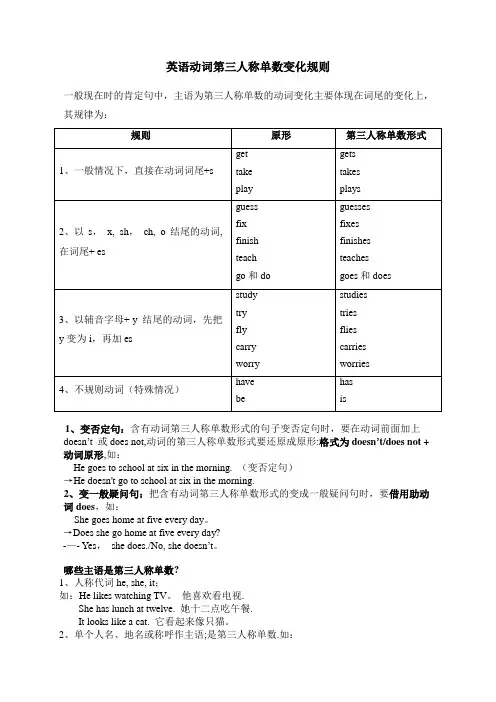
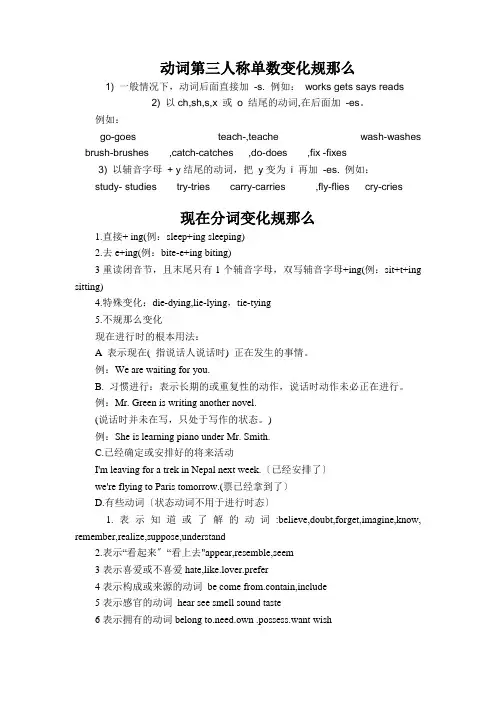
动词第三人称单数变化规则1) 一般情况下,动词后面直接加 -s. 例如: worksgets says reads2) 以ch,sh,s,x 或 o 结尾的动词,在后面加 -es。
例如:go-goes teach-,teache wash-washes brush-brushes ,catch-catches ,do-does ,fix -fixes3) 以辅音字母 + y结尾的动词,把 y变为 i 再加 -es. 例如:study- studies try-tries carry-carries ,fly-flies cry-cries现在分词变化规则1.直接+ ing(例:sleep+ing sleeping)2.去e+ing(例:bite-e+ing biting)3重读闭音节,且末尾只有1个辅音字母,双写辅音字母+ing(例:sit+t+ing sitting)4.特殊变化:die-dying,lie-lying,tie-tying5.不规则变化现在进行时的基本用法:A 表示现在( 指说话人说话时) 正在发生的事情。
例:We are waiting for you.B. 习惯进行:表示长期的或重复性的动作,说话时动作未必正在进行。
例:Mr. Green is writing another novel.(说话时并未在写,只处于写作的状态。
)例:She is learning piano under Mr. Smith.C.已经确定或安排好的将来活动I'm leaving for a trek in Nepal next week.(已经安排了)we're flying to Paris tomorrow.(票已经拿到了)D.有些动词(状态动词不用于进行时态)1.表示知道或了解的动词:believe,doubt,forget,imagine,know, remember,realize,suppose,understand2.表示“看起来”“看上去"appear,resemble,seem3表示喜爱或不喜爱hate,like.lover.prefer4表示构成或来源的动词 be come from.contain,include5表示感官的动词 hear see smell sound taste6表示拥有的动词belong to.need.own .possess.want wish1、现在进行时的构成现在进行时由"be+v-ing"构成。
be应为助动词,最容易被同学漏掉,它应与主语的人称和数保持一致。
2、现在进行时的应用(1)当句子中有now时,常表示动作正在进行,这时要用现在进行时。
如:They are playing basketball now.现在他们正在打篮球。
(2)以look, listen开头的句子,提示我们动作正进行,这时要用现在进行时。
如:Listen!She is singing an English song.听,她正在唱英语歌。
(3)表示当前一段时间或现阶段正在进行的动作,且此时有this week, these days等时间词,这时常用现在进行时。
如:We are making model planes these days.这些天我们在做飞机模型。
(4)描述图片中的人物的动作,也为了表达更生动。
此时也常用现在进行时。
如:Look at the picture. The children are flying kites in the park.看这幅图,那些孩子正在公园放风筝。
3、现在分词的变化规则:(1)一般情况下,直接在动词后加-ingwork ---- workingsleep ----- sleepingstudy ----- studying(2)动词以不发音的-e结尾,要去-e加-ingtake ----- takingmake ----- makingdance ----- dancing(3)重读闭音节的动词,要双写词尾字母,再加-ingcut ----- cuttingput ----- puttingbegin ------ beginning(4)以-ie结尾的动词,把变成y再加-inglie ----- lyingtie ----- tyingdie ----- dying4、现在进行时的变化肯定句式:主语+be( am, is, are)+现在分词+其它.否定句式:主语+be(am, is, are) +not +现在分词+其它. 一般疑问句:be(am, is, are) +主语+现在分词+其它特殊疑问句:疑问词+be(am, is, are)+主语+现在分词+其它形容词的比较级和最高级变化形式规则如下1. 在英语中,在表示“比较…”和“最…”时,形容词要用特别的形式,称为“比较级”和“最高级”,原来的形容词称为“原级”:原级比较级最高级strong强 stronger较强 strongest最强2. 形容词的比较级和最高级的构成方法如下:a. 单音节词和少数双音节词以加-er和-est的方式构成:原级比较级最高级young年轻 younger较年轻 youngest最年轻old老 older较老 oldest最老clean干净 cleaner较干净 cleanest最干净在加词尾时要注意下面的各种情况:b. 其他词都在前面加more, most构成比较级及最高级:原级比较级最高级important more important most important difficult more difficult most difficultinteresting more interesting most interestinguseful more useful most useful 3. 用比较级时常用than引起一个从句,表示和什么比较:His room is bigger than mine. 他的房间比我的房间大。
She is younger than my sister. 她比我妹妹年轻。
Exercises:I. 学会下列形容词的比较级和最高级:原级比较级最高级1. tall taller tallest strong stronger strongestold older oldest 2. large larger largest fine finer finest late later latest3. big bigger biggest hot hotter hottest thin thinner thinnest4. easy easier easiestbusy busier busiesthappy happier happiest5. valuable more valuable most valuabledangerous more dangerous most dangerouscomfortable more comfortable most comfortable1. 有几个形容词有特殊的比较级和最高级形式:原级比较级最高级good well better bestbad ill worse worst many much more mostlittle less least far farther further farthest furthestold older elder oldest eldest小贴士1:elder和eldest可用来表示兄弟和子女的长幼顺序:my elder sister 我的姐姐my eldest brother 我的大哥their eldest son他们的长子小贴士1:further表示“较远”外,还可表示“进一步的”;而farther 仅表示距离:The farther plants are too cold. 更远的行星太冷。
Do you need any further help? 你还需要更进一步的帮助吗?2. 双音节词除了以“辅音+y”结尾的词外,还有以ow, er, le结尾的词,和个别其他双音节词,可以用加词尾的办法构成比较级和最高级:原级比较级最高级narrow narrower narrowestclever cleverer cleverestsimple simpler simplestcommon commoner commonest3. 也有少数单音节词可以加more和most的办法构成比较级和最高级:原级比较级最高级pleased more pleased most pleasedtired more tired most tiredglad more glad most glad名词的复数形式英语里有一些名词的复数形式不是以词尾-s或-es构成,其它名词复数的规则变化1) 以y结尾的专有名词,或元音字母+y 结尾的名词变复数时,直接加s变复数:如: two Marys the Henrysmonkey---monkeys holiday---holidays比较:层楼:storey ---storeys story---stories2) 以o 结尾的名词,变复数时:a. 加s,如: photo---photos piano---pianosradio---radios zoo---zoos;b. 加es,如:potato--potatoes tomato--tomatoesc. 均可,如:zero---zeros / zeroes3) 以f或fe 结尾的名词变复数时:a. 加s,如: belief---beliefs roof---roofssafe---safes gulf---gulfs;b. 去f,fe 加ves,如:half---halvesknife---knives leaf---leaves wolf---wolveswife---wives life---lives thief---thieves;c. 均可,如: handkerchief:handkerchiefs / handkerchieves名词复数的不规则变化1)child---children foot---feet tooth---teethmouse---mice man---men woman---women注意:与 man 和 woman构成的合成词,其复数形式也是 -men 和-women。
如: an Englishman,two Englishmen. 但German不是合成词,故复数形式为Germans;Bowman是姓,其复数是the Bowmans。