全倒装练习题
- 格式:docx
- 大小:37.18 KB
- 文档页数:3
全倒装练习题
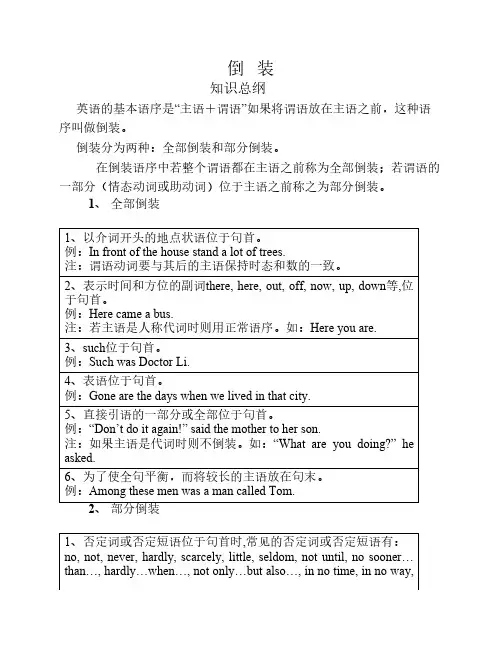
In English grammar, the inversion of subject and verb in a sentence,
known as "inverted word order" or "inversion," is a common phenomenon.
This type of sentence structure, which is called "full inversion" or "total
inversion," is used to emphasize certain parts of a sentence or to create a
specific rhetorical effect. In this article, we will explore various examples of
full inversion and practice using it in different contexts. Let's get started!
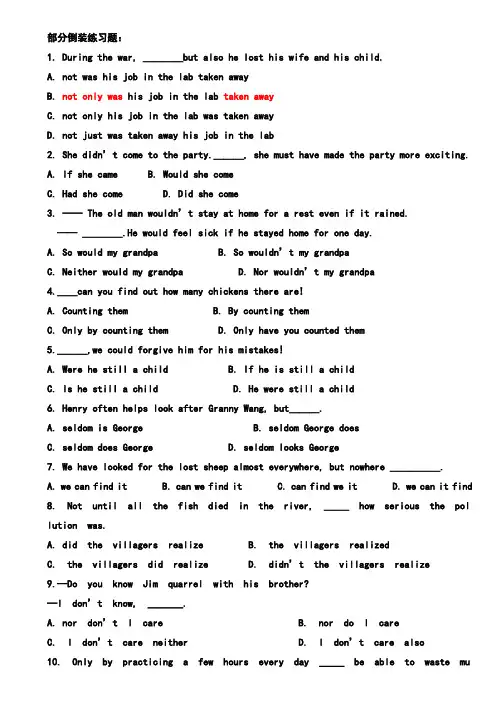
1. Negative adverbial expressions
Instead of the regular word order of subject-verb-object, full inversion is
used when a sentence starts with negative adverbial expressions. For
example:
- "Never have I seen such a beautiful sunset."
- "Not only does he play the piano, but he also sings."
By inverting the subject and verb, the emphasis is placed on the negative
adverbial expressions "never" and "not only," making the sentences more
dramatic and impactful.
2. Adverbial phrases
Full inversion can also be used with certain adverbial phrases to
highlight specific aspects of a sentence. Consider the following examples:
- "In the middle of the room stood a grand piano."
- "On top of the mountain flies a majestic eagle." In these sentences, the subject and verb are inverted to draw attention to
the adverbial phrases "in the middle of the room" and "on top of the
mountain," creating a vivid image in the reader's mind.
3. Conditional sentences
In conditional sentences, full inversion is often used to express a
hypothetical or unreal condition. Take a look at these examples:
- "Had I known about the party, I would have come."
- "Were she here, she would be impressed."
By inverting the subject and verb in the conditional clause, the sentences
convey a sense of regret or possibilities that didn't happen in reality.
4. Questions
When forming questions in formal or written English, full inversion is
commonly used. Here are a few examples:
- "Have you ever traveled abroad?"
- "Can she speak French fluently?"
- "Did they go to the party last night?"
The subject and verb are inverted to form the question, making the
sentences grammatically correct and clear in their meaning.
5. Introducing a sentence with negative expressions In some cases, full inversion is used when a sentence begins with
negative expressions such as "rarely," "seldom," or "little." Consider the
following examples:
- "Rarely have I seen such dedication and perseverance."
- "Little did he know what awaited him."
By inverting the subject and verb, emphasis is placed on the negative
expressions, emphasizing the unexpectedness or rarity of the situation.
In conclusion, full inversion is a powerful grammatical tool used in
English to create emphasis, add rhetorical effect, or convey certain
conditions. By practicing different examples of full inversion, we can
enhance our understanding and mastery of this structure. So, let's continue to
explore more opportunities to use full inversion and elevate the impact of
our writing and speech.