
一般过去时动词过去式变化规则
- 格式:docx
- 大小:10.80 KB
- 文档页数:1
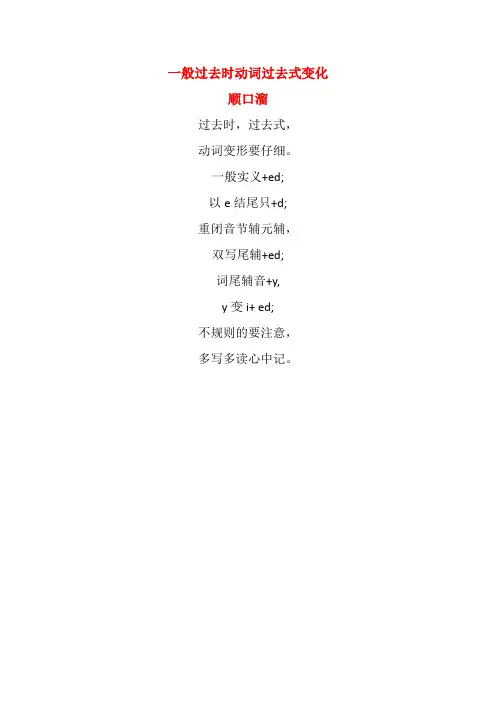

动词过去式的变化规则一、规则动词的过去式1.动词原形+-ed(大部分动词)want—wanted work—worked need—needed clean—cleaned wash—washed play—played spell—spelled help--helped 2.以不发音的e结尾的在词尾加-dlike—liked live—lived use—used move—moved hope—hoped dance—danced3.以一个元音字母(A/E/I/O/U)加一个辅音字母结尾的重读闭音节动词,先双写结尾的辅音字母,再加-edstop—stopped, trip—tripped4.以辅音字母加y结尾的动词,先把y变成i,再加-edstudy—studied carry—carried hurry—hurried marry—married copy—copied cry—cried二、不规则动词的过去式1. 以t结尾的词,过去式与原形相同。
put—put let—let cut—cut beat—beat2. 以d结尾的词,把d变成t。
build—built lend—lent send—sent spend—spent 3. 以n结尾的词,在词后加t。
mean—meant burn—burnt learn—learnt4. 以ow / aw结尾的词,把ow / aw变成ew。
blow—blew draw—drew know—knew grow—grew 5. 含有双写字母的词,将双写改为单写,在词尾加t。
keep—kept sleep—slept feel—felt smell—smelt 6. 含有元音字母o / i的词,将o / i变成a。
sing—sang give—gave sit—sat drink—drank 我们目前已学动词的过去式什么时候用一般过去时呢???1.表示在过去某一时间内发生的动作或情况◆①带有确定的过去时间状语morning five daysyesterday afternoon one week agoevening three minutesthe day before yesterday three hoursyear morninglast month one dayday the other daythat year 其他 when I was youngmorning just noweg. I went to school on foot yesterday.I finished my homework last week.◆②没有确定的过去时间状语时eg. I thought you were ill. 我原以为你生病了(这句话说明在说话之前我以为你病了,但是现在我知道你没病)2.表示过去一段时间内经常或反复发生的动作(常与always,never,often 等频度副词连用)eg. Peter always carried an umbrella. Peter 常常带着伞I never drank wine. 我从不喝酒一般过去时的句型肯定句:主语+行为动词过去式/be动词过去式eg : We played football yesterday.I was happy last night.否定句:did not / didn’t + 行为动词原型Was not / wasn’t + 其他Were not / weren’t + 其他eg:I didn’t finish my homework.I wasn’t happy last night.We weren’t finish our team work.一般疑问句:Did + 主语 + 行为动词原型?Was /Were + 主语 + 其他成分eg: -----Did you go shopping yesterday?-----Yes, I did. / No ,I didn’t.Was she 15 years old last year?特殊疑问句;特殊疑问词 + did + 主语 + 行为动词原型?特殊疑问词was / were + 主语 + 其他成分?eg: Where did you go on vacation?When and where were you born?一般过去时练习题一、单项选择:从下列各题后所给的四个选项中选择最佳答案填空。

一般过去时及动词过去式变化规则一般过去时:表示过去发生的动作或存在的状态。
结构:谓语动词为动词的过去式。
经常跟表示过去的时间连用:yesterday, last night /last year / last month/ last month比如:I went home yesterday.I played football last Sunday.肯定句:I went home yesterday.否定句:I didn't go home yesterday. (did not = didn't)一般疑问句:Did you go home yesterday?特殊疑问句:Where did you go yesterday?肯定句:I was at home last night.否定句:I wasn't at home last night. (was not = wasn't)一般疑问句:Were you at home last night?特殊疑问句:Where were you at home last night?动词过去式变化规则1. 一般情况下直接加-ed, work--workedwalk-- walked help--helped play--played2. 以不发音的字母e结尾的动词,加d, dance--danced like-liked3. 以重读闭音节结尾,而且结尾只有一个辅音字母,双写这个辅音字母,再加ed, plan--planned, stop--stopped, shop--shopped4. 以辅音字母加y结尾的动词,把y变成i,再加ed, try-- tried, study--studied5. 不规则动词的变化:take--took, have--had, see--saw, draw--drew, come--came, give--gave, sit--sat, sing--sang, swim--swam, drink--drank, run--ran, put --put read--read, buy--bought, am/is--was are--were , do --did, go --went, make---made。

一般过去时专项练习及动词过去式变化规则一般过去时专项练及动词过去式变化规则动词过去式变化规则一、规则变化1、一般情况下,动词词尾加-ed,,如:work—workedplay—playedwant—wantedask—asked2、以不发音的-e 结尾动词,动词词尾加-d,如:live—livedmove—movedtaste—tasted3、以“辅音字母+y”结尾的动词,把y改成I,加—ed,如:study—studiestry—triedcopy—copiedcarry—carried4、重读闭音节动词,以“辅元辅”结尾,双写词尾辅音字母,再加—ed,如:stop—stopped二、不规则变化Is /am—wasare—weredo—didhave/ has—hadgo—XXX—metcome—cametake—tooksteal—stoleeat—atefly—flewrun—ransee—sawsay—saidmake—madefind—foundstand—stoodsit—satsing—sangdrink—drankgive—gavering—rangswim—swamwrite—wroteride—rodedrive—drovedraw—drewgrow—grewknow—knewget—gotforget—forgotsweep—sweptkeep—XXX—sleptspeak—spokebreak—broketell—toldsell—XXX—XXX—taughtbuild—builtcan—couldshall—shouldwill—would曩昔式与动词真相一样:let—letmust—mustput—putread—read三、动词过去式构成读音1、清辅音后读清辅音[t](清读清)如:XXX2、浊辅音后读浊辅音[d](浊读浊)如:listenpull3、元音背面读浊子音[d](元音背面读浊音)如:waterplay4、[t][d]后面读[id] wantneed普通曩昔时专项操演一、写出下列动词的过去式1.am/is______2.do_______3.go________4.have_______5.isn’t_________6.aren’t________7.spend_______ _8.cook_______9.read________10.clean_______ 11.live _______ 12.study_________3、用括号内所给词的恰当方式填空1. We _________ (enjoy) ourselves at the party last night.2.XXX ____________ (study) for the English test last Sunday.3._______ you ______ (go) to the Great Wall last year?4. What day _______ (be) it yesterday?5.The old man _______(be)ill and went to see a doctor.6.We ________ (have) a party last night.7.We __________ (visit) the museum and went home.8.—How _______ (be) the students?—They were very friendly.9.He often _______ (have) supper at home. Today he ______ (have) XXX.10.—______ he _______ (have) lunch at nine?—No, he didn’t.11.They _________(buy) a guitar yesterday.5、挑选填空() 1. Lee ____ his mobile phone at home.A. XXX() 2. ___ he ___agood rest? No, he didn’t.A. Do, hadB. D id, haveC. Did, had D. Was, had() 3. As soon as he __, he _to his family.A. arrived, writesB. arrived, writtenC. arrived, wroteD. arriveds, write() 4. Mr. Black was late because he _______ XXX()5. When _________ Lee ________ school this morning?A. did, got toB. did, get toC. did, getD. did, got() 6. Will you please say it again? I _quite __you.A. XXX’t, XXX’t, XXX’t, XXX’t, hear() 7. _you __at six o’clock yesterday? A. Do ,get upB. Did, get upC. Do, got upD. Did, got up() 8.What did you see ____? A. nowB. every dayC. these daysD. just now() 9.He went into theroom and ____ XXX() 10. What __ you __last week? I bought a bag.A. did ,buy B. did , bought C. do, buy D. do, bought() 11.—__he __his lunch?—Yes, he did. A. Does ,hasB. Does, haveC. Did, haveD. Did, had()12.—Did the thieves _____ into the car?—No, they______.A. fell, XXX’tB.fall(落下), XXX(跳), XXX, did() 13. -When did May come back from Hong Kong?-She __ from Hong Kong last Friday.A. come XXX() 14. ____ she _____ XXX?A. Did, buyB. Does, buyC. Did, boughtD. Does, XXX() 15. He ____ to the station this morning and was______ for the train.A. hurry, XXX hurries, XXX hurried, in timeD. hurried, at time() 16. Where _____ XXX() 17.—Have you seen him today?—Yes, I ____ him this morning.A. XXX() 18. He ____worried when he heard the news. A. isB. wasC. doesD. did() 19. There ___ a telephone call for my brother Steven yesterday?A. isB. are C. was D. were() 20. Liu Fengwei _____ three yuan for the lost library book.A. XXX() 21. He __ in this school in 1958.A. XXX() 22. They __ tired so they stopped __a rest.A. are, haveB. were, haveC. were, to haveD. are, having() 23. XXX I _____ in bed all day because I had a XXX() 24. It was raining hard when he ____ home.A. gotB. getC. getsD. was getting() 25. She said her brother ____ in Beijing. He ______ to Japan on business last week.A. wasn’t, XXX’t, XXX’t, goD. isn’t, went七、用所给动词的适当形式填空1.Tom and Mary ___________ (come) to China last month.2.Mary __________ (read) XXX.3.There _________ (be) no one here a moment ago.4.I ___________ (call) Mike this morning.5.I listened but ___________ (hear) nothing.6.Tom ___________ (begin) to learn Chinese last year.。

一般过去时及动词的过去式变化规则一般过去时1)、表示过去发生的动作或出现的状态,用动词的过去式来表达,如:I was at the library yesterday afternoon.Tom studied hard and did well in the final exam last year.2)、动词的过去式分为规则动词和不规则动词两种:规则动词的过去式:①一般情况下在动词原形后直接加-ed。
wanted,played②以不发音的字母e结尾的动词,直接加-d。
hoped,lived③重读闭音节单词如果末尾只有一个辅音字母需双写最后一个辅音字母,再加-ed stopped④以辅音字母+y结尾的动词变y为i,再加-ed。
studied,worried以元音字母+y结尾的动词,直接加-ed. played, enjoyed规则动词过去式的读音也有规律可循。
请记住:清后[t],元浊[d],[t] [d]之后读[id]。
①清辅音后,ed要读[t]。
worked,finished②元音或浊辅音后,ed要读[d]。
lived,called③[t]或[d]后,ed读[id]。
started,needed不规则动词有其自己的变化形式,只能分别记忆。
1. go -went2.take-took3. have-had4.buy-bought5. eat-ate6.see-saw7. hang-hung(悬挂)8.meet-met9. win-won(赢得) 10.sleep-slept 11. put-put e-came13. wake-woke(醒)14.read-read 15let-let (详见课本《不规则动词表》)3)句式及其变化:a. be动词过去式的句式:否定句是在was/were后面加not,was not (wasn't)/were not (weren't)。
一般疑问句是把was / were提前并放到句首,要求首字母要大写b. 实义动词过去式的句式:①肯定式:主语+动词过去式+其它。