
unit1-How-often-do-you-exercise[上学期]section-A--新目标
- 格式:ppt
- 大小:1.08 MB
- 文档页数:23
![unit1-How-often-do-you-exercise[上学期]section-A--新目标](https://imgs-1438308264.cos.ap-hongkong.myqcloud.com/e1d56f1376c66137ee061947.webp)

Unit 1 How often do you do exerciseTeaching aims of this unit:Language goals :1.Vocabulary: always usually often sometimes hardly ever never ,once a day ,twicea week ,three times a month, my eating habits ,healthy /unhealthy lifestyle , keep in good health, junk food ,eat less meat, the same as, be different from ,the difference between…and…, of course ,look after, be good /bad for, sleep nine hours every night all /most /some /no students ,maybe, although exercise =do/play sports2.Ask and answer : What do you usually do on weekends?I often watch TV on weekends.How often do you watch TV?I watch TV twice a week..How long do you sleep every night?I sleep nine hours every night.What are the differences?3. Topic :My lifestyle or habitsAims of abilities: Talk about how often you do thingsAims of emotion: Get the messages from the others successfully.nguage functions: Wh-questions, What do …?, How o ften …?,Adverbs of frequency, All/most/some/none课时安排5课时Period One: Section A (1a—2c)Period Two: Section A (3—4)Period Three: Section B (1a—2c)Period Four:Section B (3a—4)Period Five: Self check and Revision (A-self check)Period OneTeaching Aims:1. Learn to talk about how often do you do things2. To learn the words of the adverbs of frequency.Teaching Difficulties:1.words: exercise, skateboard, hardly, ever, shop, once, twice, time, surf, internet, program.2.phrases: how often, on weekends, go to the movies, exercise, go skateboarding, always , usually , often , never , hardly ever , sometimes .3.Sentence patterns: What does she /he do on weekends ? She often goes to the movies .How often do you shop ? Once a week / Twice a week ··· .Teaching Aids: Tape recorder; Multi-Media.Teaching Procedures:Step 1 :Greeting.1.Welcome back: Talk about their holidays.2.Encourage Ss to share their holidays with the whole class.Step 2 :Leading – in1. Do you like watching TV? Yes ,I do.Do you watch TV every day? Yes, I do.How often do you watch TV?I watch TV every day. I watch TV twice a week.2.Introduce the key vocabulary.Ask the students to say what they see in the thought bubbles.Check the answers on the board.2.3. Name each activity.Repeat reading the following: watch TV, read, shop, go skateboarding, exercise, draw 4. Look at each picture in 1c.Tell what the person does on weekends.Check the Ss orally.1) Make sure what they will hear and do .2) Read these adverbs and explain.5.Play the tape twice .Write the letters on the line.Ask Ss: Well, do you still remember your last vacation?How did you spend it?Was it the same as this summer vacation?So what do you often do in your summer vacation?Then show some phrases for Ss to practice.Then present as following:always>usually>often>sometimes>hardly ever(几乎没有) >neverand let them understand their differences at the first time.Step 3 :Guessing Presentation and Practice.always, usually, often, sometimes, hardly ever(几乎没有) or never.And during this part, present surf the net exercise and go skateboarding. Step4 :.Do a survey:Ask and answer: How often do you take a shower?How often does he take a shower?Let Ss ask and answer in pairs, using always, usually, often, sometimes, hardly ever(几乎没有) or never.Step 5: Homework1.Do exercises on pages 1-2 of the workbook to practice the language presented in this unit.2.Remember what we learn today.Period TwoTeaching Aims:1. Students can learn to talk about activities and how often to each other2. Students can listen, talk ,read and write these words correctly Teaching Difficulties:1. Words: high school, most, no, result, active, for as, for about2. Phrases: for as, for about3.Sentence patterns: How often do you shop? I shop once a month.How often does Cheng watch TV? He watches TV..Teaching Aids: Tape recorder; Multi-Media.Teaching Procedures:Step One :Greeting.Step Two :Leading – inDrills:T: What do you usually do on weekends ?S1: I usually play soccer .T: How often do you play soccer ?S1: I play soccer twice a week .T: How often does he play soccer ?The other Ss: He plays soccer twice a week .Repeat for three times .Step Three :Pre-taskReview the grammar box .Step Four :While-task1. Call attention to the survey .2.Make sure the Ss understand the chart .T: What activity do ninety-five percent of Green High students do every day ?3. Ss answer .If necessary , give them help .4. Review the information in the green box with Ss .5. Read the article first by the Ss .6. Check the answers .7. Practise reading .Step Five :Post-task1.T: What can you do to improve your English ?(e.g. read English books, practice reading and speaking ) How often do you··· ?2.Think of more things you can do to improve your English and write them here .3.Ask several Ss each question .4.See: Who is the best English students in the classStep Six: Homework:1.Revise the new words .2. Preview the next sectionPeriod ThreeTeaching Aims:Learn to talk about how often they do things to keep healthy.Teaching Difficulties:1.Words:junk food, milk, coffee, chips, cola, chocolate, drink, health, how many, interviewer.2.Phrases: how many, be good for, be bad for, every day.3.Sentence patterns: How often do you drink milk, Liu Feng?How many hours do you sleep every night?She says it’s good for my health.Teaching Aids: Tape recorder; Multi-Media.Teaching Procedures:Step 1 :Greeting.Step 2 :Warm-up1.Enjoy an English song.2.Free talk. Talk with Ss about the following questions:Do you like fruit vegetables?Yes, I do.I love it/ them. It’s/They’re delicious. And it’s /they’re he althy food. It’s/They’re good for our health. Or No, I don’t. It’s awful. I can’t stand it.Ask Ss: How often do you eat fruit vegetables?Step 3: Presentation1.Teach milk. Do you like milk? Do you drink milk every day? Why /Why not?2.Then teach chip /cola/chocolate/coffee in the same way. Don’t fo rget to ask them Are they/Is it healthy food /drink? They’re /It’s healthy/unhealthy/ junk food. Don’t eat /drink them /it too often.Step 4: Pair workSs make a similar conversation by themselves.A: How often do you{ eat…?drink…?B : I eat/drink… every day/….A: Do you like it ?B: Yes, I do. It’s good for my health./No, I don’t. But my mother wants me to eat/drink it.Step5 : PresentationThe teacher asks Ss other questions:How often do you exercise/watch TV/read English/play computer games?How many hours do you exercise/watch TV/read English/sleep/play computer games? Step 6: Pair workGet Ss to make a long conversation by themselves.Step 7: Listen (work on 2a)Get the Ss to listen and circle the answers to each question .Later check the answers. Step 8: Work on 2bListen again and fill in the blanks in the survey. Then check the answers. Step 9 .Group workRole play. Student A is the interview. Student B is Katrina. Student C is Bill. Try to act the conversation out .They can use their own words.Step 10.Task Get the Ss to ask their classmates as many questions as they can about their lives. The questions above (2b) can help them. After that they can give a report in front of the class.Step 11. Homework :1. Finish the exercise in this period.2. Write the report in the exercise book.Period Four:Teaching Aims:1. Learn following expressions:2. Learn to write one’s own habits.Teaching Difficulties:1.Words: habit, try, lifestyle, grade, better, same, as, different, difference,maybe, although, for, keep, must.2.Phrases: eating habits, look after, healthy lifestyle, unhealthy lifestyle, goodgrades.3. Main task: How to write a composition of one’s habits.Teaching Aids: Tape recorder; Multi-Media.Teaching Procedures:Step1: Revision1. Free talk:2.Ask and answerHow often do you exercise? How often do you eat vegetables/fruit/junk food?How often do you drink milk/coffee/tea? How many hours do you sleep every day? Use he/she/they ask and answer these questions.Group worksStep 2.Presentation and Practice1.Free talk.What is a healthy lifestyle.After that, T can show a picture with healthy lifestyle and unhealthy one:eat fruit never eat vegetables/fruitvegetables drink coffee/wine too muchdrink milk never drink milksleep 9 hours sleep 5 hoursdo exercise never do exercisehealthy lifestyle unhealthy lifestyleT: And you know: Healthy lifestyle can help us get good grades. Good food and exercisehelp us to study better. My student Katrina has a good lifestyle. Let’s see it.Step 3.Read 3a.Compare the passage with yourselves.Explain:of course , pretty healthy/good ,unhealthy ,a healthy lifestyle, try to do sth.., look after, help sb. to do sth., study better, the same as, be different from Give more examples.Step 4. Finish 3b.Sep 5.Homework:Read the text for many many times. And correct your composition referring to it.Period Five: Self check and RevisionStep1 Greetings & free talk .Step2 DiscussionWork in groups, discuss which kind of life is healthy.Do a report according the discussion.We think we should eat fruit and vegetables…Step3 Self checkFill in each blank with the correct word given.Then make your own sentence with each word.1. wants2.exercises3.help4.try5.haveStep3 Key vocabulary1.ever adv. 曾经2. once adv. 一次3. twice adv. 两次4.internet n.互联网5. program n. 节目单,(电脑)程序6. hilltop n. 山顶7. result n. 结果,成果8. key n. 提醒,提示,线索,答案9. translate v. 翻译10. song n. 歌曲11.junk n. 垃圾,破烂物,废弃的旧物12. milk n. 牛奶13. interviewer n. 采访者14.habit n.习惯,习性15.difference n. 不同,差异,区别16.grade n. 分数,成绩,年级17. although conj. 虽然,即使,纵然18. unhealthy adj.不健康的,不益健康的19.skateboarding n. 溜滑板运动Step4 Key phrases:1. how often 多久一次2. as for至于,关于3. junk food垃圾食品4.eating habit 饮食习惯5.of course当然6.look after 照顾,照看7. start with 以……开始8. make a difference使得结果不同,有重要性9. go shopping去购物10.have a party 聚会11. go to the movie去看电影12. once a week每周一次13. hardly ever很少14. twice a week每周两次15. three times a week每周三次16. watch TV看电视17.on weekend在周末18. do homework做作业19. a lot of许多20. try to do试图(努力)做某事21. help sb (to) do sth.帮助某人做某事22. the same as和……相同23.keep in good health保持身体健康Step 5 Grammar1.掌握句型:1)What do you usually do on weekends? I often go to the movies.What does she do on weekends ? She often goes to the movies.What do you usually do on weekends? I often go to the movies.(watch TV、read books 、exercise 、clean、skateboard、 play basketball、wash clothes、go shopping、 go to movies)How often do you exercise/… ?Task one “Find my group members.”2)在规定时间内填完活动表格,再向周围同学开始询问,找出与自己课外活动大致相同的同学请他或她在每项活动后面签名。
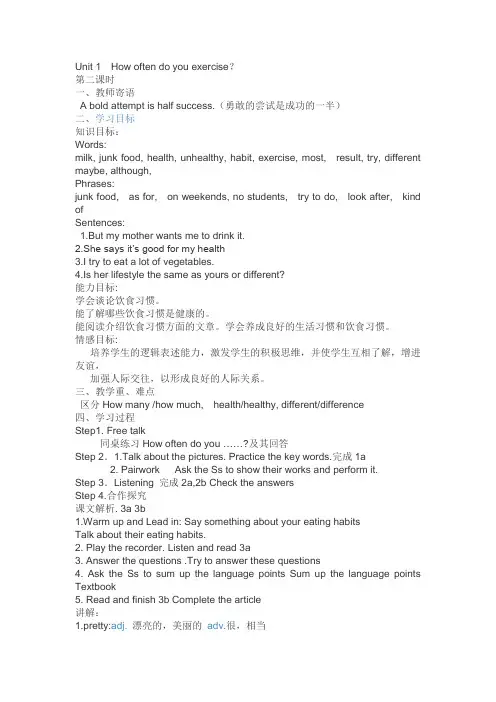
Unit 1 How often do you exercise?第二课时一、教师寄语A bold attempt is half success.(勇敢的尝试是成功的一半)二、学习目标知识目标:Words:milk, junk food, health, unhealthy, habit, exercise, most, result, try, different maybe, although,Phrases:junk food, as for, on weekends, no students, try to do, look after, kind ofSentences:1.But my mother wants me to drink it.2.She says it’s good for my health3.I try to eat a lot of vegetables.4.Is her lifestyle the same as yours or different?能力目标:学会谈论饮食习惯。
能了解哪些饮食习惯是健康的。
能阅读介绍饮食习惯方面的文章。
学会养成良好的生活习惯和饮食习惯。
情感目标:培养学生的逻辑表述能力,激发学生的积极思维,并使学生互相了解,增进友谊,加强人际交往,以形成良好的人际关系。
三、教学重、难点区分How many /how much, health/healthy, different/difference四、学习过程Step1. Free talk同桌练习How often do you ……?及其回答Step 2.1.Talk about the pictures. Practice the key words.完成1a2. Pairwork Ask the Ss to show their works and perform it.Step 3.Listening 完成2a,2b Check the answersStep 4.合作探究课文解析. 3a 3b1.Warm up and Lead in: Say something about your eating habitsTalk about their eating habits.2. Play the recorder. Listen and read 3a3. Answer the questions .Try to answer these questions4. Ask the Ss to sum up the language points Sum up the language points Textbook5. Read and finish 3b Complete the article讲解:1.pretty:adj.漂亮的,美丽的adv.很,相当2. when:conj. 当…的时候. 引导时间状语从句3. eating habits饮食习惯4. try to do sth.尽力做/努力做…. Try doing sth.试图做….5. look after 照顾=take care of ,关注,注重6. get good grades:得到好的成绩7. help sb. (to) do sth.8. the same as和…相同9. different (adj.)- (n.)difference good –better-best10. although虽然,尽管,引导让步状语从句,与though同义,但不能与but 同时出现在一个复合句中,可与still, yet同用。

八年级英语Unit 1 How often do you exercise? 人教新目标版【本讲教育信息】一. 教学内容:Unit 1 How often do you exercise?[学习过程]一. 单元内容:How often do you exercise?二. 单元目标:1. Wh- 问句2. How often……?问句3. 表示频率的副词4. 不定代词all, most, some, none的用法。
三. 重点单词:always adv. 总是usually adv. 通常often adv. 经常sometimes adv. 有时hardly ever 几乎不曾;很少never adv. 从不exercise v. 锻炼n. 练习shop v. 购物n. 商店skateboarding n. 溜滑板运动once adv. 一次twice adv. 两次three times a week 一周三次every day 每天milk n. 牛奶junk food 垃圾食品drink v. 喝. n. 饮料四. 重点短语how often 多长时间一次 a lot of 许多look after 照料try to do sth 尽力去做某事start with 以……开始as for 至于make a difference 有重要性do exercise 做运动surf the internet 上网五. 重点句子1. What do you usually do on weekends?周末你通常做什么?I usually play soccer.我经常踢足球。
2. What do they do on weekends?他们周末干什么?They often go to the movies.他们经常去看电影。
3. What does he do on weekends?他周末干什么?He sometimes watches TV.他有时候看电视。

八年级英语上册Unit 1 How often do you exercise知识点总结人教新目标版Unit 1 How often do you exercise1.What do you usually do on weekends? 你周末常常做什么?(1)这是一个由疑问词what引导的特殊疑问句。
前一个do为助动词,构成疑问句结构,后一个do为实义动词(或叫行为动词),意思是―做;干‖。
注意:助动词do要随着主语的人称、时态和数的不同作出相应的变化。
如:▲What does she do on weekends? 周末她做什么?(2)usually为频率副词,意思是―通常;经常‖,与often意思相近,但程度有别。
【辨析】:频率副词always, usually, often, sometimes, hardly ever, never频率副词词义频率英文释义always 总是100% all the timeusually 通常90% often, generallyoften 经常80% (at) many timessometimes 有时50% at times, now and thenhardly ever 几乎不10% almost not, not at allnever 从不0% not ever, not at any time八年级英语上册Unit 4 How do you get to school知识点总结人教新目标版八年级英语上册Unit 2 What’s the matter重难点解析人教新目标版Unit 2 What‘s the matter?一、本单元主要围绕身体健康状况来展开,包括询问病情,述说病情并给予合适的建议。
1.询问病情一般有以下三个句型:What‘s the matter? What‘s the trouble? What‘s wrong?注意:如果后边带上人或物时,用with.2. 回答病情:I have a + 名词(表示病痛的)(have 随人称和时态而变化)表达患病的常见短语有:I have a cold. She has a fever. He had a toothache.注意:表示病痛的名词构成方式有:①表示身体部位的名词+ ache , 如headache, stomachache, backache, toothache 等;② sore + 身体的部位,如sore back, sore throat, sore leg, sore arm 等等。