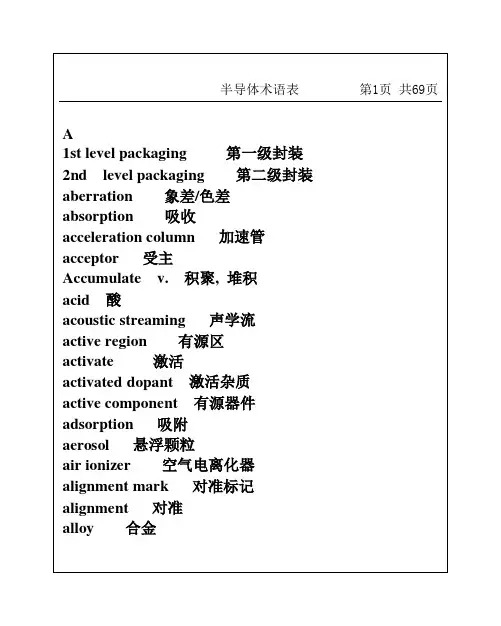
封装相关的英语术语
- 格式:docx
- 大小:24.96 KB
- 文档页数:2
封装相关的英语术语
In the realm of business and technology, encapsulation stands as a cornerstone
principle, facilitating robust software development, efficient project management, and
streamlined communication across various domains. This article delves into the essence
of encapsulation, its significance in different contexts, and its practical applications.
Encapsulation, in its essence, refers to the bundling of data and methods that operate
on the data into a single unit or class. This encapsulated unit shields the internal state of
an object from external interference and manipulation. By enforcing access restrictions
and providing well-defined interfaces, encapsulation promotes data integrity and
enhances code maintainability.
In software development, encapsulation plays a pivotal role in object-oriented
programming (OOP). Objects encapsulate data and behavior, encapsulation prevents
direct access to an object's internal state, ensuring that changes to the implementation
details do not affect other parts of the program. This fosters modular design and code
reuse, as encapsulated objects can be treated as black boxes, with their internal workings
abstracted away.
Moreover, encapsulation fosters code maintainability and scalability by minimizing
dependencies and isolating changes. Developers can modify the internal implementation
of an encapsulated object without affecting its external interface, reducing the risk of
unintended side effects. This modular approach simplifies debugging and testing, as each
encapsulated unit can be examined and verified independently.
In the context of project management, encapsulation extends beyond software
development to encompass the encapsulation of tasks, resources, and responsibilities
within a project framework. Project encapsulation involves defining clear boundaries,
interfaces, and dependencies between project components, enabling effective
coordination and collaboration among team members. By encapsulating tasks and resources within well-defined modules or phases, project
managers can mitigate risks, allocate resources efficiently, and monitor progress
effectively. Encapsulation facilitates agile project management methodologies, allowing
teams to adapt to changing requirements and priorities without disrupting the overall
project workflow.
Furthermore, encapsulation enhances communication and transparency within
project teams and stakeholders. By encapsulating project-related information within
accessible artifacts such as project plans, status reports, and documentation, project
managers can ensure that relevant stakeholders are informed and engaged throughout the
project lifecycle.
In the domain of data management and information security, encapsulation plays a
crucial role in safeguarding sensitive information and controlling access to data resources.
Encapsulating data within secure containers or databases, with well-defined access
controls and encryption mechanisms, helps prevent unauthorized access and data
breaches.
Additionally, encapsulation facilitates compliance with regulatory requirements such
as GDPR, HIPAA, and PCI DSS by ensuring that data handling practices adhere to
established standards and protocols. By encapsulating data processing operations within
auditable frameworks and documenting data flows and access controls, organizations can
demonstrate accountability and transparency in their data management practices.
In conclusion, encapsulation serves as a fundamental principle in business and
technology, enabling modular design, code reuse, project management, and data security.
By encapsulating data and functionality within well-defined units or modules,
organizations can enhance agility, maintainability, and security across various domains.
Embracing encapsulation empowers businesses to navigate complexity, mitigate risks,
and achieve sustainable growth in an ever-evolving landscape of challenges and
opportunities.