
直接引语和间接引语
- 格式:ppt
- 大小:186.00 KB
- 文档页数:10

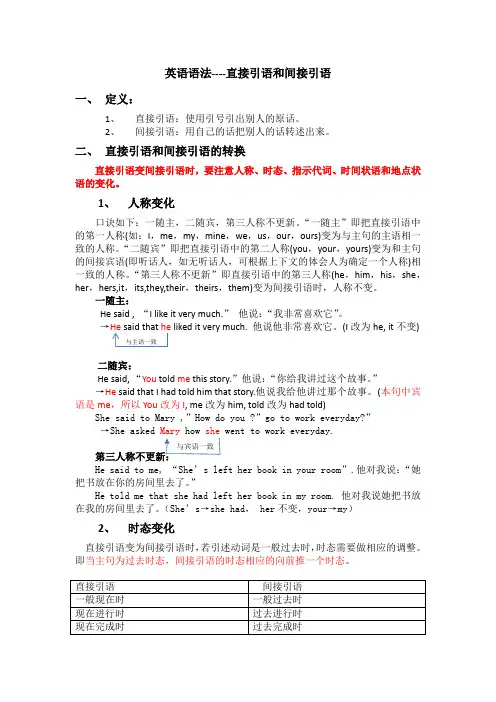
英语语法----直接引语和间接引语
一、 定义:
1、 直接引语:使用引号引出别人的原话。
2、 间接引语:用自己的话把别人的话转述出来。
二、 直接引语和间接引语的转换
直接引语变间接引语时,要注意人称、时态、指示代词、时间状语和地点状语的变化。
1、 人称变化
口诀如下:一随主,二随宾,第三人称不更新。“一随主”即把直接引语中的第一人称(如:I,me,my,mine,we,us,our,ours)变为与主句的主语相一致的人称。“二随宾”即把直接引语中的第二人称(you,your,yours)变为和主句的间接宾语(即听话人,如无听话人,可根据上下文的体会人为确定一个人称)相一致的人称。“第三人称不更新”即直接引语中的第三人称(he,him,his,she,her,hers,it,its,they,their,theirs,them)变为间接引语时,人称不变。
一随主:
He said , “I like it very much.” 他说:“我非常喜欢它”。
→He said that he liked it very much. 他说他非常喜欢它。(I改为he, it不变)
二随宾:
He said, “You told me this story.”他说:“你给我讲过这个故事。”
→He said that I had told him that story.他说我给他讲过那个故事。(本句中宾语是me,所以You改为I, me改为him, told改为had told)
She said to Mary ,”How do you ?”go to work everyday?”
→She asked Mary how she went to work everyday.
第三人称不更新:
He said to me, “She’s left her book in your room”.他对我说:“她把书放在你的房间里去了。”
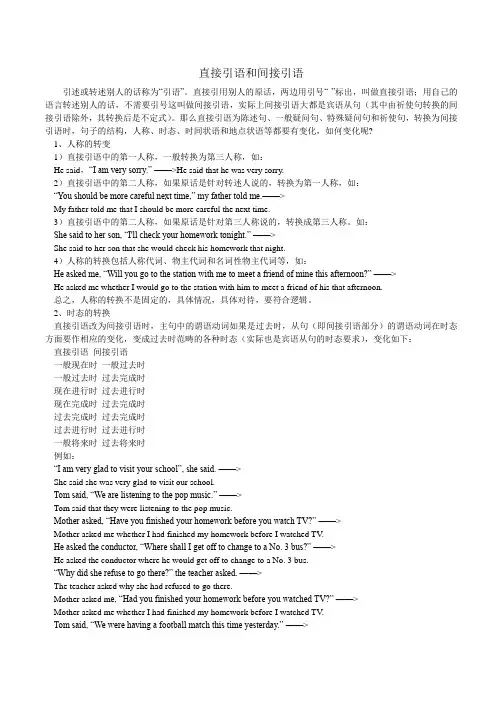
直接引语和间接引语
引述或转述别人的话称为“引语”。直接引用别人的原话,两边用引号“ ”标出,叫做直接引语;用自己的语言转述别人的话,不需要引号这叫做间接引语,实际上间接引语大都是宾语从句(其中由祈使句转换的间接引语除外,其转换后是不定式)。那么直接引语为陈述句、一般疑问句、特殊疑问句和祈使句,转换为间接引语时,句子的结构,人称、时态、时间状语和地点状语等都要有变化,如何变化呢?
1、人称的转变
1)直接引语中的第一人称,一般转换为第三人称,如:
He said,“I am very sorry.” ——>He said that he was very sorry.
2)直接引语中的第二人称,如果原话是针对转述人说的,转换为第一人称,如:
“You should be more careful next time,” my father told me.——>
My father told me that I should be more careful the next time.
3)直接引语中的第二人称,如果原话是针对第三人称说的,转换成第三人称。如:
She said to her son, “I'll check your homework tonight.” ——>
She said to her son that she would check his homework that night.
4)人称的转换包括人称代词、物主代词和名词性物主代词等,如:
He asked me, “Will you go to the station with me to meet a friend of mine this afternoon?” ——>
He asked me whether I would go to the station with him to meet a friend of his that afternoon.

英语中的直接引语和间接引语
一、直接引语和间接引语的概念
1. 直接引语
- 直接引语就是直接引用别人的原话,被引用的部分通常放在引号内。例如:He said, "I am going to the park." 在这个句子中,“I am going to the park.”就是直接引语,它原封不动地呈现了说话者所说的内容。
2. 间接引语
- 间接引语是用自己的话转述别人的话,不用引号。例如:He said that he
was going to the park. 这里“he was going to the park”就是间接引语,它是对原句“He said, 'I am going to the park.'”的转述。
二、直接引语变间接引语的变化规则
1. 人称的变化
- 如果直接引语中的主语是第一人称(I或we),在变为间接引语时,要根据句子的意思相应地变为第三人称(he/she或they)。
- 例如:
- 直接引语:I said, "I like this book." - 间接引语:I said that I liked this book.(这里因为主语都是I,人称不变,但如果是He said, "I like this book." 变为间接引语就是He said that he liked
this book.)
- 如果直接引语中的第二人称(you),在变为间接引语时,要根据转述者和听话者的关系变为第一人称(I/we)或第三人称(he/she/they)。
- 例如:
- 直接引语:He said to me, "You are a good student."
- 间接引语:He told me that I was a good student.
- 直接引语:He said to her, "You should study hard."

第十二章 直接引语和间接引语
引述某人的话一般采用两种形式:一种是直接引语(Direct Speech),即原封不动地引用原话,把它放在引号内;另一种是间接引语(Indirect Speech),即用自己的话加以转述,被转述的内容不放在引号内。
一、直接引语变间接引语
A. 陈述句的间接引语
直接引语是陈述句,变为间接引语时,在多数情况下都构成一个that引导的宾语从句,引述动词通常是say, tell等。与此同时,间接引语中的人称、时态和其他方面也要相应有所变化。
The foreigner aid to me, I like Beijing very much.那老外告诉我:我很喜欢北京。
→ The foreigner told me that he she liked Beijing very much. 那老外告诉我说他(她)很喜欢北京。
She said,We are very fond of sports. 她说:我们都喜欢体育运动。
→ She said that they were very fond of sports. 她说他(她)们都喜欢体运动。
I'll go over the grammar lesson once again,he said. 他说:我将把语法课再复习一遍。
→ He said he would go over the grammar lesson once again. 他说他将要把语法课再复习一遍。(that可省略)
B. 疑问句的间接引语
1.一般疑问句和反意疑问句
一般疑问句改为间接引语时,要用陈述语序,并要加连词if 或 whether,其主句动词常用ask, wonder, wantto know, didn't know等。句末不用问号。
My teacher asked me, Do you like American country music 我老师问我:你喜欢美国乡村音乐吗?