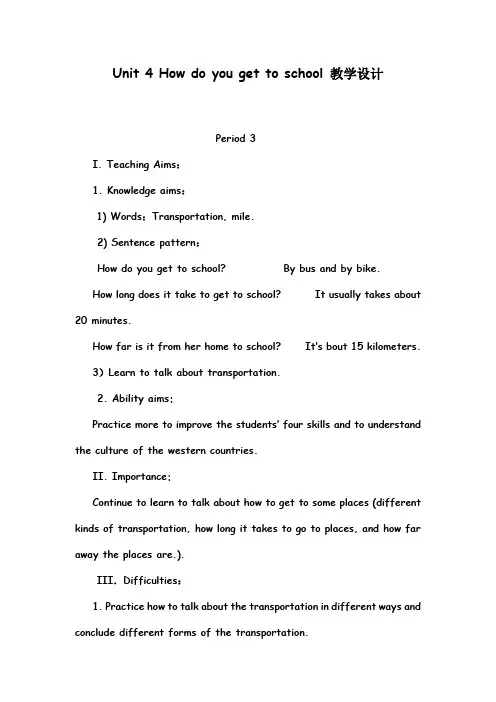
Unit4How do you get to school 五
- 格式:doc
- 大小:55.50 KB
- 文档页数:4
minute, kilometer, mile, transportation , calendar
新
知
导
学
一.英汉短语互译:
1. get to school2. get home
3.….怎么样?4. take the subway
5.骑自行车6.乘公共汽车
7. take the train8.have a quick breakfast
板
书
设
计
Unit 4 How do you get to school?
Revision
Phrases Sentences
get home
get to school
take sb.to…
课
后
记
5.从他家到学校有多远?大约10公里。
8.从地球到月球有多远?大约38万公里远。
9.本溪到沈阳有多远?大约70公里远。ቤተ መጻሕፍቲ ባይዱ
10. Lin Fei’s home is about 10 kilometers from school.
11.He leaves for school at around six-thirty.
技
能
演
练
翻译下列句子:
1.你是怎样到校的?我步行。
2.李平怎样到校的?骑自行车。
3.火车什么时候到站?
4.我们是今天早上到上海的。
5. How about the white shirt?
6. I usually walk but sometimes I take the bus.
7.How long does it take you toget to school? It takes aboutminutes to walk and 15 minutes by bus.
4). Point out the mistakes and explain them.
Step 4 Homework
1). All the students recite the words and the drills.
2). Make a survey about your parents .
20. InJapan, most students take trains to school, although others also walk or ride their bikes.
21.在中国,这要看你住在哪里。
授课
题目
Unit 4 How do you get to school?
Revision
课型
Revision
教具
Recorder
教法、学法及
个性化设计
授
课
过
程
Step 1 Warm-up
Morning report:
Describe how far your home is from school
Step 2 Sum-up
1). Review the old words .
2). Review the old phrases.
第四周第5课时编号:20
学科
英语
年级
八年级
设计者
孙秀华
授课
题目
Unit 4 How do you get to school?
Revision
学习
目标
学会谈论交通工具
合理安排行程,并合理选用交通工具
重点
难点
谈论交通方式
课前
准备
预习Selfcheck 1.2
知
识
点
讲
解
How do you get to school? I take the bus.
How long does it take? It takee20 minutes.
How far is it? It’s 10 miles.
get to, how far./ bicycle, subway, car, train.
bus stop, train station, bus station, subway station
12.我们不会离开北京到大连市。
13. Then the early bus takes him to school.
14.请把书带到学校来。
15.张强把水果从书包里拿了出来。
16.托马斯想要知道尼娜住在哪里。
17.老师想知道她住的地方离学校有多远。
18.李平想知道到学校需要多长时间。
19.他们想知道他通常怎样到校。
3). Review the old drills.
Step 3 Self Check
1).Finish the exercises.
2). Ask the students to say out the answers to the questions.
3). Check the answers.
9.早班车13. how far10. take sb. to sp.
11. want to do sth.12.步行上学
13. in North America14.在世界的其他地区
15. depend on=depend upon16. not all不是所有的
17. need to do sth.18. number of students
新
知
导
学
一.英汉短语互译:
1. get to school2. get home
3.….怎么样?4. take the subway
5.骑自行车6.乘公共汽车
7. take the train8.have a quick breakfast
板
书
设
计
Unit 4 How do you get to school?
Revision
Phrases Sentences
get home
get to school
take sb.to…
课
后
记
5.从他家到学校有多远?大约10公里。
8.从地球到月球有多远?大约38万公里远。
9.本溪到沈阳有多远?大约70公里远。ቤተ መጻሕፍቲ ባይዱ
10. Lin Fei’s home is about 10 kilometers from school.
11.He leaves for school at around six-thirty.
技
能
演
练
翻译下列句子:
1.你是怎样到校的?我步行。
2.李平怎样到校的?骑自行车。
3.火车什么时候到站?
4.我们是今天早上到上海的。
5. How about the white shirt?
6. I usually walk but sometimes I take the bus.
7.How long does it take you toget to school? It takes aboutminutes to walk and 15 minutes by bus.
4). Point out the mistakes and explain them.
Step 4 Homework
1). All the students recite the words and the drills.
2). Make a survey about your parents .
20. InJapan, most students take trains to school, although others also walk or ride their bikes.
21.在中国,这要看你住在哪里。
授课
题目
Unit 4 How do you get to school?
Revision
课型
Revision
教具
Recorder
教法、学法及
个性化设计
授
课
过
程
Step 1 Warm-up
Morning report:
Describe how far your home is from school
Step 2 Sum-up
1). Review the old words .
2). Review the old phrases.
第四周第5课时编号:20
学科
英语
年级
八年级
设计者
孙秀华
授课
题目
Unit 4 How do you get to school?
Revision
学习
目标
学会谈论交通工具
合理安排行程,并合理选用交通工具
重点
难点
谈论交通方式
课前
准备
预习Selfcheck 1.2
知
识
点
讲
解
How do you get to school? I take the bus.
How long does it take? It takee20 minutes.
How far is it? It’s 10 miles.
get to, how far./ bicycle, subway, car, train.
bus stop, train station, bus station, subway station
12.我们不会离开北京到大连市。
13. Then the early bus takes him to school.
14.请把书带到学校来。
15.张强把水果从书包里拿了出来。
16.托马斯想要知道尼娜住在哪里。
17.老师想知道她住的地方离学校有多远。
18.李平想知道到学校需要多长时间。
19.他们想知道他通常怎样到校。
3). Review the old drills.
Step 3 Self Check
1).Finish the exercises.
2). Ask the students to say out the answers to the questions.
3). Check the answers.
9.早班车13. how far10. take sb. to sp.
11. want to do sth.12.步行上学
13. in North America14.在世界的其他地区
15. depend on=depend upon16. not all不是所有的
17. need to do sth.18. number of students