英语语调用法讲解学习
- 格式:doc
- 大小:45.50 KB
- 文档页数:9
英语语调用法英语语调用法歌诀竹板一打声声高,我给大家唱语调。
英语语调并不难,请把规则记心间。
高就高,低就低,抑扬顿挫要牢记。
升调降调莫乱用,表达不同的意义。
陈述感叹祈使句,句末降调来达意。
特殊问句也一样,句末语调向下降。
一般问句要记清,句末语调往上升。
选择问句前后分,句末降调or前升。
反意问句要分清,升调降调有两种:若表疑问用升调,加强语气降调用。
以上属于一般情(况),特殊情况看语境。
降调往往表示"完成"、"确定"等意思,升调往往表示"未完成"、"疑惑"等意思。
课中讲升调时举的两例都是一般问句。
这里我们学习许编《英语》一册第13课第96页的"一般问句"及其语调部分。
要结合实例不断训练,掌握一般问句及其回答的语调讲的四大特点。
第二点讲的"动词 to be, to have或助动词to do通常都重读",初学者可这样。
但如今人们讲话时往往不重读了。
第四点要补充的是如后跟副词not时就不重读, not重读。
如与not紧缩在一起时就重读,如:isn't , don't等。
"特殊问句语调"(P.110) 在语音上:1)两类疑问词,无论疑问副词还是疑问代词,都有语句重音;疑问词又处句首,都是句子的第一个重音,声调最高,由此递降。
2)不同于一般问句,一切特殊问句的句尾语调都为降调。
学生要好好朗读所举的例句,并做相应的回答,熟悉和逐步掌握特殊问句在语音上的特点。
祈使句在语音上,一般读降调。
有时为了缓和强硬的语气,表示不强迫,也可用升调。
注意小品词please在句中的前后位置及是否有语句重音。
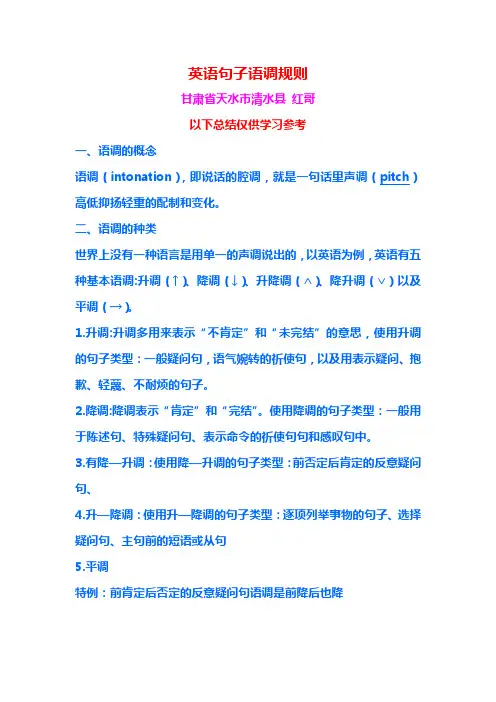
英语的语调总的特点是,全句的调子一般都是由高逐渐降低,语调主要表现在句末,升调和降调通常分别用“↗”和“↘”来表示。
(1)升调升调常用来表示不肯定,语意未完,或表示礼貌,常有含蓄、委婉、安慰、虚心征求意见等意味。
升调的用法可归纳为以下五种情况:①一般疑问句通常用升调。
Is he `making a ↗kite?Are they `cleaning the ↗classroom?Was the `traffic `very ↗busy?.Does your `uncle `like `making `things, ↗too?Did he `go `there `alone `last ↗night?Must we `wash our `clothes ↗now?Has your `father` finished the `work ↗yet?②数数、列举事物或列举一连串的动作时,除最后那个并列成分用降调外,前面所有的并列成分都要用升调。
`Let’s `count our `new ↘books. ↗One, ↗two, ↗three, ↗four, ↘five. `Oh, we have ↘five new books.We’d `li ke a `bottle of ↗coke, `two `bottles of `apple ↗juice, a ↗hamburger and `two ↗cakes.`John `likes ↗running, ↗swimming and ↘skating, but he `doesn’t like playing ↗football, ↗basketball or ↘volleyball.He `got ↗up, `got ↗dressed, `brushed his ↗teeth, `washed his ↗face, `had his ↗breakfast, and `then `quickly `went to ↘school.The `old `man `came ↗in, `asked for a `cup of ↗tea and `sat `down at a ↘table.③选择疑问句的语调分为两个部分,or前的部分用升调,or后的部分用降调,记成“前升后降”。
Is her `answer ↗right or ↘wrong?Were they in the `high ↗jump or the `long ↘jump?Would you `like a `cup of ↗tea or a `glass of ↘milk?Do you `go to `school ↗late or ↘early?`Which `colour do you `like `better, `light ↗blue or `dark ↘blue?`Which do you pre`fer, `going to the ↗cinema or `going ↘swimming?④反意疑问句的语调也得分两种情况:若说话者对所陈述的内容没有把握,想询问对方这一廉洁是否正确,则陈述句部分用降调,简略问句用升调;若说话者对所陈述的内容已经很有把握,只是想要对方同意自己的观点,或是想从对方那里得到证实,则前后两部分都用降调。
--Your `uncle is ↘tall, ↗isn’t he? --↘No, he’s very ↘short.You `like ↘apples, ↗don’t you?He `went to `London with his ↘family, ↗didn’t he?-- You `won’t `go `there to↘morrow, ↗will you? -- ↘Yes, I ↘will.-- His `sister has `never been to ↘Beijing, ↗has she? -- No, she↘hasn’t.-- It’s a ↘fine day, ↘isn’t it? -- `Yes, it ↘is.It’s `quite a `nice ↘picture, ↘isn’t it?You were `born in `19`89. So you are ↘fifteen, ↘aren’t you?⑤含状语从句的复合句的语调也要分两种情况:若主句在前,从句在后,主句结束时意思已比较完整,则通常用降调,整个句子读完时也应该用降调;但是,若从句在前,主句在后,则常常是“前升后降”。
I was `drawing a ↘picture when my `mother `came ↘back.`When she `got to the ↗station, the `train had `already ↘left.(2)降调在英语句子中,降调的使用比升调更为广泛,它表示肯定、决断、坚决或终结,但有时含有生硬、不容质疑的意味。
降调的用法可归纳为以下七种:①陈述句用降调:`Lucy is `cleaning her ↘bedroom.`Li `Lei `doesn’t have a ↘watch.I `like ↘swimming.I’ve been to `Bei`jing `only ↘once.②特殊疑问句也用降调:`Whose is `this ↘coat?`What `happened to her ↘car?`Which `shirt do you ↘like?`Where does your `English `teacher ↘come from?`When is `Teachers’ ↘Day?`Why `didn’t `Jim `come to `school ↘yesterday?`How `long have you been at `this ↘school?③表示命令的祈使句也常用降调:`David, `open the ↘door.Go and `ask your ↘father.`Put `on your ↘coat.`Don’t `throw it on the ↘floor.`Don’t `put your `feet on the ↘desk.`Don’t `run `so ↘fast.`Let’s `go to the ↘zoo.`Let’s `go and `have a ↘look.④问候用语常用降调,以示真诚:Good ↘morning.Good ↘afternoon.How ↘are you?Good ↘evening.⑤感谢用语也常用降调,以表示诚挚的谢意:↘Thank you.⑥感叹句用降调:What a ↘lovely day!What a ↘terrible day I spent today!`How ↘hot it is today!⑦在并列句中,并列连词and, but, or等的前后两上分句都用降调:We `come to `school by ↘bus and he `comes by ↘bike.`Let’s ↘run, or we’ll be `late for ↘school.I `could n’t `sleep `well `last ↘night, so I’m `very `tired to↘day.(3)特殊语调现象在日常口语中,人们除了使用规范的语调外,还经常灵活地运用语调,以表达自己的不同态度、感情、情绪、意图以及隐含意义。
①不同语调的“yes”↘Yes. (降调表示同意对方的观点)↗Yes?(升调表示疑问,意为“真的吗?”或“是吗?”。
若在回答对方的呼唤时使用,则意为“什么事?”或者“怎么啦?”)②两种味道的“all right”`All ↗right.(升调,正常的语调,意为“好吧”)`All ↘right! You `shall re`pent ↘this.(降调,带有威胁的口气,意为“好!以后不要懊悔!”)③两种味儿的感谢用语↘Thank you.(降调,表示真诚的感谢。
)↗Thank you.(升调,出于礼貌而说的客气话。
)④你喜欢哪种问候?Good ↘morning.(降调,此乃真诚的问候)Good ↗morning.(升调,这是较熟的朋友之间漫不经心的问候)⑤特殊疑问句用升调表示亲切、礼貌、友好和关切。
`What can I ↗do for you?`How are you, ↗Lily?⑥祈使句用升调表示委婉客气的请求。
`Come `in and `have a `cup of `tea, ↗please.`Beg your ↗pardon.⑦陈述句用升调表示疑问、抱歉或含蓄的隐含意义。
You have a `new ↗watch!I `can’t `help you `this ↗evening.I `don’t `think ↗so.(句意为“我不这样认为”,但隐含意义却为“我把握不大”。