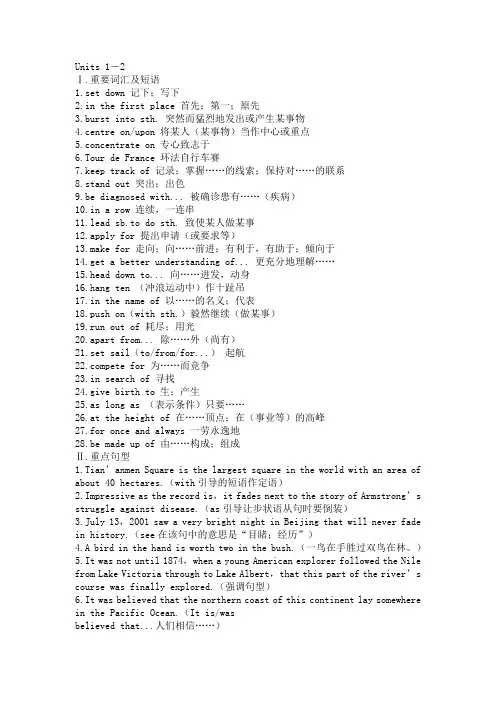
高中英语重点短语词组句子
- 格式:doc
- 大小:25.34 KB
- 文档页数:4
高中英语重点短语词组句子
Mastering the English language is a crucial aspect of academic and
professional success, particularly for high school students who are
preparing to navigate the challenges of higher education and the
workforce. One of the key elements of this linguistic proficiency is
the command of essential phrases, expressions, and sentences that
are commonly encountered in the realm of high school English.
These linguistic building blocks serve as the foundation for effective
communication, reading comprehension, and written expression.
At the heart of this linguistic proficiency lies the understanding and
appropriate usage of key phrases, expressions, and sentences. These
linguistic elements are not merely isolated units of language but
rather, they represent the nuanced and contextual nature of
communication. They convey subtle shades of meaning, tone, and
style that can significantly impact the overall effectiveness of one's
language skills.
One of the most fundamental aspects of high school English is the
mastery of common phrases and expressions. These linguistic units often transcend the literal meaning of individual words and carry a
deeper, more idiomatic significance. For instance, the phrase "to hit
the books" does not actually refer to physically striking books but
rather, it conveys the idea of diligently studying or preparing for an
exam. Similarly, the expression "to be on the same page" does not
imply a literal physical position but rather, it suggests a shared
understanding or alignment of perspectives.
In addition to these idiomatic expressions, high school English also
emphasizes the importance of constructing well-structured
sentences that effectively convey one's ideas. This includes the ability
to craft complex sentences that incorporate various grammatical
elements, such as dependent clauses, participial phrases, and parallel
structures. These sophisticated sentence structures not only enhance
the clarity and coherence of one's writing but also demonstrate a
refined command of the language.
Moreover, high school English curriculum often places a strong
emphasis on the usage of academic vocabulary and formal language.
This includes the appropriate application of subject-specific
terminology, as well as the ability to employ precise and concise
language in both written and oral communication. Students are
expected to move beyond the colloquial or informal language used
in everyday conversations and to adopt a more formal and
sophisticated linguistic style that is suitable for academic and professional settings.
One of the key challenges faced by high school students in
mastering these linguistic elements is the need to recognize and
understand the contextual nuances that govern their usage. For
instance, the phrase "I could care less" may be commonly used in
casual speech, but in academic writing, the more appropriate
expression would be "I couldn't care less." Similarly, the sentence
structure "It is believed that..." is often preferred in formal writing
over the more conversational "I believe that..." These subtle
distinctions require a deep understanding of the linguistic norms and
conventions that are expected in high school English.
To effectively navigate the linguistic landscape of high school English,
students must engage in a multifaceted approach that combines
extensive reading, targeted practice, and thoughtful reflection. By
immersing themselves in a wide range of literary and informational
texts, students can develop a keen awareness of how these key
phrases, expressions, and sentences are employed in context.
Furthermore, regular practice in both written and oral
communication allows students to internalize the appropriate usage
of these linguistic elements and to refine their overall language skills.
Additionally, students should actively seek feedback and guidance
from their teachers, who can provide valuable insights into the nuances of high school English and offer constructive criticism on
areas for improvement. This collaborative approach, coupled with a
willingness to learn and adapt, can greatly enhance a student's ability
to master the linguistic complexities of high school English.
In conclusion, the mastery of key phrases, expressions, and sentences
is a crucial component of success in high school English. By
developing a deep understanding of these linguistic elements and
their contextual usage, students can enhance their overall
communication skills, improve their academic performance, and lay
the foundation for future success in higher education and the
professional world. Through a combination of dedicated study,