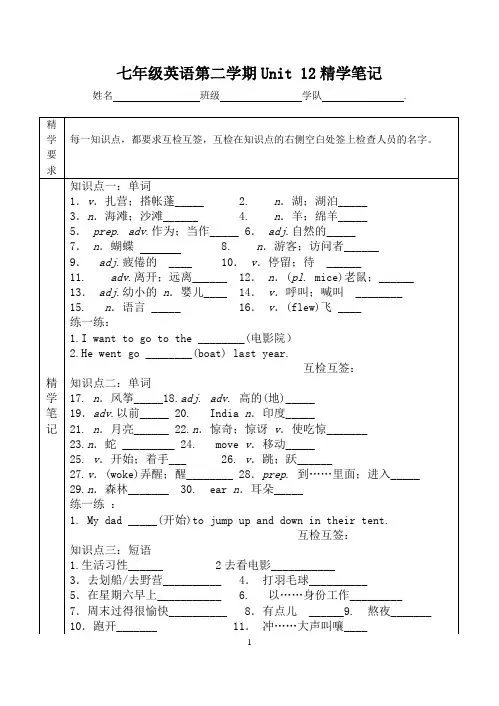
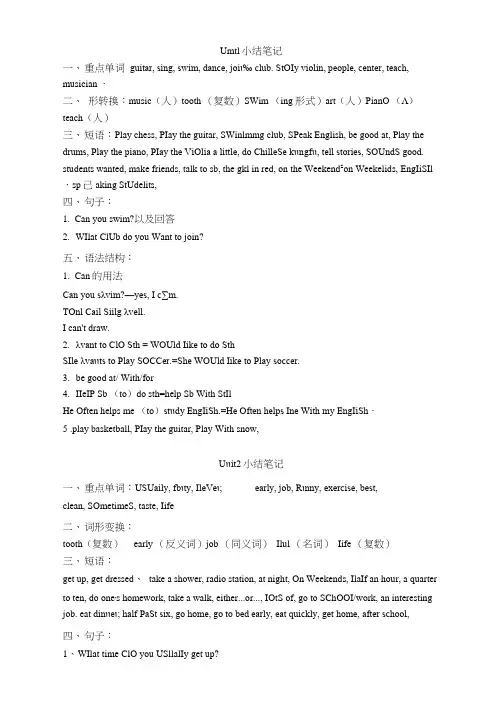
人教版七年级下册英语1-12单元学霸笔记
- 格式:docx
- 大小:27.03 KB
- 文档页数:14
人教版七年级下册英语1-12单元学霸笔记
Unit1小结笔记
一、重点单词guitar, sing, swim, dance, join, club, story, violin,
people, center, teach, musician.
二、形转换:music(人) tooth(复数)swim (ing形式)art(人)
piano (人) teach(人)
三、短语:play chess, play the guitar, swimming club, speak
English, be good at, play the drums, play the piano, play the violin,
a little, do Chinese kungfu, tell stories, sounds good, students
wanted, make friends, talk to sb, the girl in red, on the
weekend/on weekends, English-speaking students,
四、句子:
1. can you swim?以及回答
2. what club do you want to join?
五、语法结构:
1. can 的用法
Can you swim?—yes, I can.
Tom can sing well.
I can’t draw.
2. want to do sth = would like to do sth
She wants to play soccer.=She would like to play soccer.
3. be good at/ with/for
4. help sb (to)do sth=help sb with sth
He often helps me (to)study English.=He often helps me with
my English.
5.play basketball, play the guitar, play with snow,
Unit2小结笔记
一、重点单词:usually, forty, never, early, job, funny, exercise,
best, clean, sometimes , taste, life 二、词形变换:
tooth(复数) early (反义词)job(同义词)run(名词)life(复数)三、短语:
get up, get dressed, take a shower, radio station, at night, on
weekends, half an hour, a quarter to ten, do one’s homework,
take a walk, either…or…, lots of, go to school/work, an interesting
job, eat dinner, half past six, go home, go to bed early, eat quickly,
get home, after school,
四、句子:
1、what time do you usually get up?
2、when does she go to work?
3、I sometimes play basketball for half an hour.
4、that’s a funny time for breakfast.
五、语法结构:
1、when/what time +do/does+主语+动词原形+其他?
2、时间表达法:
顺读法如:7:20读作seven-twenty
倒读法:此方法是“先读分钟数”,再读“钟点数”,使用此方法要注意两点:A、如果分钟数在30以内,就用“分钟数+past+钟点数”表示,介词past意为“过”。如:6:10读作ten past six.
B、当分钟数正好是“三十分钟”时,可用“顺读法”中的“钟点数+thirty”,也可用“half+past+钟点数”。如:7:30可读作seven
thirty或half past seven.
C、如果分钟数超过30,则用“(60-分钟数)+ to +(钟点数+ 1)”来表示,介词to为“差”的意思。如:6:35读作twenty-five to
seven (差二十五分钟到七点)
D、在“倒读法”中,当分钟数涉及到“15分钟”时,一般不用fifteen,而用a quarter(一刻钟)来表示。如:10:15读作a quarter
past ten (一般不读fifteen past ten)
3、job与work 辨析 job是可数名词, 主要指有报酬的工作。work是不可数名词, 鲍勃想找一份好的工作。Bob wants to find a good ____.
4、be late for 意为“做……迟到”Tom is always ____ ____
school.
5、lots of/many/much
.这三个词都有“许多;大量”之意,但用法不同。
1) lots of ,后面可以跟可数名词也可以跟不可数名词。如:
He doesn’t have lots of (=many) books. We have lots of
(=much) work to do.
2) many与可数名词复数形式连用。如:There are many apples
in the basket.
3) much表示数量时,只能修饰不可数名词。如:We don’t
have much milk.
6、either… or… 意为“或者……或者…… ”
You can either play chess or play the guitar.你可以下棋或者弹吉它。
当either…or…连接两个名词作主语时,谓语动词的时态和数应与最近的一个相匹配。Either you or he is right. 不是你对就是他对。
Unit3小结笔记
一、重点单词:
subway, hundred, minute, kilometer, drive, village, between,
bridge, afraid, dream 二、词形变换:
far反义词new 反义词by 同音词drive名词cross形容
词village人ride单三walk同义词组quick 副词
三、短语:
take the subway, ride a bike, every day, by bike, think of,
between…and…, come true, get to school, one hundred and five,
have a good day, how long, how far, bus station, go to work, get
home, half an hour, be far from, ride a bike to school
四、句子: 1.how do you get to school?
2. how long does it take(to get to school)?
3.how far is it (from your home to school)?
五、语法结构:
1. How do/does + 某人+ get to+地点? 问某人怎么去某地? 你叔叔是怎么样去香港的?
回答方式有两种:
A: 某人+ take(s) + the/a交通工具+ to 某地。B: 某人+ get(s) to
某地+ by +交通工具
我叔叔乘飞机去香港。___________________________________
B.乘坐某种交通工具去某地
take + the/a + 交通工具+ to + 地点= get/go to + 某地+ by +
交通工具He often takes the subway to work.
= He goes to work by subway.
2.如果对时间段提问的话,就用
How long + does it take sb. to do sth.?句型。
对两地间的距离提问下列句型:
How fa+ is it from某地to 某地?
3.cross =go across横过; 穿越(指横向穿过马路、河等)
Look careful before you cross(go across) the road. 过马路前要细心看
4.it’s easy to get to school. It’s +adj.+to do sth
5.There be(is/are)+sth+地点There is a book on the desk.
6. Between … and … 在……与……之间
between 是个介词,表示在两者之间。
如:Mary is between Jane and Linda in the line.在队伍中,玛丽在简和琳达之间。
7. year 年;年纪
Mary is only six years old. 玛丽仅六岁。
Tom is an eight-year-old boy. 8. like 像
like 在这里作介词,而不是动词。
The fish looks like a big boat.那条鱼看起来像条船。(介词)
Jane likes history very much.简很喜欢历史。(动词)
Unit 4 Don’t eat in class.
一、重点单词:rule, arrive, fight, outside, important, quiet,
practice, before, dirty, kitchen, noisy, terrible, remember, luck,
learn
二、词形变换:
Outside(反义词) wear (同音词) important(名词) before(反义词)
dirty(反义词) noise (形容词) relax(形容词) luck(形容词) friend (形容词) happy(反义词)三、短语:
dining hall餐厅,listen to听,in class课堂上in the dining hall在餐厅,be quiet=keep quiet安静,don't arrive late for…=don’t be
late for... 不要…迟到wear a hat /the school uniform穿着帽子/穿着校服bring …to… 带…到(给)…on time准时(按时)have to,has to 不得不,go out 外出(娱乐)don't(doesn’t) have to do …=needn’t....不必做……do the dishes=wash the dishes清洗餐具practice the