河北大学研一英语期末考试第一单元
- 格式:doc
- 大小:495.50 KB
- 文档页数:12
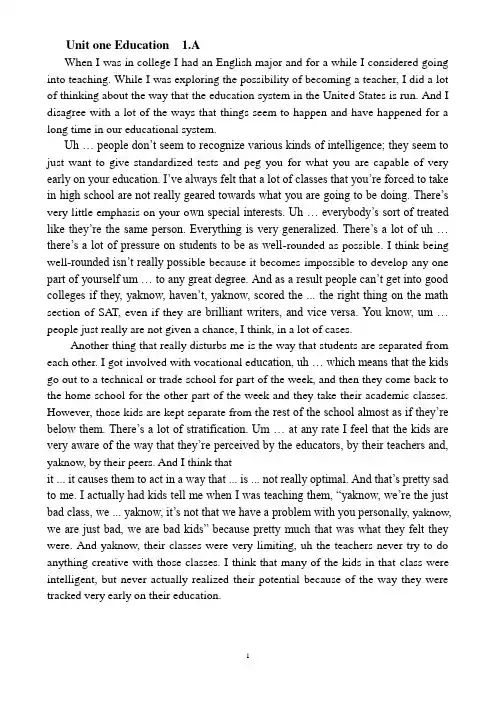
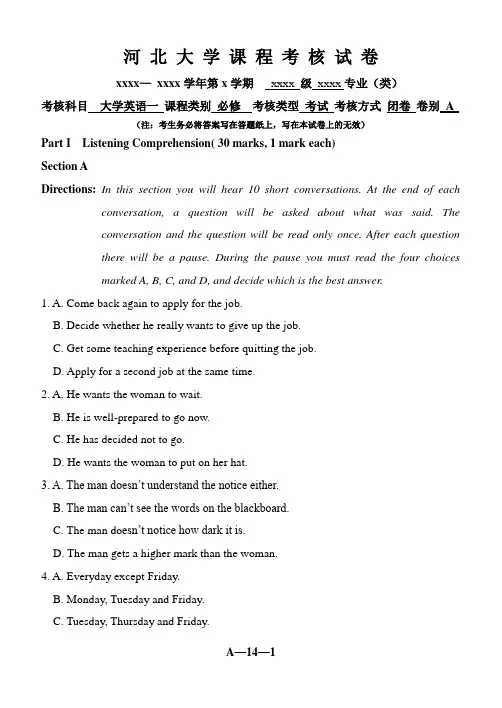
Unit one Education 1.AWhen I was in college I had an English major and for a while I considered going into teaching. While I was exploring the possibility of becoming a teacher, I did a lot of thinking about the way that the education system in the United States is run. And I disagree with a lot of the ways that things seem to happen and have happened for a long time in our educational system.Uh … people don’t seem to recognize various kinds of intelligence; they seem to just want to give standardized tests and peg you for what you are capable of very early on your education. I’ve always felt that a lot of classes that you’re forced to take in high school are not really geared towards what you are going to be doing. There’s very little emphasis on your o wn special interests. Uh … everybody’s sort of treated like they’re the same person. Everything is very generalized. There’s a lot of uh … there’s a lot of pressure on students to be as well-rounded as possible. I think being well-rounded isn’t really poss ible because it becomes impossible to develop any one part of yourself um … to any great degree. And as a result people can’t get into good colleges if they, yaknow, haven’t, yaknow, scored the ... the right thing on the math section of SAT, even if they a re brilliant writers, and vice versa. You know, um … people just really are not given a chance, I think, in a lot of cases.Another thing that really disturbs me is the way that students are separated from each other. I got involved with vocational ed ucation, uh … which means that the kids go out to a technical or trade school for part of the week, and then they come back to the home school for the other part of the week and they take their academic classes. However, those kids are kept separate from t he rest of the school almost as if they’re below them. There’s a lot of stratification. Um … at any rate I feel that the kids are very aware of the way that they’re perceived by the educators, by their teachers and, yaknow, by their peers. And I think thatit ... it causes them to act in a way that ... is ... not really optimal. And that’s pretty sad to me. I actually had kids tell me when I was teaching them, “yaknow, we’re the just bad class, we ... yaknow, it’s not that we have a problem with you person ally, yaknow, we are just bad, we are bad kids” because pretty much that was what they felt they were. And yaknow, their classes were very limiting, uh the teachers never try to do anything creative with those classes. I think that many of the kids in that class were intelligent, but never actually realized their potential because of the way they were tracked very early on their education.1.BMargaret Warner:Mr. Unz. Why do you believe that bilingual education should be scrapped?Ron Unz: Well, the overwhelming practical evidence is that bilingual education has failed on every large scale case that’s been tried in the United States, in particular in California. The origins of this initiative was the case last year of a lot of immigrant Latino parents in downtown LA, who had to begin a public boycott of their local elementary school to try to force the school to give their children the right to be taught English, which the school was denying. And I think that really opened my eyes to the current state of the program in California, where the statistics are dreadful. Margaret Warner: Mr. Lyons.Janies Lyons: It is not the case that bilingual education is failing children. There are poor bilingual education programs, just as there are poor programs of every type in our schools today. But bilingual education has made it possible for children to have continuous development in their native language, while they're in the process of learning English, something that doesn't hap pen overnight, and it’s mad e it possible for children to learn math and science at a rate equal to English-speaking children while they’re in the process of acquiring English.Margaret Warner: Mr. Unz, what about that point —for these children who don't speakEnglish well they will fall behind in the basic subjects if they can't be taught those in Spanish, or whatever language? I shouldn’t say just Spanish, but whatever their family’s language is.Ron Unz: That’s a very reasonable point. And to the extent that we’re talking about older children. 14 or 15 year olds who come to the United States, don't know any English and are put in the public schools I think a very reasonable case can be made for bilingual education. I don’t know if it’s correct, but at least you can make a case for it. But most of the children we're talking about enter California or America public schools when they’re five or six or seven. At the age of five years old, the only academic subjects a child is really doing is drawing with crayons or cutting and, you know, with paper and that type of thing. And at that age children can learn another language so quickly and easily that the only reasonable thing to do is to put them in a program where they're taught English as rapidly as possible and then put into the mainstream classes with the other children so they can move forward academically. Margaret Warner: There is something to that point, isn’t there, Mr. Lyons, that very youngchildren do absorb languages very quickly?James Lyons: They absorb certain facets of language very quickly. They learn to speak in an unaccented form like a native English speaker. But the research shows that actually adults are much more efficient and quicker language learners than children because they're working from a broader linguistic base, a greater conceptual base. I really take objection to what Mr. Unz is saying that children at the age of five, six, and seven are only coloring and cutting out paper. That isn't going to lead to the high standards.2.AInterviewer: Professor Gardner, what did you find in your studies to be the biggest difference between arts education in the United States and arts education in China? What struck you most, then?Gardner:I was so struck by the differences between arts education in the United States and arts education in China. US youngsters love to explore and think that they explore very well; and yet, without the requisite discipline, their products are typically of little interest ─except perhaps to their doting parents.Education in all of the arts in China is very precisely prescribed. Teachers and parents know exactly what they want children to be able to do and they know how to get the desired behaviour and performance in almost perfect fashion. On the other hand, there is little free exploration.But I must add another surprise. When young children in China were given a novel task in the arts, they performed very well. Before visiting China, I had thought that young people must always begin with a period of free exploration, before they begin to acquire discipline and skills.After visiting China and thinking about what I had seen, I came to a different conclusion. It is not important that one “explore” first; what is important is that one has a significant period for exploration, either before, during, or after one has acquired some discipline.Interviewer:As you might have noticed, these days after-school classes in music, dance, painting and calligraphy are very popular in China, although many of the “young emperors” might not be so willing to learn all these “extra skills.” What’s your opinion on this?Gardner: The fewer children you have, and the more resources at your disposal, the more likely you are to give your children every form of enrichment. China has thousands of years of history of encouraging talent development, so it not at all a surprise that many kids are taking after-school arts classes. But what children do when their parents push them, is very different than what they do when they grow up, and their parents are no longer in control of the rewards and punishment. By and large, thosegrown-up students who continue their area of talent are those who use the talent professionally and those who gain intrinsic pleasure from the activity. Interviewer:In recent years, art museums and community arts centres have been mushrooming in China as the country experiences rapid modernization and internationalization. How do you balance arts education in schools and arts education beyond school walls?Gardner:It is entirely to the good that students now have opportunities to learnabout the arts outside of class ─in museums, in children’s palaces, through the electronic media, community centres, and outdoor installations. Very often children learn much more comfortably and perso nally in what we call “informal educational settings.”Optimally, there should be a division of labour between schools and informal settings. As just one example: Schools could focus more on providing history and cultural background ─whereas museums might provide the opportunity to learn about special topics, or probe into a topic more deeply.2.BAnn: Do you find there’s much opportunity... to do other things, besides studying, during term- time? I mean, if you have a, a very academic course, you say the social life is good, but you might not always have time to, er, enjoy it, if you ... have a lot... Ian: Not being a very academic course, I wouldn’t know.Ann: How about you, Tony?Tony: I suppose ... a business course isn’t particularly academic, if you like, but, er, I certainly find quite enough time to do newspapers and ... all I want to do on the social side. [Yes] Go to dances and so, on.Ian: But then you work till five in the morning, don’t you? [Laughter]Tony: Let’s not bring personalities into this!Ann: D'you think that a lot of students, are interested in producing things like newspapers and plays and writing poetry?Tony: No, but a lot of students like to have those things and a few students like to do them. This is why, I mean if you had—out of a college of, what is it, fifteen hundred students —if you had five hundred students going along to the Drama Club on the first week of term ... they try and mount two productions out of five hundred people. It’d be absolutely impo ssible. Yet, there are those, the sufficient people to see, what is it, twenty, thirty people, doing those productions. It’s the same with the newspaper. Ann: Yes. But erm, I think this is because more students haven’t got the confidence to show the work they do. I think a lot of students write things and paint, in the background, and just don’t like to er ...Ian: Er, I think, I think myself, they’re just not interested, in [You don’] sort of taking part in joint efforts. They prefer just to erm, well, they might write poetry on their own or something, but they were asked to write something for a newspaper, they wouldn’t be interested.Ann: Is this because the courses are too difficult? They have too much academic work, as I said before?Tony: I think i t’s all psychological, to bring a nice big word into it! Erm ... those students think they shouldn’t do it, because they think they won’t have [Mm] time and so on. I think this is the thing. It’s not a question of not having enough time. It’s just organizing it. I mean, Ian says I stay up till five in the morning or whatever, you know, never go to bed till two. [Yes] You can, if you, if you’re determined to do something, you can arrange it. You can say, “Okay, I’ll do the newspaper between lectures finishin g at four, or whatever, and go home at six”, and you have two hours a day on the newspaper, say. You know, [Yes] just, say, this is a way of organizingthings. A lot of other students will say at four, “Oh dear, I must go on working, but before that I must have a break”. And they spend two hours in a coffee bar. Okay, this [laughter] is the way they want to organize their time. [Yes] They spend it... you know ... it’s just that I want to do it doing newspaper, whereas other students want to drink coffee.Ann: So, in other words, students have an awful lot of freedom of choice on how they organize their social life and how they organize their working life, how they spend their money. And I think this is erm, one of the ideal things about being a student.Ia n: You’re not tied down by anything. You just do more or less as you please, within the framework of going to lectures, or the majority of lectures.Ann: Yes, that’s right, I mean, I, I have worked before and erm ... although I had, theoretically, a lot more free time ... erm ... it was only within certain hours, you know, after working hours, and at weekends, [Mm] and this isn’t what I call free time. You know, I mean, at the moment with lectures, you can take off two or three hours during the afternoon a nd go to see an art exhibition. Whereas if you’re ... erm, working all week, you have to restrict it to weekends when the art gallery is ... crowded with the weekend trippers and, [Mm. Mm.] and it’s quite unpleasant.3.ADaniel Denecke: Hello and welcome! Thank you for the opportunity to speak to so many of you about the issues facing graduate education today.Virginia: Hi, Daniel. My company recently hired a lot of PhDs. Many have good research skills, but no social skills and no working experiences besides academic experiences. Maybe universities can do a better job to address this issue.Daniel Denecke: This is something that graduate deans are beginning to address now through various professional development programs.At the master’s level, there are many “professional master’s degrees” that combine core, curricular content of a traditional degree with internships and workshops in “soft skills” such as communication, presentation, lab and budget management, etc. New York, N.Y.: Hello Daniel. Isn’t it a little disingenuous to talk about how we need to protect America’s huge production of PhDs when America can’t employ many of those PhDs? When the academic job market is so tight, it seems like perhaps we need to do a better job of screening people out of doctoral programs, rather than accepting so many who will only be disappointed when they can’t get the jobs they want.Daniel Denecke: Some disciplines (History, for example) have attempted to addressthis by limiting enrollments.My own opinion is that a graduate degree is not only about preparing students for a “job” slot that already exists. Graduate degrees are giving people the high level cognitive skills and advanced thinking that will enable them to be flexible and to adapt to an economic world where jobs are always changing. This is why China and India and Europe are so aggressively building up their graduate degree programs. Princeton, N.J.:Hi, I’m very grateful for this Q&A session. I’m an electrical engineering doctoral student in my third year. When I got shoulder-deep into doctoral research. I found it to be arduous and unrewarding, and I’m leaving graduate school without my PhD.My question then is: in the face of 50-60% attrition rates, should we really be handing out fellowships and support to push students right out of undergrad (like myself) who don’t necessarily know what they want to do with their lives? Won’t this worsen the attrition rates? Thank you for your time.Daniel Denecke: One of the things that universities are doing now to try to address exactly the problem you experienced here is to enhance the pre-admission and orientation processes so that students have a better sense of what a career in research entails. For instance, pre-admission summer research opportunities, workshops, peer mentoring, etc.Burke, Va.:Hello, Daniel. Is it better for future career prospects to earn a master’s degree from an online university or to earn a master’s degree from a university where classroom attendance at the university is a compulsory step to graduating?Daniel Denecke: Distance and online graduate education is becoming more and more common. But there is a lot of fluctuation in quality. Some online degrees are very good, and for others the quality is unknown or contested. Regional accreditation is one way of inquiring about how the graduate education community perceived these degrees.113.BSince we’re meeting here at Wisconsin, I'll draw upon a local example of a faculty member who embodies the principle of research and education being two sides of the same “integrated” coin. U.W. plant pathologist Paul Williams invented what are called “Fast Plants” — these go from being a seed to producing seeds in just 35 days. Fast plants were first developed as a research tool for biologists, but have come to be used in science classrooms around the globe. Because the plants grow and develop so fast, students can study the plants’ genetic changes over a semester. Professor Williams says fast plants “became part of a la rger sea-change in the way biology is taught. We measure our success,” he says, “by how much our ideas are adopted and adapted.” What a glowing example of integrating education and research! Throughout my own career, I have had a passion for the integration of teaching and learning with research, within both undergraduate and graduate education. Educating engineers has occupied the greater part of my life. While I was Dean of Engineering at the University of Pennsylvania, we experienced the usual challenges in supporting our graduate students financially as well as intellectually. One mechanism of financial support, still ubiquitous across academe, was to appoint first-year graduate students as Teaching Assistants (TAs), a kind of itinerant labor performed adhoc for pay, and rarely integrated within the students’ research activities. This practice fosters the attitude among students that teaching is some sort of “add-on”, not part and parcel of their doctoral education.However, our Department of Chemical. Engineering implemented quite another approach — to support all first-year graduate students fully the first year, with stipend funds drawn primarily from departmental general funds contributed by the Dean, industry and endowment income. Then, around each student’s third year, he or she would undertake a teaching practicum—first, being given preparation on how to teach and, second, teaching undergrads as a component of the doctoral curriculum. When I tried to institutionalize this paradigm across the school, one argument posed against it was that since the graduate students were partly supported by industrial monies, industry would not want their investment used for a teaching practicum. So. I canvassed a group of CEQs —and 100% of them said they’d love to hire PhDs with both teaching training and experience.Indeed, graduate students today may follow ever more diverse pathways, yet all will need the skills of teaching and learning, whether they end up as professors, practicing in industry, or serving in government.12。