第二讲 供给与需求
- 格式:doc
- 大小:126.00 KB
- 文档页数:9
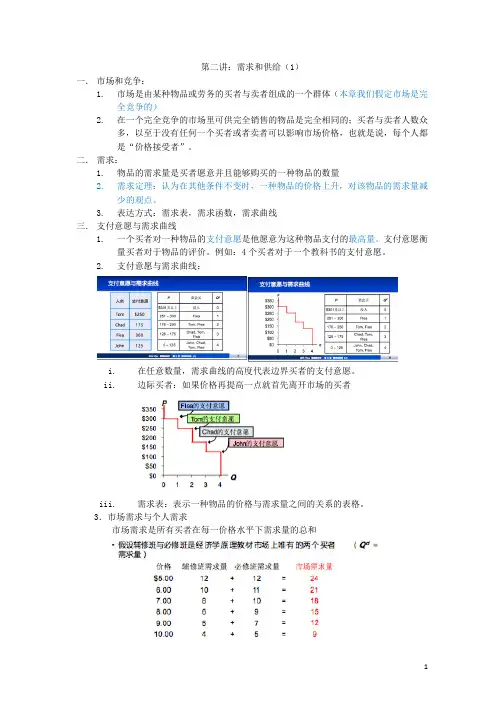
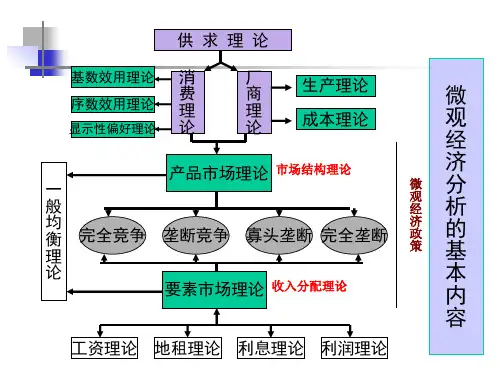
Part II 供给与需求(Supply and Demand)●供求的基本原理●弹性●供求及弹性的应用一、供求的基本原理(Basic Elements of Supply andDemand)1.市场的分类(Market Types)●完全竞争(Perfect Competition)Identical productsNumerous buyers and sellersNo barriers to entryComplete information●垄断(Monopoly)One sellerNo close substitutesBarriers to entry●寡头(Oligopoly)Few sellersSimilar or identical products●垄断竞争(Monopolistic Competition)Many sellersSlightly differentiated productsFree entry2.需求(Demad)Quantity demanded is the amount of a good that buyers are willing and able to purchase.The law of demand states that, other things being equal, the quantity demanded of a good falls when the price of the good rises.demand is the relationship between the quantity demanded of a good and the price of that good.●Demand schedule●Demand curve●Demand function个人需求与市场需求(Market Demand Versus Individual Demand):由个人需求曲线推出市场需求曲线需求量的变化与需求的变化(Change in Qd Versus Change in Demand):沿着一条需求曲线点的位移和整条曲线的移动Variables That Influence Buyers3.供给(Supply)Quantity supplied is the amount of a good that sellers are willing and able to sell.The law of supply states that, other things being equal, the quantity supplied of a good rises when the price of the good rises.supply is the relationship between the price of the good and the quantity supplied.●Supply schedule●Supply curve●Supply function个人供给与市场供给(Market Supply Versus Individual Supply):由个人供给曲线推出市场供给曲线供给量的变化与供给的变化(Change in Qs Versus Change in Supply):沿着一条供给曲线点的位移和整条曲线的移动Variables That Influence Sellers4.供求均衡(Equilibrium of Supply and Demand)Equilibrium refers to a situation in which the price hasreached the level where quantity supplied equals quantity demanded.Equilibrium Price is the price that balances quantity supplied and quantity demanded.Equilibrium Quantity is the quantity supplied and the quantity demanded at the equilibrium price.Law of supply and demand is the claim that the price of any good adjusts to bring the quantity supplied and the quantity demanded for that good into balance.问题: What happens to price and quantity when supply or demand shifts?Three Steps to Analyzing Changes in Equilibrium: •Decide whether the event shifts the supply or demand curve (or both).•Decide whether the curve(s) shift(s) to the left or to the right.•Use the supply-and-demand diagram to see how the shift affects equilibrium price and quantity.二、 弹性(Elasticity )1. 需求弹性(The Elasticity of Demand )需求价格弹性Price elasticity of demand is a measure of how much the quantity demanded of a good responds to a change in the price of that good, which is computed as the percentage change in the quantity demanded divided by the percentage change in price.The Midpoint Method:The Variety of Demand Curves• Inelastic Demand (0<e d p <1)• Elastic Demand (e d p >1)• Perfectly Inelastic (e d p =0)• Perfectly Elastic (e d p =∞)• Unit Elastic (e d p =1)Determinants of the Price Elasticity of Demand: • Necessities Versus Luxuries• Availability of Close SubstitutesPrice elasticity of demand =Percentage change in quantity demanded Percentage change in price Price elasticity of demand =()/[()/]()/[()/]Q Q Q Q P P P P 2121212122-+-+•Definition of the Market•Time HorizonTotal Revenue and the Price Elasticity of Demand:Total revenue is the amount paid by buyers and received by sellers of a good.TR = P x Q•Inelastic Demand(0<e d p<1)if P↑,then TR↑if P↓,then TR↓•Elastic Demand(e d p>1)if P↑,then TR↓if P↓,then TR↑需求收入弹性Income elasticity of demand measures how much the quantity demanded of a good responds to a change in consumers’ income. It is computed as the percentage change in the quantity demanded divided by the percentage change in income.Income elasticity of demand=Percentage change in quantity demanded Percentage changein income需求交叉弹性Cross-Price elasticity of demand is a measure of how much the quantity demanded of a good responds to a change in the price of related goods.• Substitutes, e xy >0• Complements, e xy <0• Independent goods, e xy =02. 供给弹性(The Elasticity of Supply )供给价格弹性Price elasticity of supply is a measure of how much the quantity supplied of a good responds to a change in the price of that good.The Variety of Supply Curves• Inelastic Demand (0<e s p <1)• Elastic Demand (e s p >1)• Perfectly Inelastic (e s p =0)Cross-Price elasticityof demand= △Qx/Qx △Py/Py Price elasticity of supply =Percentage changein quantity supplied Percentage change in price•Perfectly Elastic(e s p=∞)•Unit Elastic(e s p=1)Determinants of the Price Elasticity of Supply:•Ability of sellers to change the amount of the good they produce•Time period3.供求及弹性的应用(Application of Supply, Demand and Elasticity)丰收悖论(Paradox of bumper harvest)“Good news for farming is bad news for farmer.”“The bumper harvest has lowed framer’s income.”价格控制(Price controls)•Price Ceiling is a legal maximum on the price at which a good can be sold.•Price Floor is a legal minimum on the price at which a good can be sold.How Price controls Affect Market Outcomes• a surplus or a shortage•nonprice rationing税收归宿(Tax incidence)Tax incidence is the study of who bears the burden of a tax.How Taxes on Buyers (and Sellers) Affect Market Outcomes: •Taxes discourage market activity.•When a good is taxed, the quantity sold is smaller.•Buyers and sellers share the tax burden.So, how is the burden of the tax divided?•The burden of a tax falls more heavily on the side of the market that is less elastic.。