2013专八真题及各种答案
- 格式:doc
- 大小:92.50 KB
- 文档页数:10
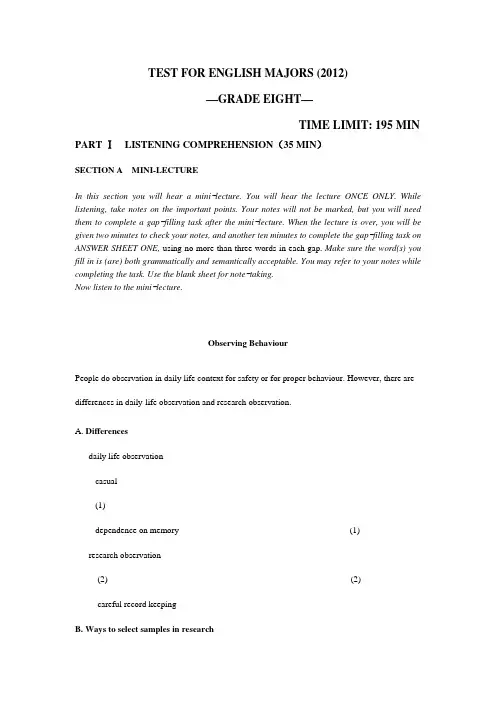
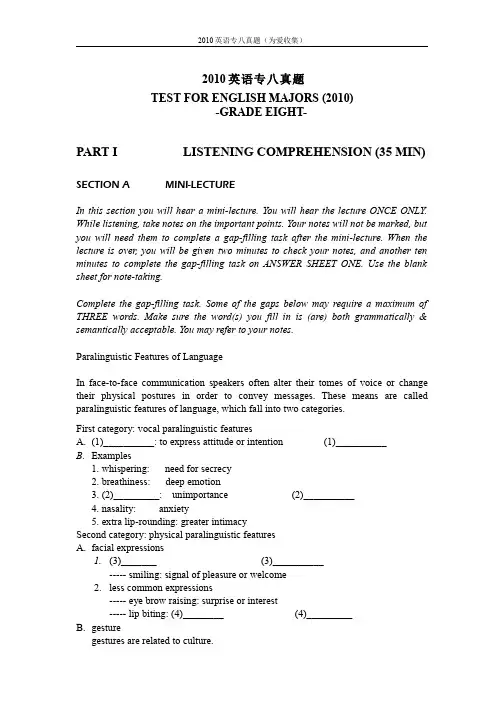
What Do Active Learners Do?
There are difference between active learning and passive learning.
Characteristics of active learners:
I. reading with purposes
A. before reading: setting goals
B. while reading: (1) ________
II. (2) ______ and critical in thinking
i.e. information processing, e.g.
-- connections between the known and the new information
-- identification of (3) ______ concepts
-- judgment on the value of (4) _____.
III. active in listening
A. ways of note-taking: (5) _______.
B. before note-taking: listening and thinking
IV. being able to get assistance
A. reason 1: knowing comprehension problems because of (6) ______.
B. Reason 2: being able to predict study difficulties
V. being able to question information
A. question what they read or hear
B. evaluate and (7) ______.
VI. Last characteristic
A. attitude toward responsibility
-- active learners: accept
-- passive learners: (8) _______
B. attitude toward (9) ______
-- active learners: evaluate and change behaviour
-- passive learners: no change in approach
Relationship between skill and will: will is more important in (10) ______.
Lack of will leads to difficulty in college learning.
1.According to the interviewer, which of the following best indicates the relationship
between choice and mobility?
A.Better education → greater mobility → more choices.
B.Better education → more choices → greater mobility.
C.Greater mobility → better education → more choices.
D.Greater mobility → more choices → better education.
2.According to the interview,which of the following details about the first poll is
INCORRECT?
A.Shorter work hours was least chosen for being most important.
B.Chances for advancement might have been favoured by young people.
C.High income failed to come on top for being most important.
D.Job security came second according to the poll results.
3.According to the interviewee,which is the main difference between the first and the
second poll?
A.The type of respondents who were invited.
B.The way in which the questions were designed.
C.The content area of the questions.
D.The number of poll questions.
4.What can we learn from the respondents’answers to items 2,4 and 7 in the second
poll?
A.Recognition from colleagues should be given less importance.
B.Workers are always willing and ready to learn more new skills.
C.Psychological reward is more important than material one.
D.Work will have to be made interesting to raise efficiency.
5.According to the interviewee,which of the following can offer both psychological
and monetary benefits?
A.Contact with many people. B.Chances for advancement.
C.Appreciation from coworkers. D.Chances to learn new skills
6.According to the news item,“sleep boxes”are designed to solve the problems of
A.airports. B.passengers. C.architects. D.companies.
7.Which of the following is NOT true with reference to the news?
A.Sleep boxes can be rented for different lengths of time.
B.Renters of normal height can stand up inside.
C.Bedding can be automatically changed.
D.Renters can take a shower inside the box.
8.What is the news item mainly about?
A.London’S preparations for the Notting Hill Carnival.
B.Main features of the Notting Hill Carnival.
C.Police's preventive measures for the carnival.
D.Police participation in the carnival.
9.The news item reports on a research finding about
A.the Dutch famine and the Dutch women.
B.early malnutrition and heart health.
C.the causes of death during the famine.
D.nutrition in childhood and adolescence.
10.When did the research team carry out the study?
A.At the end of World War II.
B.Between 1944 and 1945.
C.In the 1950s.
D.In 2007.
TEXT A
Three hundred years ago news travelled by word of mouth or 1etter, and
circulated in taverns and coffee houses in the form of pamphlets and
newsletters.“The coffee houses particularly are.very roomy for a free conversation,and for reading at an easier rate all manner of printed news,”noted one
observer.Everything changed in 1833 when the first mass-audience newspaper, The
New York Sun,pioneered the use of advertising to reduce the cost of news,thus
giving advertisers access to a wider audience.The penny press,followed by radio and
television,turned news from a two-way conversation into a one—way broadcast,with
a relatively small number of firms controlling the media.
Now, the news industry is returning to something closer to the coffee house.The
internet is making news more participatory,social and diverse,reviving the discursive
characteristics of" the era before the mass media.That will have profound effects on