
1.4.2 Answers to failure Investigation Workshop. DO NOT DISTRIBUTE.
- 格式:pdf
- 大小:55.03 KB
- 文档页数:2

Annual MeetingMarch 20-22, 2011Marriott RivercenterSan Antonio, TXAM-11-35 Twenty Questions:Identify Probable Cause of High FCCCatalyst LossPresented By:Phillip K. NiccumDirector – FCCTechnologyKellogg Brown & RootLLCHouston, Texas, USAN ational Petrochemical & Refiners Association 1667 K Street, NWSuite 700202.457.0480 voice 202.457.0486 faxThis paper has been reproduced for the author or authors as a courtesy by the National Petrochemical & Refiners Association. Publication of this paper does not signify that the contents necessarily reflect the opinions of the NPRA, its officers, directors, members, or staff. Requests for authorization to quote or use the contents should be addressed directly to the author(s)Twenty Questions:Identify Probable CauseofHigh FCC Catalyst LossPhillip K. NiccumDirector – FCC TechnologyKellogg Brown & Root LLCHouston, Texas, USAAbstractFluid catalytic cracking unit performanceand reliability are primary drivers of refineryeconomics. The containment of the finelypowdered catalyst within the circulatingFCC unit inventory is a critical element ofeffective FCC operation. Identifying theprobable causes of high catalyst loss from afluid catalytic cracking unit remains one ofthe more important yet esoteric challengesthat can be faced by FCC operators andengineers. The answers to twenty keyquestions provide a basis to list the morelikely causes of high losses. Armed with alisting of the most likely causes, a refinercan develop cost effective mitigation strate-gies to relieve if not solve the problem on-line or be prepared to confirm and correctthe situation during the next unit shut-down.This can prevent chasing unlikely solutions,while the real culprits escape detection.Figure 1 – Where Has the Cat Gone?IntroductionFluid catalytic cracking unit performance and reliability are pri-mary drivers of refinery economics. The containment of the fine-ly powdered catalyst within the circulating FCC unit inventory is critical for effective FCC operation. It is remarkable that two-stage reactor and regenerator cyclones as depicted in Figure 2 typically capture more than 99.997% of the catalyst dust en-trained with the product and flue gas vapors. Any significant loss in the ability to contain the catalyst will have serious nega-tive economic consequences such as those listed below. • Catalyst contamination of the slurry oil product reducing its value in the marketplace • Severe erosion of slurry circulation pumps• Required cleaning of heavy oil tanks due to catalyst build-up • Loss of compliance with permitted atmospheric particu-late emissions • Premature failure of flue gas power recovery turbines • Loss of catalyst fluidity; causes irregular or unstable cata-lyst circulation leading to lower FCC unit throughput and less desirable product yields • Several fold increase in fresh catalyst make up costs After a refinery notices an increase in FCC catalyst loss rate, an unfortunate scenario can start with a premature conclusion that the high loss rate must be due to mechanical problems that can only be cured by a unit shut-down and repairs. This scenario can then deepen when no obvious mechanical damage is found during a shutdown and it becomes apparent that the root cause of the losses can only be diagnosed by gathering clues and studying unit operations while the FCC unit is in service. In-deed, the worst thing that can be found during the shutdown and inspection could be finding nothing at all.Figure 2Orthoflow™ FCCUThere are many questions that can be asked when gatheringclues to determine the most likely cause of high FCC catalyst losses. These questions can be grouped into three categories.9 Questions with answers at your fingertips9 Questions that should have readily available answers9 Questions whose answers require data or analysis beyond that considered routine The above groupings can provide an order to an investigation, starting with the questions where answers are most easily available, and working down the list toward those requiring more time and cost to answer.Another complicating factor in FCC catalyst loss investigations, like many troubleshooting exercises, is that some of the supposed evidence may be corrupt or just plain wrong. It is up to the investigator to look for what is being indicated by the preponderance of a body of evidence, and not be drawn into making premature conclusions based on limited data. First Things First (Questions 1 -7)If the increased rate of catalyst loss is not severe, the first indication may be the report of higher than expected fresh catalyst additions needed to maintain the unit catalyst inventory. The first order of business is to ascertain which side of the reactor-regenerator system, if not both sides, is responsi-ble for the increased cata-lyst loss.Q1: What is the relativerate of catalyst loss in thefractionator bottoms com-pared to normal? loss rate through the reac-tor cyclones is normally astraightforward multiplica-tion of the slurry oil produc-tion rate times the concen-tration of ash in the slurry oil product. Q2: What is the relative stack opacity or rate offines catch compared tonormal?An increase in regeneratorindicates an increase in stack catalyst emissions.It is noted that particles with diameters greater than a few microns generally have an in-creasingly smaller impact on opacity while those with diameters in the range of 0.1 to 1.0 microns have the larger impact on opacity 1,2. The presence of third stage separators, elec-trostatic precipitators and flue gas scrubbers can obscure the impact of increased regene-rator catalyst losses on stack opacity 3.A concept referred to again and again in this paper is “what is normal?” Unfortunately, in many cases, this “normal” data may be difficult to obtain as the incentive to document prob-lems often gets more priority than collecting data concerning what things look like when all is well.It is also noteworthy if either the reactor or regenerator loss rate has decreased while losses from the other vessel have increased. With a constant rate of fines input (fresh catalyst) and fines generation by attrition, anything that reduces the fines losses from one vessel will increase the fines concentration in the unit and result in a corresponding in-crease in fines flow rate from the other vessel. For instance, commissioning a catalyst slur-ry oil filter with recycle back to the riser will increase the loss rate from a regenerator.Q3: What is the relative amount of equilibrium catalyst in the 0-40 micron range?An equilibrium catalyst data sheet provides a long term accounting of many important equi-librium catalyst properties that are useful in diagnosing catalyst loss issues. Chief among these is the particle size data4.The relative amount of fines in the catalyst inventory is often indicated by the percentage of the catalyst particles having a diameter less than 40 microns. This parameter provides an indication of whether or not the increased loss rate is due to cyclone malfunction versus an increase in fines generation due to increased attrition or a higher loading of fines with the fresh catalyst.Q4: What is the average equilibrium catalyst APS compared to normal?The change in average particle size (APS) of the equilibrium catalyst generally moves op-posite the fraction of fines in the catalyst. However, APS can also increase over time due to decreasing equilibrium catalyst withdrawals that traps the largest particles within the cir-culating catalyst inventory.Q5: How does the volumetric flow rate of reactor product vapors through the cyclones com-pare to normal?The volumetric rate of vapor flowing through the reactor cyclones can be estimated based on the reactor operating temperature and pressure together with the hydrocarbon product rate, reactor and stripper steam rates, and an estimate of the hydrocarbon product molecu-lar weight. The rates and molecular weights of any hydrocarbon recycle streams should also be included in the calculations.Q6: How does the volumetric flow rate of air or flue gas through the regenerator compare to normal?The regenerator air rate together with the regenerator operating temperature and pressure provide an indication of the volumetric vapor traffic through the regenerator and its cyclone system. Even better accuracy can be obtained by calculating the molar rate of the flue gas based on the air rate and flue gas composition.Q7: How does the catalyst circulation rate compare to normal?The most common method of estimating the catalyst circulation rate is based on the rege-nerator air rate, flue gas analysis and reactor and regenerator temperatures. For the pur-pose of catalyst loss troubleshooting, consistency of method is more important than the ab-solute accuracy of the method.The Next Level of Questions Require Legwork (Questions 8 – 13)Q8: What is the relative rate of catalyst loss from the regenerator compared to normal? On the regenerator side, quantification of the catalyst loss rate is best determined over a period of time by subtracting the reactor catalyst loss rate from the catalyst addition rate. Careful attention to changes in the unit and catalyst hopper inventories over the same time period is important for the catalyst balance.As mentioned previously, the presence of particulate capture devices downstream of the regenerator may obscure the impact of increased regenerator catalyst losses on stack opacity. In these cases, the investigator can review the catalyst catch rate in the post-regenerator flue gas clean-up equipment. For instance, data on the catch rate in a fourth stage cyclone fines hopper or electrostatic precipitator (ESP) dust bins can provide more evidence of increased re-generator catalyst loss.Q9: How does the freshcatalyst make-up ratecompare to normal?Documentation of catalystadditions is important forseveral reasons. Firstly,after accounting for anychanges in routine equili-brium catalyst withdrawalcatalyst additions to main-tain unit inventory corro-borates other indicationslosses. Secondly, increasing fresh catalyst addition rate, in and of itself, generally leads to increased losses due to increased fines input with the fresh catalyst and because the newer catalyst may have surfaces that are more easily abraded5.Q10: Are the losses steady or intermittent?If the increased catalyst losses seem to come and go with time, that is an indication that the problem may be more related to operating conditions than mechanical damage. For in-stance, the diplegs may be operating close to a flooded condition, where changes in gas rate or catalyst loading drastically affect the cyclone efficiency. In a counter-example, if the increased loss rate is due to a hole in a plenum or cyclone outlet tube, then the losses are more likely continuous and increasing.Q11: When did you last change the type of fresh FCC catalyst?If the type of fresh catalyst has changed in a timeframe that could coincide with the in-creased catalyst losses, the catalyst itself becomes suspect. Similarly, the same is true if the fresh catalyst receipts show significant physical property changes, especially in terms of the fraction of fines, density or Attrition Index6.Q12: When did the loss increase first occur?Q12: When did the loss increase first occur? It is also worthwhile to consider the date when the increased catalyst losses seemed to be-gin. Look for coincidences with other significant events in the FCC operation. For instance, did the time of the increased loss rate correspond with a unit turnaround or upset? Equip-ment damage is more likely to occur during a start-up, upset or shut down. Loss of restric-tion orifices that can cause an attrition prob-lem more commonly occurs during a turna-round. Were there other significant changes in the operation corresponding to the time of the increase in catalyst losses such as changes in feed rate, combustion air rate, catalyst circulation rate or feedstock quali-ty?Q13: How long did it take for the losses to Increase from a normal rate?If the catalyst loss rate made a step change from normal to a higher value, then that generally indicates the problem is not an erosion induced hole somewhere in the cyc-lone system; the hole size will increasegradually if erosion is to blame. Figure 3 – Microscopic View of FCC CatalystQuestions that may be Harder to Answer(Questions 14 -20) Most of the questions inthis grouping require some sample capture and/or la-boratory testing that would be considered non-routine.Q14: What is the relative angularity of the equili-brium catalyst?Looking at the sample ofloss under a microscopeas shown in Figure 3 can be very revealing. If thesample contains a lot ofsmall, jagged, or broken pieces, it indicates an ab-normally severe degree of catalyst attrition 7.Q15: What is the relative angularity of lost catalyst?Generally speaking, samples of the catalyst lost from the reactor are readily available from a sample of the slurry oil product or circulating slurry oil. The slurry oil can be washed and filtered in a laboratory, and the captured catalyst can be viewed under a microscope. If available, samples of catalyst lost from the regenerator can be viewed under a microscope. The microscope can reveal whether the sample contains a high concentration of small, jagged, or broken pieces indicating an abnormally severe degree of catalyst attrition.Q16: What is the relative APS of the catalyst in the reactor carryover?Catalyst taken from the slurry oil can be subjected to the all important particle size analysis. For a given rate of fines input and fines generation within the unit, material balance consid-erations dictate that the APS of the lost catalyst must increase as the loss rate increases. The image from the microscope can corroborate the particle size analysis by showing more than an expected fraction of larger particles and even very large particles that would never escape a properly functioning cyclone system.9If the average particle size (APS) of the lost catalyst is smaller than normal, and the loss rate is higher than normal, then that would indicate an increased degree of fines input or increased catalyst attrition.9Moderately increasing APS would indicate some loss of cyclone efficiency if the loss rate is higher than normal.9Moderately increasing APS would indicate a reduction in fines input or attrition if the loss rate is less than normal.9 A large increase in APS would indicate a major cyclone malfunction or serious dam-age.Q17: What is the shape of the differential particle size curve of the catalyst in the reactor carryover?The particle size analysis of a loss sample can also be reported as differential particle size distribution, indicating the fraction of particles falling in narrow size ranges. This is a differ-ent presentation than a cumulative particle size distribution displaying the weight percen-tage of particles having less than a given diameter8.Twenty Questions: Identify Probable Cause of High FCC Catalyst LossPARTICLE SIZE DISTRIBUTION0123456789100102030405060708090100PARTICLE SIZEP E R C E N TTypical PSDPoor Second Stage CyclonePerformanceFigure 4a -Reduced System Efficiency0123456789100102030405060708090100PARTICLE SIZEP E R C E N TAttrition0123456789100102030405060708090100P E R C E N THole or Crack in Outlet Tube or PlenumFigure 4b - Bi-Modal Distribution Indicating an Attrition ProblemFigure 4c - Bi-Modal Distribution IndicatingCyclone BypassThe shape of the differential particle size distribution curve can be insightful.9If the curve has only a single broad peak centered about a higher than normal par-ticle size as shown in Figure 4a, then this could indicate a partial loss of cyclone effi-ciency, but not complete bypassing of solids.9 A bimodal curve having a peak near that considered normal as well as a secondarypeak at a lower than normal particle size as shown in Figure 4b may indicate a cata-lyst attrition problem.9Some bypassing of material around the cyclones altogether would occur with a breached plenum chamber or hole in a secondary cyclone outlet tube as shown in Figure 4c. This curve has a peak near that considered normal as well as a second-ary peak at a higher than normal particle size.Q18: What is the relative APS of the catalysts in the regenerator carryover?The collection of a representative sample of catalyst lost from the regenerator is less straightforward than the collection of fines from slurry oil. Ideally, a dust sample can be col-lected from the regenerator effluent, and the results can be analyzed as previously dis-cussed with respect to catalyst separated from slurry oil. If dust collection equipment exists downstream of the regenerator, such as a scrubber, ESP or TSS, then the fines catch can also be analyzed and useful in the investigation.Q19: What is the shape of the differential particle size curve of the catalysts in the regene-rator carryover?If a dust sample from the regenerator effluent can be obtained, then the results can be ana-lyzed as previously discussed with respect to catalyst separated from slurry oil.Q20: How does the cyclone system pressure drop compare to normal?Some FCC units are instrumented with differential pressure measurements across vessel disengaging space and the vapor outlet. This provides an indication of the pressure drop though the cyclone system and it will indicate whether there has been a significant change in the catalyst or vapor loadings of the cyclones.Possible Causes of High FCC Catalyst LossesOnce answers to many of the 20 questions are available, these answers can be analyzed for fit with the characteristics of the problems described below to establish the more likely causes of the catalyst loss problem.Excessive Attrition in a Fluid BedCatalyst attrition in a fluid bed is caused by catalyst par-Array ticles colliding at high velocity with other particles or solidsurfaces. The high particle velocities in a fluid bed arechiefly the result of particle acceleration driven by highvelocity gas jets within the fluid bed. The focus of an in-vestigation into the source of excessive catalyst attritioncan include looking for the following types of problems:¾Missing restriction orifices or open orifice by-passes associated with pressure taps, torch oil nozzles, and other vessel connec-tions intended to pass only a small amount of gas, air or steam.¾ High velocity gas jets can also emanate from broken or eroded steam or air distribu-tors where gas escapes without traveling through a velocity reducing nozzle typically used in the design of such distributors.A high fines concentration in the lost catalyst, high fines content in the catalyst inventory and splintered, broken and jagged particles as viewed with a microscope, all are indicative of a catalyst attrition problem.Excessive Reactor or Regenerator Dilute Phase Attrition Excessive Reactor or Regenerator Dilute Phase Attrition Since there is little catalyst in a dilute phase, by definition, high attrition rates in this region are likely associated with particle impacts on solid surfaces within the cyclones, especially cyclones with high exit velocities.¾ The nature of the solid surfaces can also play a role in catalyst attrition with badlydamaged refractory or unusually rough refractory surfaces providing more opportu-nity for abrupt impact of the travelling catalyst.Plugged Reactor Secondary Cyclone DiplegSecondary cyclone dipleg plugging is much more common than the plugging of primary cyclone diplegs. The reason is smaller diameter diplegs. The plugging of a second stage reactor cyclone dipleg often calls for an immediate shutdown of the FCC unit due to high catalyst losses.¾ Coke can form in a reactor cyclone and then fall into the dipleg causing a full or par-tial plug 9.¾ If feed is introduced into the reactor before the internals are sufficiently heated, suchas can happen during start-up or upset, then large amounts of coke can appearwherever feedstock can condense.¾ Some cyclones have check valves on the dipleg.Anything that can cause the flapper to stick or beheld closed, including design problems or hingecoking will provide an effectively plugged dipleg.¾ Failures of the cyclone hexsteel attachments tothe cyclone interior shell can release sheets ofhexsteel and refractory sufficiently large to plugeven a large diameter diplegs. Such failures canbe attributed to poor hexsteel design or installa-tion as well as coke induced refractory anchorfailure 10.Plugged Reactor Primary Cyclone DiplegThe causes of primary reactor cyclone dipleg plugging are the same as given above for theplugging of reactor secondary cyclone diplegs.Plugging of reactor primary cyclone diplegs is relatively uncommon due to the large diplegdiameters normally associated with primary cyclones.If a primary cyclone dipleg does become plugged, then the catalyst loading to the second-ary cyclone may exceed the capacity of the secondary cyclone dipleg. In this event, thesecondary cyclone will become flooded with catalyst and full range catalyst will begin flow-ing at a high rate from the secondary cyclone outlet.Plugged Regenerator Cyclone DiplegsThe plugging of regenerator cyclone diplegs has sim-Array ilar causes and effects to those encountered with re-spect to the reactor cyclones, but plugging of rege-nerator cyclone diplegs is less common. In the re-generator, the coking phenomenon that is at the rootof most reactor cyclone plugging problems does notexist. However, there are some situations peculiar tothe regenerator cyclones.¾agents such as sodium, potassium, calcium ,introduced with contaminated feedstock, andespecially at high temperatures, the catalysttemperatures as low as 930 to 1200°F5. Athigher temperatures, the catalyst can fusetogether and prevent flow through the diplegs.¾secondary cyclone diplegs is that the almostextinct use of spray water in the regenerator primary cyclone outlets can lead to the formation of wet catalyst in the dipleg, preventing catalyst flow.¾Regenerator upsets, such as a sudden drop in pressure or the activation of emergency spent catalyst riser lift steam can precipitate a large catalyst carryover that may persist even after the disturbance is gone. This has been explained by noting that defluidized solids will drain from a cyclone much more slowly than flui-dized solids. So much catalyst can be thown into the cyclones that it defludizes before it can get into the dipleg. Then, even at normal entainment rates, the catalyst will not drain out of the cyclone fast enough to eliminate the packed catalyst level in the cyclone11.Holes in Plenum or Second Stage Cyclone Outlet TubeA hole in a plenum or secondary cyclone outlet tube as shown in Figure 5 provides a direct path for catalyst escape, bypassing the cyclone system, and allowing even large catalyst particles to show up in the main fractionator bottoms or flue gas system. Even a 10 mm hole can increase the catalyst losses several fold. In time, the passage of high velocitycatalyst through the hole will increase the hole size and the catalyst losses will intensify.¾ Holes often start as cracks or tears inthe metal, and in time they grow due tothe erosive effects of the catalyst flow.If the catalyst loss problem is not yetsevere, a unit inspection may have dif-ficulty finding the cracks as the cracksmay tend to close as the unit cools.¾ The impact of a hole in the outlet tubeor plenum of a reactor with Riser Cyc-lones will be less than with an inertialriser termination device because therewill be little catalyst in the dilute phasethat can be sucked into the hole.Holes in a Second Stage CycloneHoles in a secondary cyclone (or a singlestage cyclone), including holes in the cyclone dipleg will have serious consequences on catalyst containment. The rate of performancedeterioration will be controlled by how quickly the hole enlarges due to erosion. Holes in the dipleg allow the vapor flow into and up the dipleg. This can restrict the ability of catalyst to flow down the dipleg and even entrain catalyst up the dipleg. If the hole is in the cyclone body, then the incoming vapor jet can disrupt the desired vapor profile in the cyclone, da-maging the collection efficiency.Figure 5 – Two StageRegenerator Cyclone SystemHoles in First Stage CycloneHoles in primary cyclones are not as common due to the lower velocities in primary cyc-lones. The catalyst loss impact from a hole in a primary cyclone will be much less severe compared to a hole in a secondary cyclone, because the secondary cyclone will catch al-most all the catalyst lost from the primary cyclone. In fact, it may be difficult to even notice the increased catalyst loss associated with a hole in a primary cyclone.Stuck Open or Missing Flapper in First Stage Cyclone Stuck Open or Missing Flapper in First Stage Cyclone Most first stage cyclones are submerged in a fluid bedand do not have or need check valves because thecatalyst traffic is sufficiently high that gas does notforce itself up the dipleg. Sometimes check valves asshown in Figure 6 are included to limit losses duringstart-up when the diplegs are not submerged. In thesecases, a stuck-open flapper will be of little conse-quence during normal operations.In some cases, due to the unit geometry or tech-nical preference, the primary cyclones can be de-signed to discharge above the bed. In these cas-es, assuming the cyclone is not a positive pres-sure riser cyclone, a properly functioning valve isrequired. The consequences of a valve that isstuck open would be a major loss of cyclone effi-ciency, increasing the loading to the secondarycyclones and increasing the catalyst losses fromthe unit. Stuck Open or Missing Flapper in Second Stage CycloneA flapper stuck open or missing may not affect thecyclone performance if the dipleg is submergedsufficiently in a well-fluidized bed. If the bed fluidi-zation is erratic, then the losses may increase dueto unsteady catalyst flow down the dipleg or due togas bypassing up the dipleg.If the secondary cyclone dipleg is not submergedinto the fluid bed, a stuck open or missing flapperturns the dipleg into a vacuum tube sucking vaporsinto the cyclone; destroying the cyclone efficiency. A detached dipleg would have similar consequences.Figure 6 – Cyclone Dipleg Check ValveReactor Cyclone Overload (Excessive Dipleg Back-up / Insufficient Dipleg Diameter)A reactor cyclone system can become overloaded if thecatalyst or vapor traffic exceeds the design hydrauliccapability of the cyclone system. The cyclone systempressure drop increases with both catalyst and vaporloading. As the pressure drop increases, the catalyst inthe dipleg must back-up to a higher elevation as shownin Figure 7 to provide enough static head to force thecatalyst out of the dipleg. When the catalyst height inthe dipleg reaches the dipleg top, the swirling vapors inthe bottom of the cyclone will re-entrain the catalyst anddrastically reduce cyclone collection efficiency. Thissituation is referred to as “cyclone flooding”. Increasing。

2021年12月四级考试预测押题卷(一)Part I Writing(30minutes)Directions:For this part,you are allowed30minutes to write a letter to offer your suggestions to your cousin who sought your advice on how to make his resume distinctive.You should write at least120words but no more than 180words.Part II Listening Comprehension(25minutes)Section ADirections:In this section,you will hear three news reports.At the end of each conversation,you will hear four questions.Both the news report and the questions will be spoken only once.After you hear a question,you must choose the best answer from the four choices marked A),B),C)and D).Then mark the corresponding letter on Answer Sheet1with a single line through the centre.Questions1and2are based on the news report you have just heard.1.A)Two.B)Three.C)Four.D)Five.2.A)He called the police after the accident.B)He broke his arm in the accident.C)He was caught taking drugs.D)He was arrested by the police.Questions3and4are based on the news report you have just heard.3.A)A cure to brain cancer.B)A new surgical instrument.C)A pen that can identify cancerous tissue.D)A new drug that can eliminate cancerous tissue.4.A)Finding the border between the cancerous and normal tissue.B)Identifying the accuracy rate of the new device.C)Improving their speed of removing a tumour.D)Using the new device in brain surgery.Questions5to7are based on the news report you have just heard.5.A)To collect scientific data on it.C)To take photos of the storm on it.B)To monitor the storm on it.D)To investigate its environment.6.A)It has lasted for nearly350years.B)It has lasted for more that350months.C)It seems to be getting smaller.D)It seems to be getting larger.7.A)What initially caused the storm.C)What is the impact of the storm.B)What is underneath the storm.D)What makes the storm last for so long.Section BDirections:In this section,you will hear two long conversations.At the end of each conversation,you will hear four questions.Both the conversation and the questions will be spoken only once.After you hear a question,you must choose the best answer from the four choices marked A),B),C),and D).Then mark the corresponding letter on Answer Sheet1with a single line through the centre.Questions8to11are based on the conversation you have just heard.8.A)It’s for disabled adults.B)It’s in a sports centre.C)It’s rewarding and challenging.D)It’s compulsive in her community.9.A)The skills they need.B)The products they have.C)The market they target.D)The language they require.10.A)Diversify markets and sales strategies.B)Reduce costs and jobs.C)Learn from other companies.D)Listen to the opinions of experts.11.A)The salary and the workload.B)The office hour and the penalty system.C)The welfare and the holiday system.D)The ethical policy and the carbon footprint.Questions12to15are based on the conversation you have just heard.12.A)Double-decker buses.B)The traffic in London.C)Bus routes.D)Travels in Britain.13.A)It has no windows.B)People get onto it at the front.C)It has two carriages.D)It is open at the back.14.A)Uncomfortable.B)Noisy.C)Dangerous.D)Shabby.15.A)Bendy buses can help reduce the traffic jam.B)Bendy buses are more environmentally friendly.C)Bendy buses are convenient for people in wheelchairs.D)Bendy buses are more popular among tourists.Section CDirections:In this section,you will hear three passages.At the end of each passage,you will hear some questions. Both the passage and the questions will be spoken only once.After you hear a question,you must choose the best answer from the four choices marked A),B),C)and D).Then mark the corresponding letter on Answer Sheet1 with a single line through the centre.Questions16to18are based on the passage you have just heard.16.A)They had four toes.B)They were not as big as dogs.C)They lived in South America.D)They lived in thick forests.17.A)They had long legs and a long tail.B)They were smaller and had front eyes.C)They began to eat grass as well as fruit.D)They were bigger and had long legs.18.A)They evolved into donkeys in Asia and Africa.B)They used their long legs to run south to South Africa.C)They began to eat apples on the North American plains.D)They preferred grass to fruit and vegetables.Questions19to21are based on the passage you have just heard.19.A)Being rejected by friends and teachers.B)Staying away from his native land.C)Adapting to new study expectations.D)Keeping a balance between study and job.20.A)Talking with older brothers or sisters.C)Starting a conversation with close friends.B)Having a casual talk with a college student.D)Playing with friends on the same sports team.21.A)Follow traditions of with a college student.C)Respect the customs of different colleges.B)Take part in as many activities as possible.D)Take others’advice as reference only.Questions22to25are based on the passage you have just heard.22.A)They tend to harm wildlife.C)They are thrown away everywhere.B)They are hardly recyclable.D)They are made from useless materials.23.A)It is fatal.B)It is weird.C)It is very serious.D)It is complicated.24.A)The sea creatures that have taken in then are consumed by humans.B)The ocean’s ecology has been polluted and affected humans.C)Humans eat the seabirds that have swallowed plastic particles.D)Humans consume the fish that have eaten sea creatures with them.25.A)Its use has been drastically reduced.C)Most products use natural materials.B)It is still an indispensable material.D)The use of plastic items will be charged.PartⅢReading Comprehension(40minutes)Section ADirections:In this section,there is a passage with ten blanks.You are required to select one word for each blank from a list of choices given in a word bank following the passage.Read the passage through carefully before making your choices.Each choice in the bank is identified by a letter.Please mark the corresponding letter for each item on Answer Sheet2with a single line through the centre.You may not use any of the words in the bank more than once.Questions26to35are based on the following passage.A third of the planet’s land is severely degraded and fertile soil is being lost at the rate of24bn tonnes a year, according to a new United Nations-backed study that calls for a shift away from destructively intensive agriculture, The alarming____26____,which is forecast to continue as demand for food and productive land increases,will ass to the risks of conflicts unless____27____actions are implemented,warns the institution behind the report.“As the ready supply of healthy and productive land dries up and the population grows,competition is ___28___for land within countries and globally,”said executive secretary of the UN Convention to Combat Desertification(UNCCD)at the launch of the Global Land Outlook.“To___29____the losses,the outlook suggests it is in all our interests to step back and rethink how we are managing the pressures and the competition.”The Global Land Outlook is____30____as the most comprehensive study of its type,mapping the interlinked impacts of urbanization,climate change,erosion and forest loss.But the biggest factor is the___31___of industrial farming.Heavy tilling,multiple harvests ans___32____use of agrochemicals have increased yields at the____33____of long-term sustainability.If the past20years,agricultural production has increased threefold and the amount of irrigated land has doubled,notes a paper in the outlook by the Joint Research Centre(JRC)of the European commission.Over time,however,this___34___fertility and can lead to abandonment of land and ___35___desertification.A)absorb I)limitedB)abundant J)minimizeC)billed K)occasionallyD)decline L)optimizesE)diminishes M)rateF)expansion N)remedialG)expense O)ultimatelyH)intensifyingSection BDirections:In this section,you are going to read a passage with ten statements attached to it.Each statement contains information given in one of the paragraphs.Identify the paragraph from which the information is derived. You may choose a paragraph more than once.Each paragraph is marked with a letter.Answer the questions by marking the corresponding letter on Answer Sheet2.Take Naps at Work.Apologize to No One[A]In the past two weeks I’ve taken three naps at work,a total of an hour or so of shut-eye while on the clock.And I have no shame or uncertainty about doing it.I couldn’t feel better about it,and my productivity reflects it,too.[B]Sleeping on the job is one of those workplace taboos-like leaving your desk for lunch or taking an afternoon walk-that we’re taught to look down on.If someone naps at2p.m.while the rest of us furiously write memos and respond to emails,surely it must mean they’re slacking off(偷懒).Or so the assumption goes.[C]Restfulness and recharging can take a back seat to the perception and appearance of productivity.It’s easier to stay on a virtual hamster(仓鼠)wheel of activity by immediately responding to every email than it is to measure aggregate productivity over a greater period of time.But a growing field of occupational and psychological research is building the case for restfulness in pursuit of greater productivity.[D]Companies are suffering from tremendous productivity problems because people are stressed out and not recovering from the workday,said Josh Bersin,Principal and Founder of Bersin by Deloitte.“They’re beginning to realize that this is their problem,and they can’t just say to people,‘Here’s a work-life balance course,go teach yourself how to manage your inbox,’”Mr.Bersin said.“It’s way more complicated than that.”[E]To be sure,the ability to nap at work is far from widespread,experts said.Few among us have the luxury of being able to step away for a half-hour snoozefest.But lunch hours and coffee breaks can be great times to duck out,and your increased productivity and alertness will be all the evidence you need to make your case to inquiring bosses.[F]In an ideal world,we’d all solve this problem by unplugging early and getting a good night’s sleep. Here’s our guide on how to do just that.But the next best thing is stealing away for a quick power nap when you’re dragging after lunch.[G]In a study published in Nature Neuroscience,researchers tested subjects on their perceptual performance four times throughout the day.Performance deteriorated with each test,but subjects who took a30-minute nap between tests stopped the deterioration in performance,and those who took a60-minute nap even reversed it.[H]“Naps had the same magnitude of benefits as full nights of sleep if they had a quality of nap.”said Sara Mednick,a co-author of the study and associate professor of psychology at the University of California,Riverside.[I]Dr.Mednick,a sleep researcher and the author of Take a Nap!Change Your Life,said daytime napping can have many of the benefits of overnight sleep,and different types of naps offer specific benefits.[J]For example,Dr.Mednick said a20-to60-minute nap might help with memorization and learning specific bits of information.It’s just long enough to enter stage-two sleep,or non-rapid eye movement(R.E.M.)sleep.[K]After60minutes,you start getting into R.E.M.sleep,most often associated with that deep,dreaming state we all enjoy at night R.E.M.sleep can improve creativity,perceptual processing and highly associativethinking,which allows you to make connections between disparate ideas,Dr.Mednick said.Beyond that,your best bet is a90-minute nap,which will give you a full sleep cycle.[L]Any nap,however,can help with alertness and perception and cut through the general fog that creeps in during the day,experts said.[M]So how did we even arrive at this point where aptitude is inextricably tied(紧密相连)to working long, concentrated hours?Blame technology,but think broader than smartphones and laptops;the real issue is that tech has enabled us to be available at all times.[N]“We went through a period where people were in denial and business leaders were ignoring it,”Mr. Bersin said.“They were assuming that if we give people more tools,more emails,more Slack,more chatter,and we’ll just assume they can figure out how to deal with it all.And I think they’ve woken up to the fact that this is a big problem,and it is affecting productivity,engagement,health,safety,wellness and all sorts of things.”[O]It isn’t just office workers who can benefit from an afternoon siesta(午睡).A2015study published in Current Biology looked at the at the sleeping habits of three hunter-gatherer preindustrial societies in Tanzania, Namibia and Bolivia.[P]“They’re active in the morning,then they get in the shade under the trees and have a sort of quiet time, but they’re not generally napping,”said Jerome Siegel,professor of psychiatry and biobehavioral sciences,and director of the U.C.L.A.Center for Sleep Research,a co-author of the study.“Then they do some work and go to sleep,and they sleep through the night.”[Q]Still,Mr.Siegel said,“the only genuine way to solve daytime sleepiness and fatigue starts the night before with a solid night’s sleep.”The real Holy Grail of restfulness is a regular sleep schedule with ideally seven or eight hours of sleep each night,which experts say is optimal.[R]“Daytime napping certainly does increase alertness,”Mr.Siegel said.“But it’s not as simple as going to the gas station and filling the tank.”[S]He also advises avoiding caffeine late in the day and waking around the same time every morning,even if you can’t get to sleep at the same time every night,This helps acclimate(使适应)your body to your regular wake-up time,regardless of how much sleep you got the night before.[T]So if you’ve made it this far and you’re interested in giving workday naps a try(or just starting to nod off),here’s a quick guide to the perfect nap;Find a quiet,unoccupied space where you won’t be disturbed.Try to make your area as dim as possible(or invest in a sleep mask you can keep in the office).Earplugs might help.too.Aim for around20minutes.Any longer than that and you’re likely to wake up with sleep inertia(睡眠惰性),which will leave you even groggier(头脑昏沉的)than before.36.Participants’perceptual performance became better after sleeping one hour between tests in an article inNature Neuroscience.37.Jerome Siegel found that only by sleeping soundly through the previous night could people tackle theirweariness during the day.38.Our talent is closely bound to working with concentration for long periods of time because technologymakes us accessible24/7.39.Taking a nap at work is normally regarded as laziness that should be held in contempt and avoided inworkplace.40.Between20to60minutes,people can get into non-REM sleep which may improve memory and learningability according to Dr.Mednick.41.People can doze off at lunch and coffee breaks and defended themselves by saying their improvedproductivity and alertness when bosses investigated their whereabouts.42.The author’s tips on taking a perfect nap involve sleeping place,environment and duration.43.The author believes business leaders are aware that availability at any time due to technology has negativeeffects on every aspect of people’s life.44.The optimal length of a nap was an hour and a half so that people could go through a complete sleep cycle.45.Josh Bersin mentioned the cause of companies’big productivity problems and the solution which needsmore that just employees’efforts.Section CDirections:There are2passages in this section.Each passage is followed by some questions or unfinished statements.For each of them there are four choices marked A),B),C)and D).You should decide on the best choice and mark the corresponding letter on Answer Sheet2with a single line through the centre.Passage OneQuestions46to50are based on the following passage.Every office worker hates meetings.But it’s a strange sort of hate,similar to the hatred of Londoners for the Northern Line,or New Yorkers for tourists who walk too slowly:the dislike is real,yet if the despised thing were to vanish,it’d be like surrendering a piece of your soul.When researchers probed into why people put up with the strain that meetings place on their time and sanity, they found something-those who resent and dread meetings the moat also defend them as a“necessary evil”, sometimes with great passion.True,research suggests that meetings take up vastly more of the average manager’s time than they used to.True,done badly,they’re associated with lower levels of innovation and employee wellbeing(幸福).But that’s just office life,right?It’s not supposed to be fun.That’s why they call it work.Underlying(引起)this attitude is an assumption that’s drummed into us not just as workers but as children, parents and romantic partners;that more communication is always a good thing.So suggestions abound for(大量存在)communicating better in meetings-for example,hold them standing up,so speakers will come to the point more quickly.But even when some companies consider abolishing meetings entirely,the principle that more communication is better isn’t questioned.If anything,it’s reinforced when such firms introduce“flat”management structures,with bosses always available to everyone,plus plenty of electronic distraction.In fact,constant connectivity is disastrous for both job satisfaction and the bottom line.And anyway,once you give it three seconds’thought,isn’t it cleat that more communication frequently isn’t a good thing?Often,the difference between a successful marriage and a second-rate one consists of leaving about three or four things a day unsaid.At work,it’s surely many more than four,though for a different reason;office communication comes at the cost of precisely the kind of focus that’s essential to good work.Yet we’re so accustomed to seeing talking as a source of solutions-for resolving conflicts or finding new ideas-that it’s hard to see when it is the problem.46.What does the author say about meetings?A)Londoners hate them as well as the Northern Line.B)They can help to keep workers’physical and spiritual health.C)Workers might be reluctant to give up them completely.D)New Yorkers dislike meetings more than Londoners.47.What did researchers find about people’s attitude towards meeting?A.Their attitude and behavior are paradoxical.B)People who hate meetings the most are senior insane.C)Those who like meetings might be considered insane.D)More meetings are regarded as a sign of less innovation.48.Why do people think that more communication is always a good thing?A)Because the concept is firmly believed by workers.B)Because everyone loves to communicate with others.C)Because the idea has been instilled into people’s mind.D)Because communication is vital for building relationships.49.What does the author think of the“flat”management structure?A)It forces bosses to frequently contact their employees.B)It helps to soften employees’bottom line of work.C)It is definitely a disaster to employees’job satisfaction.D)It strengthens people’s deeply-rooted notion of communication.50.What is the author’s argument about office communication?A)It is an effective way to solve office conflicts.B)It affects work efficiency in a negative way.C)It should come to a halt at intervals.D)It is useful for workers to find new ideas.Passage TwoQuestions51to55are based on the following passage.The Internet has enabled the spread of information at lightning speed.This information revolution has created tremendous business opportunities for online publishers,but not all of them maintain proper quality-control mechanisms to ensure that only good information is being shared.Instead,many publishers aim simply to make money by whatever means possible,with no regard for the implications for society at large.When selfish publishers set up shops online,the primary goal is to publish as much as possible,often at the cost of quality.In this respect,many publishers start numerous online journals focused on overlapping(重叠的)disciplines—to increase their total number of published papers—and hire young business managers who do not have any experience in either science or publishing.In some cases,online publishers even give up peer review, while still presenting themselves as scientific journals—deception designed to take advantage of scientists who simply want to share their research.If publishers structure their business to make more revenue,it often does harm to their products.When publishers start journals with overlapping domains,in combination with the pressure to publish more studies,this could promote the publication of marginal or even questionable articles.Moreover,publishers with multiple overlapping journals and journals with very narrow specialties(专业)increase the demands on the time and efforts of willing reviewers.With the fact that reviewers are generally not compensated for their time and effort,journal editors are often unable to find enough reviewers to keep up with the increased publication rate.To improve the situation and increase the trust in scientific community,the pressure to publish must be reduced.Funding and promotion decisions should not be based on the number of publications,but on the quality of those publications and a researcher’s long-term productivity and instructions.And that’s just the start.We need additional mechanisms,such as Beall’s list of predatory(掠夺的)publishers, to alert scientists to fake journals and fake articles.In addition,the price for online publication must be controlled and a mechanism must be put in place to honor and reward hard-working reviewers.51.What does the author think of online publishers?A)A small proportion of them can guarantee their publishing quality.B)They have lots of opportunities to renovate their business models.C)Many of them tend to try every means to make a buck.D)Social impact is their first priority when publishing books.52.It can be inferred from the second paragraph that______.A)peer review generally is a criterion to identify academic journalsB)researchers focus their research on the combination of disciplinesC)scientists care about their publications rather than researchD)young business managers are willing to face new challenges53.Why can’t publishers find enough reviewers to review papers?A)Reviewers are pressed for time when reviewing articles.B)Reviewers’gains can’t make up for what they have done.C)Publishers may compel reviewers to accept marginal articles.D)Publishers urge reviewers to increase publication rate rapidly.54.What is the author’s suggestion for online publication?A)More weight should be put on the quantity of publications.B)It is worthwhile to reward diligent reviewers for their effort.C)Fake journals should be reported to a regulatory organization.D)The price of online publication should be lowered greatly.55.What is the main idea of this passage?A)Online publishers should take measures to fight against fake scientific journals.B)Online publishers are pursuing their work efficiency at the cost of quality.C)Online publishers business models are quite likely to harm their publications.D)Online publishers are sacrificing the quality of research articles to make money.PartⅣTranslation(30minutes)Directions:For this part,you are allowed30minutes to translate a passage from Chinese intoEnglish.You should write your answer on Answer Sheet2.春节是中国的传统节日,相当于美国的圣诞节。

英文悬疑作文The night was dark and foreboding as I made my way down the narrow alleyway. The only illumination came from the flickering streetlamps, casting eerie shadows that danced along the crumbling brick walls. My heart pounded in my chest, the sound of my footsteps echoing through the desolate passage. I couldn't shake the feeling that I was being watched, that unseen eyes were following my every move.As I turned the corner, a chill ran down my spine. There, at the end of the alley, a figure stood in the shadows, motionless and silent. I strained my eyes, trying to make out the details, but the darkness obscured their features. A sense of dread washed over me, and I found myself rooted to the spot, unable to move.Slowly, the figure began to advance, their steps measured and deliberate. I wanted to run, to escape this unseen threat, but my legs felt like lead. The closer they came, the more my fear grew, until it threatened to consume me entirely.Suddenly, a ray of light pierced the darkness, and I caught a glimpse of the figure's face. It was a woman, her eyes dark and intense, her expression unreadable. She stopped just a few feet away, and I could feel the weight of her gaze upon me."Who are you?" I managed to choke out, my voice barely above a whisper.She said nothing, only stared at me with an unsettling intensity. The air was thick with tension, and I could feel the sweat beading on my brow.Without warning, she lunged forward, her hands outstretched. I stumbled backward, my heart racing, but she was too quick. Her fingers wrapped around my throat, squeezing with a strength that belied her slender frame.I gasped for air, my vision blurring as I struggled against her iron grip. Panic surged through me, and I clawed at her hands, desperate to break free. But she held fast, her eyes burning with a fierce determination.Just as I felt myself slipping into unconsciousness, a noise echoed through the alley. A door slammed, and the woman's head snapped to the side, her grip momentarily loosening.I seized the opportunity, wrenching myself free and staggering away.I didn't dare look back, my only thought to escape this nightmare. I ran, my lungs burning, until I finally burst out onto the main street, gasping for air.Once I had caught my breath, I turned to look back at the alley, but the woman had vanished. Had it all been a dream, a figment of my imagination? Or had I truly come face to face with a deadly threat?The questions swirled in my mind as I made my way home, my heart still pounding. I knew I should report what had happened to the police, but something held me back. Perhaps I was afraid they wouldn't believe me, or perhaps I simply wanted to unravel the mystery myself.As I lay in bed that night, sleep eluded me. The woman's intense gaze, the strength of her grip, it all played out in my mind, over and over again. I knew I had to find out who she was and what she wanted.The next day, I began my investigation, scouring the neighborhood for any clues. I spoke to the local shop owners, the residents, anyone who might have seen something out of the ordinary. But no one seemed to know anything, and the trail quickly went cold.Undeterred, I turned to the internet, searching for any news reports or articles that might shed light on the incident. It was a long shot, but I was desperate for answers.And then, I found it – a news story from several months ago, about a woman who had been found dead in an alley, the victim of a brutal attack. The details were chilling, and as I read on, I realized that the woman in the article bore a striking resemblance to the one I had encountered.Could it be the same person? Had I somehow stumbled upon a ghostly remnant of a past tragedy? The more I thought about it, the more convinced I became that there was a connection.With renewed determination, I continued my investigation, delving deeper into the case. I pored over the police reports, searching for any leads or clues that might help me unravel the mystery.And then, just when I was about to give up, I stumbled upon a crucial piece of information. The woman in the news report had been involved in a high-profile investigation, one that had put her at odds with a powerful criminal organization.It all began to make sense now – the woman's intensity, herdetermination, the danger that seemed to surround her. She was on the run, hiding from those who wanted her silenced.But why had she targeted me? Was I simply an unfortunate bystander, or did she somehow see me as a threat? The questions continued to pile up, and I knew I had to find the answers.With a newfound sense of purpose, I set out to uncover the truth. I followed every lead, chased down every clue, determined to get to the bottom of this mystery.And then, one night, as I was making my way home, I saw her again. She was standing in the shadows, just as before, her eyes locked onto mine.This time, I didn't hesitate. I approached her, my heart pounding, and demanded answers."Who are you?" I asked, my voice trembling. "What do you want from me?"She stared at me for a long moment, her expression unreadable. And then, to my surprise, she spoke."My name is Sophia," she said, her voice barely above a whisper."And I need your help."I was taken aback, not expecting such a direct response. "Help with what?" I asked, my curiosity piqued."I'm being hunted," she said, her eyes darting around the alley. "By the same people who killed me."I felt a chill run down my spine. "Killed you?" I echoed, my mind racing.Sophia nodded, her gaze intense. "I'm not who you think I am," she said. "I'm not the woman you saw in the news report. That was my twin sister, Natalia. And she was murdered because of the investigation she was involved in."I felt my head spinning, the pieces of the puzzle slowly falling into place. "So, you're the one who's been haunting the alley?" I asked, the realization dawning on me.Sophia nodded, her eyes filled with a desperate pleading. "I need your help to find the people who killed my sister and clear my name," she said. "Will you help me?"I hesitated, my mind racing with the implications of what she wasasking. But as I looked into her eyes, I saw the raw desperation, the fear that lurked beneath the surface. And I knew, in that moment, that I couldn't refuse."Yes," I said, my voice steady. "I'll help you."And so began our quest to uncover the truth, to bring Sophia's sister's killers to justice and clear her name. It would be a perilous journey, filled with danger and uncertainty, but I was determined to see it through.For in the end, the only thing that mattered was the truth – and the chance to right a terrible wrong.。
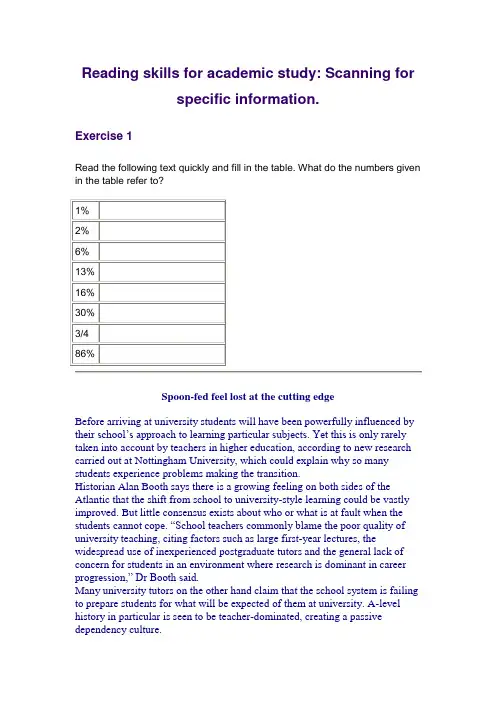
Reading skills for academic study: Scanning forspecific information.Exercise 1Read the following text quickly and fill in the table. What do the numbers given in the table refer to?Spoon-fed feel lost at the cutting edgeBefore arriving at university students will have been powerfully influenced by their school’s approach to learning particular subjects. Yet this is only rarely taken into account by teachers in higher education, according to new research carried out at Nottingham University, which could explain why so many students experience problems making the transition.Historian Alan Booth says there is a growing feeling on both sides of the Atlantic that the shift from school to university-style learning could be vastly improved. But little consensus exists about who or what is at fault when the students cannot cope. “School teachers commonly blame the poor quality of university teaching, citing factors such as large first-year lectures, the widespread use of inexperienced postgraduate tutors and the general lack of concern for students in an environment where research is dominant in career progression,” Dr Booth said.Many university tutors on the other hand claim that the school system is failing to prepare students for what will be expected of them at university. A-level history in particular is seen to be teacher-dominated, creating a passive dependency culture.But while both sides are bent on attacking each other, little is heard during such exchanges from the students themselves, according to Dr Booth, who has devised a questionnaire to test the views of more than 200 first-year history students at Nottingham over a three-year period. The students were asked about their experience of how history is taught at the outset of their degree programme. It quickly became clear that teaching methods in school were pretty staid.About 30 per cent of respondents claimed to have made significant use of primary sources (few felt very confident in handling them) and this had mostly been in connection with project work. Only 16 per cent had used video/audio; 2 per cent had experienced field trips and less than 1 per cent had engaged in role-play.Dr Booth found students and teachers were frequently restricted by the assessment style which remains dominated by exams. These put obstacles in the way of more adventurous teaching and active learning, he said. Of the students in the survey just 13 per cent felt their A-level course had prepared them very well for work at university. Three-quarters felt it had prepared them fairly well.One typical comment sums up the contrasting approach: “At A-level we tended to be spoon-fed with dictated notes and if we were told to do any background reading (which was rare) we were told exactly which pages to read out of the book”.To test this further the students were asked how well they were prepared in specific skills central to degree level history study. The answers reveal that the students felt most confident at taking notes from lectures and organising their notes. They were least able to give an oral presentation and there was no great confidence in contributing to seminars, knowing how much to read, using primary sources and searching for texts. Even reading and taking notes from a book were often problematic. Just 6 per cent of the sample said they felt competent at writing essays, the staple A level assessment activity.The personal influence of the teacher was paramount. In fact individual teachers were the cent re of students’ learning at A level with some 86 per cent of respondents reporting that their teachers had been more influential in their development as historians than the students’ own reading and thinking.The ideal teacher turned out to be someone who was enthusiastic about the subject; a good clear communicator who encouraged discussion. The ideal teacher was able to develop students involvement and independence. He or she was approachable and willing to help. The bad teacher, according to the survey, dictates notes and allows no room for discussion. He or she makes students learn strings of facts; appears uninterested in the subject and fails to listen to other points of view.No matter how poor the students judged their preparedness for degree-level study, however, there was a fairly widespread optimism that the experiencewould change them significantly, particularly in terms of their open mindedness and ability to cope with people.But it was clear, Dr Booth said, that the importance attached by many departments to third-year teaching could be misplaced. “Very often tutors regard the third year as the crucial time, allowing postgraduates to do a lot of the earlier teaching. But I am coming to the conclusion that the first year at university is the critical point of intervention”.Alison Utley, Times Higher Education Supplement. February 6th, 1998.Reading skills for academic study: Scanning forspecific information.Exercise 1 - AnswersRead the following text quickly and fill in the table. What do the numbers given in the table refer to?Reading skills for academic study: Scanning forspecific information.Exercise 2Read the following text quickly and answer the questions.1. W hen were X-rays discovered?2. W ho discovered them?3. W hat are the four characteristics of X-rays?The Discovery of X-raysExcept for a brief description of the Compton effect, and a few other remarks, we have postponed the discussion of X-rays until the present chapter because it is particularly convenient to treat X-ray spectra after treating optical spectra. Although this ordering may have given the reader a distorted impression of the historical importance of X-rays, this impression will be corrected shortly as we describe the crucial role played by X-rays in the development of modern physics.X-rays were discovered in 1895 by Roentgen while studying the phenomena of gaseous discharge. Using a cathode ray tube with a high voltage of several tens of kilovolts, he noticed that salts of barium would fluoresce when brought near the tube, although nothing visible was emitted by the tube. This effect persisted when the tube was wrapped with a layer of black cardboard. Roentgen soon established that the agency responsible for the fluorescence originated at the point at which the stream of energetic electrons struck the glass wall of the tube. Because of its unknown nature, he gave this agency the name X-rays. He found that X-rays could manifest themselves by darkening wrapped photographic plates, discharging charged electroscopes, as well as by causing fluorescence in a number of different substances. He also found that X-rays can penetrate considerable thicknesses of materials of low atomic number, whereas substances of high atomic number are relatively opaque. Roentgen took thefirst steps in identifying the nature of X-rays by using a system of slits to show that (1) they travel in straight lines, and that (2) they are uncharged, because they are not deflected by electric or magnetic fields.The discovery of X-rays aroused the interest of all physicists, and many joined in the investigation of their properties. In 1899 Haga and Wind performed a single slit diffraction experiment with X-rays which showed that (3) X-rays are a wave motion phenomenon, and, from the size of the diffraction pattern, their wavelength could be estimated to be 10-8 cm. In 1906 Barkla proved that (4) the waves are transverse by showing that they can be polarized by scattering from many materials.There is, of course, no longer anything unknown about the nature of X-rays. They are electromagnetic radiation of exactly the same nature as visible light, except that their wavelength is several orders of magnitude shorter. This conclusion follows from comparing properties 1 through 4 with the similarproperties of visible light, but it was actually postulated by Thomson several years before all these properties were known. Thomson argued that X-rays are electromagnetic radiation because such radiation would be expected to be emitted from the point at which the electrons strike the wall of a cathode ray tube. At this point, the electrons suffer very violent accelerations in coming to a stop and, according to classical electromagnetic theory, all accelerated charged particles emit electromagnetic radiations. We shall see later that this explanation of the production of X-rays is at least partially correct.In common with other electromagnetic radiations, X-rays exhibit particle-like aspects as well as wave-like aspects. The reader will recall that the Compton effect, which is one of the most convincing demonstrations of the existence of quanta, was originally observed with electromagnetic radiation in the X-ray region of wavelengths.Reading skills for academic study: Scanning forspecific information.Exercise 2 - AnswersRead the following text quickly and answer the questions.1. W hen were X-rays discovered?2. W ho discovered them?3. W hat are the four characteristics of X-rays?1. 18952. R oentgen3. 1. they travel in straight lines2. they are uncharged3. they are a wave motion phenomenon4. the waves are transverse。