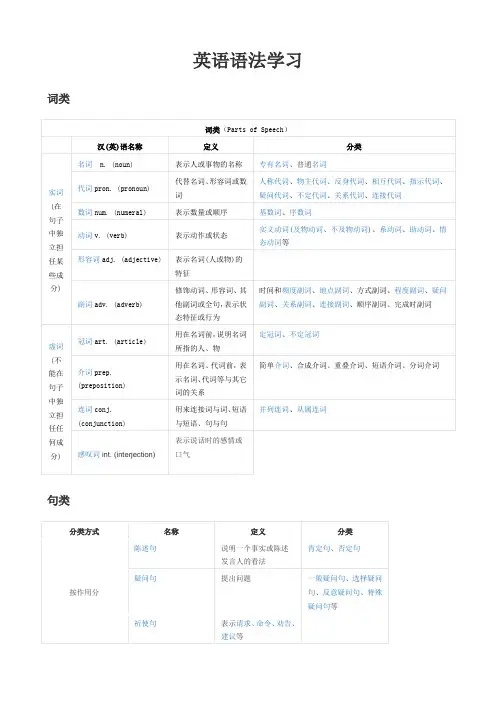
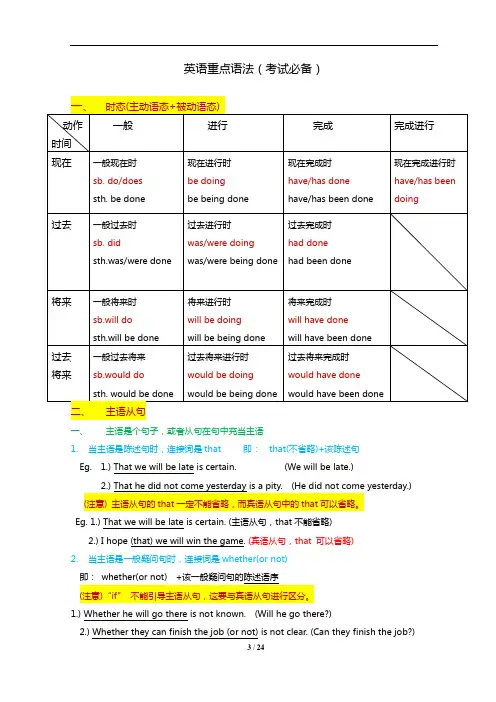
必备的英语语法
- 格式:docx
- 大小:195.88 KB
- 文档页数:94
第1章主谓一致一.概念:主谓一致是指:1)语法形式上要一致,即单复数形式与谓语要一致。
2)意义上要一致,即主语意义上的单复数要与谓语的单复数形式一致。
3)就近原则,即谓语动词的单复形式取决于最靠近它的词语,一般来说,不可数名词用动词单数,可数名词复数用动词复数。
例如:There is much water in the thermos.但当不可数名词前有表示数量的复数名词时,谓语动词用复数形式。
例如:Ten thousand tons of coal were produced last year.二.相关知识点精讲1.并列结构作主语时谓语用复数,例如:Reading and writing are very important. 读写很重要。
注意:当主语由and连结时,如果它表示一个单一的概念,即指同一人或同一物时,谓语动词用单数,and 此时连接的两个词前只有一个冠词。
例如:The iron and steel industry is very important to our life. 钢铁工业对我们的生活有重要意义。
典型例题The League secretary and monitor ___ asked to make a speech at the meeting.A. isB. wasC. areD. were答案B. 注:先从时态上考虑。
这是过去发生的事情应用过去时,先排除A.,C。
本题易误选D,因为The League secretary and monitor 好象是两个人,但仔细辨别,monitor 前没有the,在英语中,当一人兼数职时只在第一个职务前加定冠词。
后面的职务用and 相连。
这样本题主语为一个人,所以应选B。
2. 主谓一致中的靠近原则1)当there be 句型的主语是一系列事物时,谓语应与最邻近的主语保持一致。
例如:There is a pen, a knife and several books on the desk. 桌上有一支笔、一把小刀和几本书。
There are twenty boy-students and twenty-three girl-students in the class.班上有二十个男孩,二十三个女孩。
2)当either…or… 与neither… nor,连接两个主语时,谓语动词与最邻近的主语保持一致。
如果句子是由here, there引导,而主语又不止一个时,谓语通常也和最邻近的主语一致。
例如:Either you or she is to go. 不是你去,就是她去。
Here is a pen, a few envelops and some paper for you. 给你笔、信封和纸。
3.谓语动词与前面的主语一致当主语有with, together with, like, except, but, no less than, as well as 等词组成的短语时,谓语动词与前面的主语部分一致。
例如:The teacher together with some students is visiting the factory. 教师和一些学生在参观工厂。
He as well as I wants to go boating.他和我想去划船。
4. 谓语需用单数的情况1)代词each以及由every, some, no, any等构成的复合代词作主语时,或主语中含有each, every时, 谓语需用单数。
例如:Each of us has a tape-recorder. 我们每人都有录音机。
There is something wrong with my watch. 我的表坏了。
2)当主语是一本书或一条格言时,谓语动词常用单数。
例如:The Arabian Night is a book known to lovers of English. 《天方夜谭》是英语爱好者熟悉的一本书。
3)表示金钱,时间,价格或度量衡的复合名词作主语时,通常把这些名词看作一个整体,谓语一般用单数。
例如:Three weeks was allowed for making the necessary preparations. 用三个星期来做准备。
Ten yuan is enough. 十元够了。
5.指代意义决定谓语的单复数1)代词what, which, who, none, some, any, more, most, all等词的单复数由其指代的词的单复数决定。
例如:All is right.一切顺利。
All are present.人都到齐了。
2)集体名词作主语时,谓语的数要根据主语的意思来决定。
如family, audience, crew, crowd, class, company, committee等词后,谓语动词用复数形式时强调这个集体中的各个成员,用单数时强调该集体的整体。
例如:His family isn't very large. 他家成员不多。
His family are music lovers.他家个个都是音乐爱好者。
但集合名词people, police, cattle, poultry等在任何情况下都用复数形式。
例如:Are there any police around? 附近有警察吗?3)有些名词,如variety, number, population, proportion, majority 等有时看作单数,有时看作复数。
例如:A number of +名词复数+复数动词。
The number of +名词复数+单数动词。
A number of books have lent out.The majority of the students like English.6.与后接名词或代词保持一致的情况1)用half of, most of, none of, heaps of, lots of, plenty of 等引起主语时,谓语动词通常与of 后面的名词/代词保持一致。
例如:Most of his money is spent on books. 他大部分的钱化在书上了。
Most of the students are taking an active part in sports. 大部分学生积极参与体育运动。
2)用a portion of, a series of, a pile of, a panel of 等引起主语时,谓语动词通常用单数。
例如: A series of accidents has been reported. 媒体报道了一连串的事故。
A pile of lots was set beside the hearth. 炉边有一堆木柴。
3)如 many a 或 more than one 所修饰的短语作主语时,谓语动词多用单数形式。
但由more than… of 作主语时,动词应与其后的名词或代词保持一致。
例如:Many a person has read the novel.许多人读过这本书。
More than 60 percent of the students are from the city.百分之六十多的学生来自这个城市。
三.巩固练习() 1. The number of people invited ______ fifty, but a number of them _______ absent for different reasons.A. were, wasB. was, wasC. was, wereD. were, were() 2. E-mail, as well as telephones, ________ an important part in daily communication.A. is playingB. have playedC. are playingD. play() 3. ______ of the land in that district ______ covered with trees and grass.A. Two fifth, isB. Two fifth, areC. Two fifths, isD. Two fifths, are() 4. Ten minutes ______ a long time for one who waits.A. seemB. seemsC. seemedD. are seemed() 5. Eric is the only one of the boys who _____ a driving license.A. hasB. haveC. is havingD. are having’() 6. Joy and Sorrow _____ next-door neighbours.A. isB. areC. wereD. be()7. In my opinion, some of the news _____ unbelievable.A. areB. isC. has beenD. have been()8. When ______ the United Nations founded?A. isB. areC. wasD. were()9. Every possible means _____ .A. has triedB. has been triedC. was triedD. were tried() 10. What she says and does _____ nothing to do with me.A. wasB. wereC. hasD. have()11. There _____ a dictionary and several books on the desk.A. areB. mustC. have beenD. is()12. Nobody ______ seen the film. It’s a pi ty.A. but Tom and Jack haveB. except Tom and Jack haveC. but my friends hasD. but I have()13. No teacher and no student ______.A. are admittedB. is admittedC. are admittingD. is admitting()14. All but one ______ here just now.A. isB. wasC. has beenD. were()15. When and where to build the new factory _____ yet.A. is not decidedB. are not decidedC. has not decidedD. have not decided() 16. The writer and singer ______ here.A. isB. areC. wereD. do() 17. As I have a meeting at four, ten minutes _____ all that I can spare to talk with you.A. areB. wasC. isD. were() 18. In those days John with his classmates _____ kept busy preparing for the exam.A. isB. areC. wasD. were() 19. —— ____ your clothes?——No, mine _____ hanging over there.A. Is it, isB. Are these, areC. Is it, areD. Are these, is()20. The Smith’s family, which ____ rather a large one, ____ very fond of their old houses.A. were, wereB. was, wasC. were, wasD. was, were() 21. What the teacher and the students want to say _____ that either of the countries ____ beautiful.A. are, areB. is, isC. are, isD. is, are() 22. He is the only one of the students who _____ a winner of scholarship for three years.A. isB. areC. have beenD. has been() 23. _____ of my brothers are reporters. Covering events, meetings, or sports meetings ______ their duty.A. Each, areB. Both, isC. Neither, areD. None, is() 24. —— What do you think of the ______ of the coat?——It’s rather high. You can buy a cheaper one in that shop.A. valueB. costC. priceD. use() 25. —— Are the two answers correct?—— No, ______ correct.A. no one isB. both are notC. neither isD. either is not() 26. The wind, together with rain and fog, _____ making sailing difficult.A. have beenB. wasC. / D/ are四.答案1.C2. A3. C4. B5. A6. B7. B8. C9. B 10. C 11. D 12. C 13. B 14. D 15.A 16. A 17. C 18. C 19.B 20. D 21. B 22. D 23. B 24.C 25. C 26. B第2章动词的时态一. 概念:时态是英语谓语动词的一种形式,表示动作发生的时间和所处的状态.英语中的时态是通过动词形式本身的变化来实现的.英语有16种时态,但中学阶段较常用的有十种:一般现在时,一般过去时,一般将来时,过去将来时,现在进行时,过去进行时,将来进行时,过去完成时,英在完成时和现在完成进行时.二.相关知识点精讲1.一般现在时的用法1)经常性或习惯性的动作,常与表示频腮度的时间状语连用。