
小学英语单词趣味游戏_食物food
- 格式:ppt
- 大小:2.07 MB
- 文档页数:11


Possible article:Exploring Favorite Foods in Primary English ClassUnit 3 of the primary English textbook asks students to share their opinions about food and learn vocabulary related to different typesof cuisine. In this lesson plan, we will introduce some pedagogical activities that encourage children to talk about their favorite foods, practice basic sentence structures, and develop theircognitive and social skills.Objectives:-To enable students to communicate in English about their favorite foods using simple phrases and expressions-To enrich students' vocabulary and comprehension of food-related terms-To foster students' empathy and tolerance towards different food preferences and cultural backgrounds-To promote students' creativity and cooperation in designing and presenting their culinary creationsMaterials:-The textbook page with Unit 3 topic and vocabulary- A list of food-related questions and prompts-Pictures or samples of various foods (real or virtual)-Recipe cards or templates for a food-making activity (optional)-Feedback sheets for peer assessment (optional)Procedure:1.Warm-up: Food FlashcardsStart the lesson by showing some flashcards or images of different types of food, such as pizza, burger, sushi, noodles, chicken,carrot, apple, ice cream, etc. Ask the students to guess or name the food and tell whether they like it or not. You can also use a 5-star rating system to gather their opinions.2.Vocabulary Practice: Word AssociationUsing the vocabulary list from the textbook, ask the students to brainstorm words that are associated with food, such as taste, smell, texture, ingredients, utensils, cooking methods, etc. Write thewords on the board or on a mind map, and use them to elicit further examples from the students. You can also play a word chain game,where each student has to say a new word that starts with the last letter of the previous word.3.Speaking and Listening: Favorite Foods InterviewPair up the students and give them some interview questions to ask each other, such as:-What's your favorite food? Why do you like it?-Have you ever tried any foreign food? Which one did you like the most?-Do you prefer sweet or salty food? Hot or cold food? Spicy or mild food?-How do you usually eat your favorite food? With whom do you share it?Encourage the students to take turns asking and answering the questions, and to listen actively to their partner's answers. Youcan also provide some sentence patterns for them to use, such as:-My favorite food is ______. I like it because it tastes _______.-I haven't tried ______ before, but I'm curious about it.-I usually eat ______ for _______ meal. I share it with my _______.4. Writing and Reading: Food PoemAs a group activity, ask the students to brainstorm some adjectives that describe different foods, such as yummy, juicy, crunchy, burnt, sticky, sour, etc. Then, model a simple poem structure, such as: (Title) My Favorite Food(Line 1) (Food name) is _______ (adjective).(Line 2) It smells like _______ (noun).(Line 3) It feels _______ (adjective) in my mouth.(Line 4) I could eat it _______ (number) times a day.(Line 5) It reminds me of _______ (memory).Have the students work in pairs or small groups to create their own food poems, using the vocabulary and sentence structures they have learned. You can provide some examples or scaffolding sentences to help them, such as:-Pizza is cheesy and crispy.-It smells like fresh-baked bread.-It feels greasy and hot on my tongue.-I could eat it every day for a week.-It reminds me of my birthday party.5. Project and Presentation: Food FaceThis is a fun and creative art project that also involves some food decoration skills. Give each group a blank paper plate and someedible materials, such as fruits, vegetables, sauces, cheese, bread, etc. Explain that they have to design a face or a character usingthe food ingredients and present it to the class, explaining their choices and creativity. You can use some themes or challenges tomake it more engaging, such as:-Make a healthy food face.-Make a funny food face.-Make a traditional food face from your own culture.-Make a food face inspired by a famous person or character.After the presentations, ask the students to give feedback to each other, using some criteria such as creativity, effort, taste,variety, etc. You can also provide some reflective questions forthem to think about, such as:-How did you feel about making and sharing your food faces?-What did you learn from your classmates' presentations?-Did you discover any new favorite foods or combinations today?-How can you use English to talk about food in your daily life? Assessment:The students' performance can be assessed through various means,such as observation, participation, oral and written tasks, and peer feedback. You can use a rubric or a checklist that includes the learning objectives and some criteria for success, such as fluency, accuracy, vocabulary range, coherence, pronunciation, creativity, cooperation, etc.Conclusion:This lesson plan offers a variety of activities that cater todifferent learning styles and language skills. By exploring thetopic of favorite foods, students can enhance their communicative competence in English, broaden their cultural awareness, and develop their artistic and culinary abilities. Through collaborative and reflective tasks, students can also experience a sense of belonging and achievement in the classroom. The teacher's role is tofacilitate and scaffold the learning process, while encouraging and guiding the students to express themselves and learn from each other.。


Unit 4 Food Lesson 1教案Play the cartoon.1.Let’s see the picture. Who are they?Where are they?What are they doing?Ok! Let’s learn some new words about food.ⅢPresentationwordsabout foodShow students somepictures.Picture 1What’s on the table?Show them differentkinds of fish and askthem question group bygroup.What’ this?Boys and girls, Do youlike fish?If you like it.If you do not like it.What else (does he eat)?What’s this?Boys attention! Chickenchicken chicken…Girls attention! Chickenchicken chicken…Do you like chicken?Look at the picture!What else?Show them differentkinds of vegetables andask them question groupby group.What’ this?Do you like chicken?What’ this?Let them read wordFish!FishYes, I do.( asmiling face)No, I don’t.( acrying face)Chicken.Chicken chickenchicken…Yes, I do.No, I don’t.Vegetables.Vegetables…Yes, I do.No, I don’t.Rice!Rice rice rice…to teach thempronunciation offish and let themsay what they like.group by group.Who are they?What’ this?Show them different kinds of vegetables and ask them question group by group.Do you like noodles? What’s on the table?Do you like noodles? 1.I point and you say.Unit 4 Food--Do you like...?--Yes, I do / No, I don’t.Binbin Lily studentsBinbin likes vegetables and rice...Lily likes noodles....。
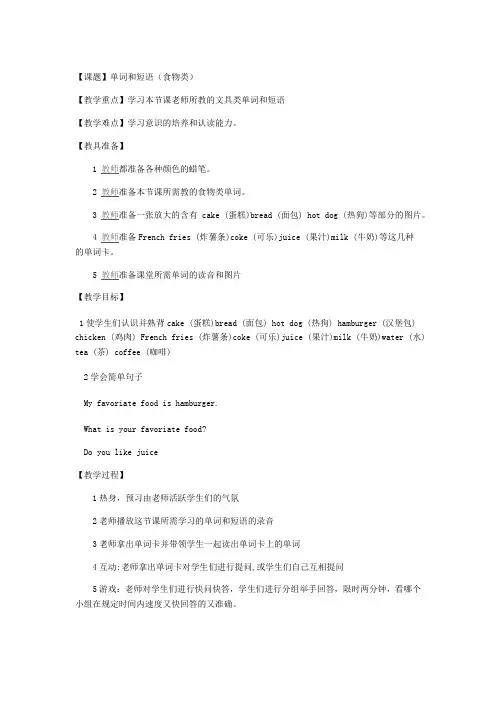
【课题】单词和短语(食物类)
【教学重点】学习本节课老师所教的文具类单词和短语
【教学难点】学习意识的培养和认读能力。
【教具准备】
1 教师都准备各种颜色的蜡笔。
2 教师准备本节课所需教的食物类单词。
3 教师准备一张放大的含有cake (蛋糕)bread (面包) hot dog (热狗)等部分的图片。
4 教师准备French fries (炸薯条)coke (可乐)juice (果汁)milk (牛奶)等这几种
的单词卡。
5 教师准备课堂所需单词的读音和图片
【教学目标】
1使学生们认识并熟背cake (蛋糕)bread (面包) hot dog (热狗) hamburger (汉堡包) chicken (鸡肉) French fries (炸薯条)coke (可乐)juice (果汁)milk (牛奶)water (水) tea (茶) coffee (咖啡)
2学会简单句子
My favoriate food is hamburger.
What is your favoriate food?
Do you like juice
【教学过程】
1热身,预习由老师活跃学生们的气氛
2老师播放这节课所需学习的单词和短语的录音
3老师拿出单词卡并带领学生一起读出单词卡上的单词
4互动:老师拿出单词卡对学生们进行提问,或学生们自己互相提问
5游戏:老师对学生们进行快问快答,学生们进行分组举手回答,限时两分钟,看哪个小组在规定时间内速度又快回答的又准确。