灯具检测流程及标准规范
- 格式:doc
- 大小:37.51 KB
- 文档页数:3
灯具检测流程及标准规范
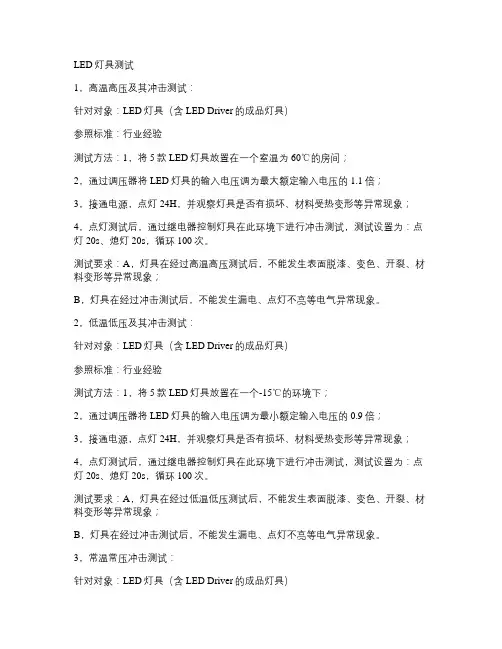
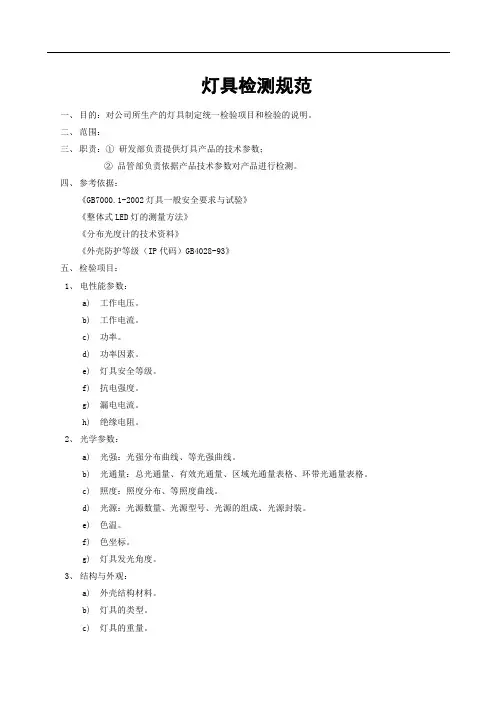
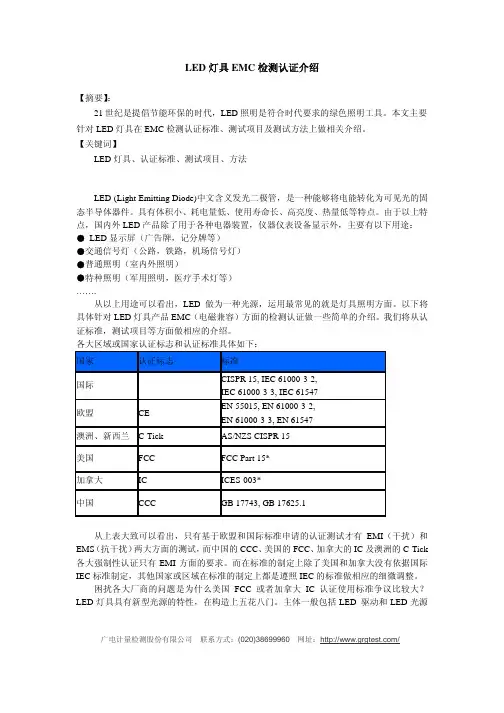
English: The process of testing lighting fixtures involves several steps
to ensure their quality and compliance with industry standards.
Firstly, the initial inspection is conducted to assess the physical
condition of the fixture, checking for any damages or defects. Next,
electrical testing is performed to verify if the fixture meets safety
requirements, including insulation resistance, grounding, and
electrical leakage. This step also includes testing for electrical
performance parameters such as wattage, voltage, current, and
power factor, using specialized testing equipment. Additionally,
photometric testing is carried out to assess the fixture's lighting
characteristics, including luminous flux, illuminance distribution,
color temperature, and color rendering index. This is done by using
photometric measurement devices such as integrating spheres and
spectroradiometers. Furthermore, the thermal performance of the
fixture is evaluated through thermal testing, which measures the
temperature rise and heat dissipation ability, ensuring that the fixture
operates within safe temperature limits. Finally, environmental
testing is conducted to evaluate the fixture's resistance to different
environmental factors such as moisture, heat, cold, dust, and vibrations. This may involve subjecting the fixture to temperature
and humidity chambers, mechanical stress tests, and accelerated
aging tests.
Overall, the process of testing lighting fixtures follows a standardized
approach to verify compliance with industry regulations and ensure
their reliable and safe operation. By conducting thorough inspections
and tests throughout the manufacturing process, manufacturers can
guarantee that their products meet the required quality standards
and will perform as expected in various applications.
中文翻译: 灯具检测流程包括几个步骤,以确保其质量和符合行业标准。首先,进行初步检查,评估灯具的物理状况,检查是否有任何损坏或缺陷。接下来进行电器测试,验证灯具是否符合安全要求,包括绝缘电阻、接地和电气泄漏。该步骤还包括使用专用测试设备对功率、电压、电流和功率因数等电气性能参数进行测试。此外,进行光电度测试,评估灯具的照明特性,包括光通量、照度分布、色温和色彩再现指数。通过使用积分球和分光辐射仪等光电测量设备来实现。此外,通过热测试评估灯具的热性能,测量温升和散热能力,确保灯具在安全温度范围内工作。最后进行环境测试,评估灯具对湿度、热、寒冷、灰尘和振动等不同环境因素的抵抗能力。这可以涉及将灯具放入温度和湿度室、进行机械应力测试和加速老化测试。总体而言,灯具检测流程遵循标准化的方法,验证符合行业法规,确保其可靠和安全的运行。通过在整个生产过程中进行彻底的检查和测试,制造商可以保证其产品符合所需的质量标准,并在各种应用中发挥预期的性能。