
《初中状语从句》PPT课件
- 格式:ppt
- 大小:3.78 MB
- 文档页数:57

1
初中英语语法---状语从句小结
状语从句是一种作状语用的从句,修饰主句的动词、形容词、副词或修饰全句,补充说明时间、地点、原因、条件、方式、程度、状态等。根据它表达的意思的不同,可分为时间状语从句、地点状语从句、原因状语从句、条件状语从句、比较状语从句、目的状语从句、结果状语从句等。时间状语从句、条件状语从句、结果状语从句、原因状语从句都是中考的重点。
一、时间状语从句
时间状语从句表示主句动作发生的时间,引导时间状语从句的连词有when, as, while,
before, after, as soon as, till, until, since等。
until 用于肯定句中,表示句子的动作一直持续到until短语所表示的时间为止,即表示动作的终点。一般可译为“直到……时(为止)”或“在……以前”。在这种用法中,句子的谓语动词必须是持续动词(非瞬间动词),如live, wait, last, love, like, stay, work, continue等。until用于否定句中,表示句子的动作直到until短语所表示的时间才开始发生,即表示动作的起点。一般译为“直到……才”或“直到……之前(……还不 )”
eg. It may last until Friday. 这可能要延续到星期五。
用于否定句中:
eg. The secret was never told until after the old man's death.
这个秘密在老人去世后才说出来。
连词until
以同样的方式分析作连词的until的用法。作连词用的until的英文释义是up to the time
when(直到……时为止)。
作连词的until用于肯定句中,表示主句的动作一直持续到从句动作发生或状态出现时为止。一般可译为“……直到……为止”。在这种用法中,主句的谓语动词必须是持续动词(非瞬间动词),如live, wait , last, love, like, stay, work, continue 等。
(一)状语从句概述
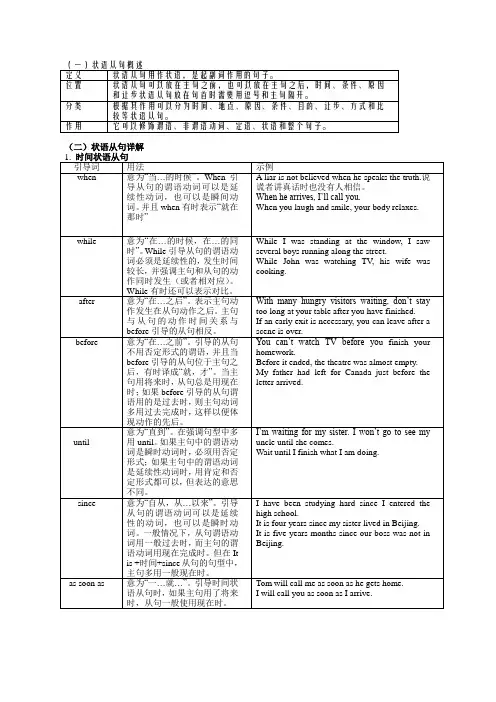
定义 状语从句用作状语,是起副词作用的句子。
位置 状语从句可以放在主句之前,也可以放在主句之后,时间、条件、原因和让步状语从句放在句首时需要用逗号和主句隔开。
分类 根据其作用可以分为时间、地点、原因、条件、目的、让步、方式和比较等状语从句。
作用 它可以修饰谓语、非谓语动词、定语、状语和整个句子。
(二)状语从句详解
1. 时间状语从句
引导词 用法 示例
when 意为“当…的时候”。When引导从句的谓语动词可以是延续性动词,也可以是瞬间动词。并且when有时表示“就在那时” A liar is not believed when he speaks the truth.说谎者讲真话时也没有人相信。
When he arrives, I’ll call you.
When you laugh and smile, your body relaxes.
while 意为“在…的时候,在…的同时”。While引导从句的谓语动词必须是延续性的,发生时间较长,并强调主句和从句的动作同时发生(或者相对应)。While有时还可以表示对比。 While I was standing at the window, I saw
several boys running along the street.
While John was watching TV, his wife was
cooking.
after 意为“在…之后”。表示主句动作发生在从句动作之后。主句与从句的动作时间关系与before引导的从句相反。 With many hungry visitors waiting, don’t stay
too long at your table after you have finished.
If an early exit is necessary, you can leave after a
状语从句练习(一)
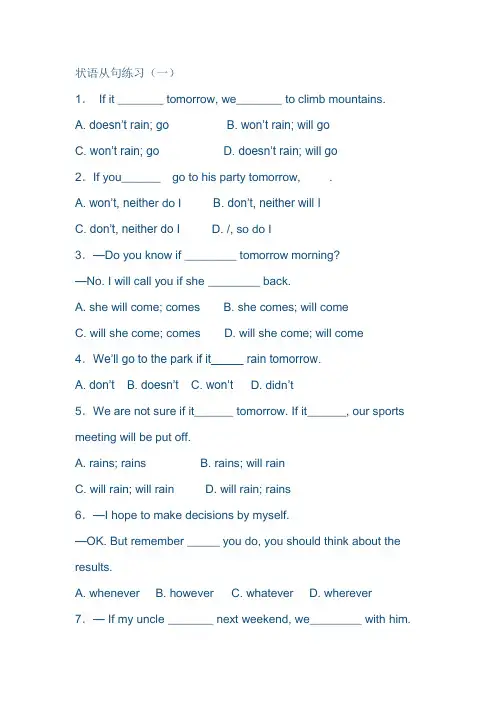
1. If it _______ tomorrow, we_______ to climb mountains.
A. doesn’t rain; go B. won’t rain; will go
C. won’t rain; go D. doesn’t rain; will go
2.If you______ go to his party tomorrow, .
A. won’t, neither do I B. don’t, neither will I
C. don’t, neither do I D. /, so do I
3.—Do you know if ________ tomorrow morning?
—No. I will call you if she ________ back.
A. she will come; comes B. she comes; will come
C. will she come; comes D. will she come; will come
4.We’ll go to the park if it_____ rain tomorrow.
A. don’t B. doesn’t C. won’t D. didn’t
5.We are not sure if it______ tomorrow. If it______, our sports
meeting will be put off.
A. rains; rains B. rains; will rain
C. will rain; will rain D. will rain; rains
1 冀教八年级
中考专题语法-----状语从句
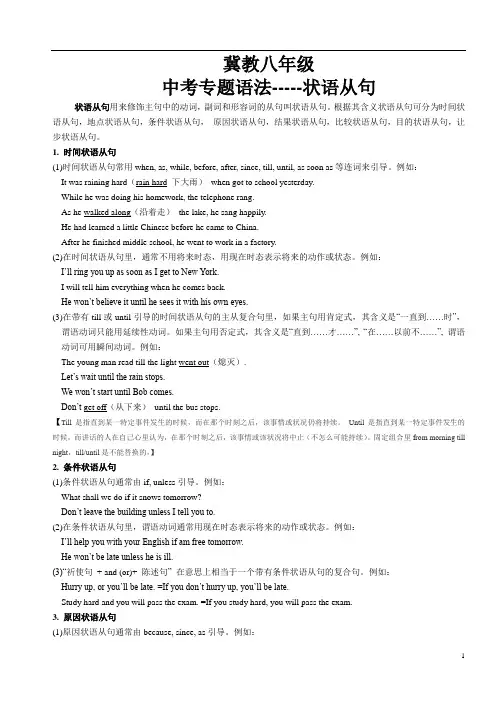
状语从句用来修饰主句中的动词,副词和形容词的从句叫状语从句。根据其含义状语从句可分为时间状语从句,地点状语从句,条件状语从句, 原因状语从句,结果状语从句,比较状语从句,目的状语从句,让步状语从句。
1. 时间状语从句
(1)时间状语从句常用when, as, while, before, after, since, till, until, as soon as等连词来引导。例如:
It was raining hard(rain hard 下大雨) when got to school yesterday.
While he was doing his homework, the telephone rang.
As he walked along(沿着走) the lake, he sang happily.
He had learned a little Chinese before he came to China.
After he finished middle school, he went to work in a factory.
(2)在时间状语从句里,通常不用将来时态,用现在时态表示将来的动作或状态。例如:
I’ll ring you up as soon as I get to New York.
I will tell him everything when he comes back.
He won’t believe it until he sees it with his own eyes.
(3)在带有till或until引导的时间状语从句的主从复合句里,如果主句用肯定式,其含义是“一直到……时”,谓语动词只能用延续性动词。如果主句用否定式,其含义是“直到……才……”, “在……以前不……”, 谓语动词可用瞬间动词。例如: