英语疑问词的用法
- 格式:docx
- 大小:19.02 KB
- 文档页数:6
英语疑问词的用法
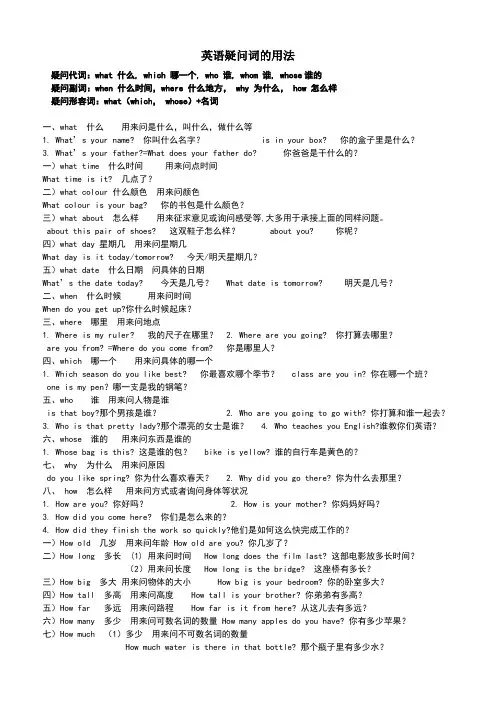
疑问代词:what 什么, which 哪一个, who 谁, whom 谁, whose谁的
疑问副词:when 什么时间,where 什么地方, why 为什么, how 怎么样
疑问形容词:what(which, whose)+名词
一、what 什么 用来问是什么,叫什么,做什么等
1. What’s your name 你叫什么名字? 2.What is in your box 你的盒子里是什么?
3. What’s your father=What does your father do 你爸爸是干什么的?
一)what time 什么时间 用来问点时间
What time is it 几点了?
二)what colour 什么颜色 用来问颜色
What colour is your bag 你的书包是什么颜色?
三)what about 怎么样 用来征求意见或询问感受等,大多用于承接上面的同样问题。
1.What about this pair of shoes 这双鞋子怎么样? 2.What about you 你呢?
四)what day 星期几 用来问星期几
What day is it today/tomorrow 今天/明天星期几?
五)what date 什么日期 问具体的日期
What’s the date today 今天是几号? What date is tomorrow 明天是几号?
二、when 什么时候 用来问时间
When do you get up你什么时候起床?
三、where 哪里 用来问地点
1. Where is my ruler 我的尺子在哪里? 2. Where are you going 你打算去哪里?
3.Where are you from =Where do you come from 你是哪里人?
四、which 哪一个 用来问具体的哪一个
1. Which season do you like best 你最喜欢哪个季节? 2.Which class are you in 你在哪一个班?
3.Which one is my pen?哪一支是我的钢笔?
五、who 谁 用来问人物是谁 1.Who is that boy那个男孩是谁? 2. Who are you going to go with 你打算和谁一起去?
3. Who is that pretty lady那个漂亮的女士是谁? 4. Who teaches you English谁教你们英语?
六、whose 谁的 用来问东西是谁的
1. Whose bag is this 这是谁的包? 2.Whose bike is yellow 谁的自行车是黄色的?
七、 why 为什么 用来问原因
1.Why do you like spring 你为什么喜欢春天? 2. Why did you go there 你为什么去那里?
八、 how 怎么样 用来问方式或者询问身体等状况
1. How are you 你好吗? 2. How is your mother 你妈妈好吗?
3. How did you come here 你们是怎么来的?
4. How did they finish the work so quickly他们是如何这么快完成工作的?
一)How old 几岁 用来问年龄 How old are you 你几岁了?
二)How long 多长 (1) 用来问时间 How long does the film last 这部电影放多长时间?
(2)用来问长度 How long is the bridge 这座桥有多长?
三)How big 多大 用来问物体的大小 How big is your bedroom 你的卧室多大?
四)How tall 多高 用来问高度 How tall is your brother 你弟弟有多高?
五)How far 多远 用来问路程 How far is it from here 从这儿去有多远?
六)How many 多少 用来问可数名词的数量 How many apples do you have 你有多少苹果?
七)How much (1)多少 用来问不可数名词的数量
How much water is there in that bottle 那个瓶子里有多少水?
(2)多少钱 用来问价格
How much is this dress 这个连衣裙多少钱?
表格归纳
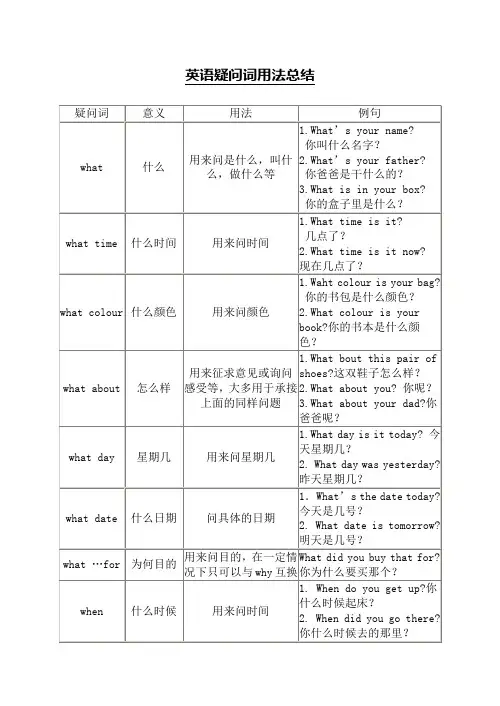
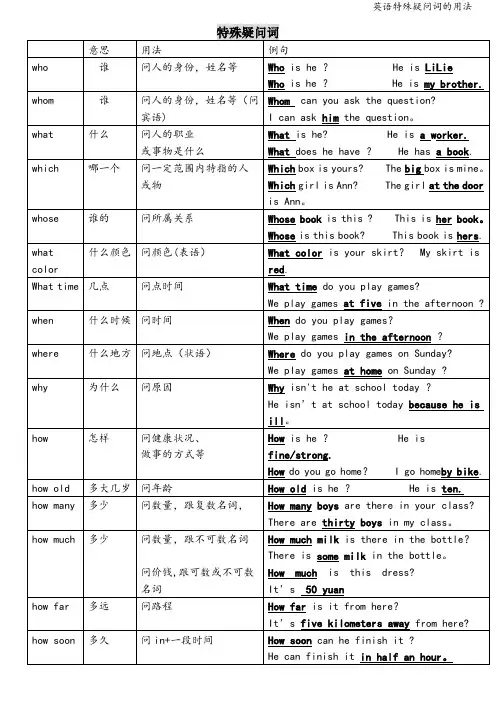
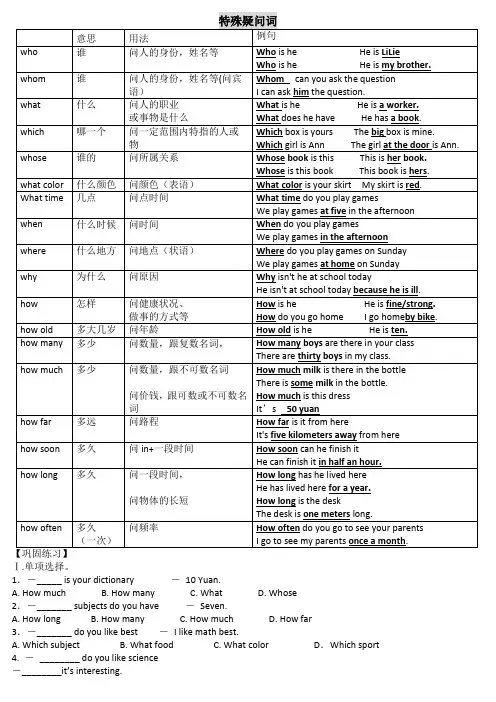
疑问词 词义 用法 例句
who 谁 问人的身份,姓名等 He is Li Lie Who is he
He is my brother. Who is he
whom 谁 问人的身份,姓名等(问I can ask him the question. 宾语) Whom can you ask the question
what 什么 问人的职业
或事物是什么 He is a worker. What is he
He has a book. What does he have
which 哪一个 问一定范围内特指的人或物 The big box is mine. Which box is yours
The girl at the door is Ann. Which girl is Ann
whose 谁的 问所属关系 This is her book. Whose book is this
This book is hers. Whose is this book
what color 什么颜色 问颜色(表语) My skirt is red. What color is your skirt
what time 几点 问点时间 We play games at five in the afternoon
What time do you play games in the afternoon
when 什么时候 问时间 We play games in the afternoon
When do you play games
where 什么地方 问地点(状语) We play games at home on Sunday.
Where do you play games on Sunday
why 为什么 问原因 He isn't at school today because he is ill.
Why isn't he at school today
how 怎样 问健康状况
问做事的方式 He is fine/strong. How is he
I go home by bike. How do you go home
how old 多大,几岁 问年龄 He is ten. How old is he
how many 多少 问数量(跟可数名词) There are thirty boys in my class.
How many boys are there in your class
how much 多少 问数量(跟不可数名词)
问价钱 There is some milk in the bottle.
How much milk is there in the bottle
The book is fifteen yuan.
How much is the book
how far 多远 问路程 It's five kilometers away from here. How far is it from here
how long 多久
多长 问一段时间
问物体的长度 He has lived here for a year.
How long has he lived here
The desk is one meters long.
How long is the desk
对划线部分提问的语序
对划线部分提问,除了要注意选择正确的疑问词外,还要注意语序的运用:
1、对句子的主语提问,其语序是:疑问词+谓语+其他成分?(整个句子是陈述句语序)
She is their teacher. Who is their teacher
主语 谓语
主语 谓语
2、对句子主语的定语部分提问,其语序是:疑问词+主语(即定语所修饰的名词)+ 谓语+其他成分?(整个句子是陈述句语序)
My book is over there. Whose book is over there
主语的定语 主语 谓语
疑问词
主语 谓语
以上两条方法都是:
用正确的疑问词代替划线部分,再把句号改为问号,其余部分一般不做改变。
3、对表语或宾语的定语部分提问,其语序是:疑问词+表语或宾语(划线部分所修饰的名词)+一般疑问句?
I'm looking for my watch.. Whose
watch are you looking for
宾语的定语 宾语 疑问词 宾语 一般疑问句
This is my brother’s room. Whose room is this
表语的定语 表语 表语的定语 表语 一般疑问句
4、对表语、宾语或状语提问,其语序是:疑问词+ 一般疑问句(省略掉画线部分)? He lives in Beijing. Where does he live
状语 疑问词 一般疑问句(省略掉画线部分in Beijing )
5、对谓语和宾语提问,其语序是: 疑问词(What)+ 一般疑问句(其中谓语动词要用do 的相对应形式代替, 省略掉宾语)
He watches TV in the evening What does he do in the evening
He watched TV yesterday evening. What did he do in the evening
He is watching TV now. What is he doing now
He is going to watch TV this evening. What is he going to do