
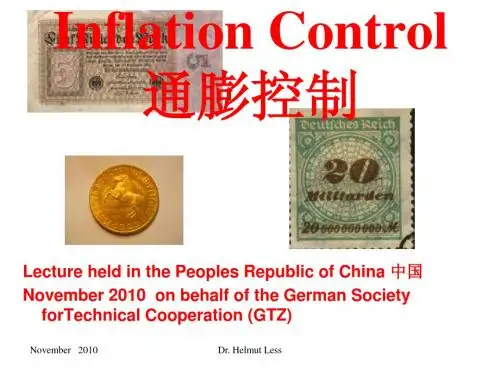
Translated Inflation-Short-Version2010
- 格式:ppt
- 大小:386.50 KB
- 文档页数:49

Unit 1A computer system consists of hardware system and software system. The hardware of the computer is usually divided into three major parts or three primary subsystems: the CPU, the memory subsystem, and the I/O subsystem.The CPU performs many operations and controls computer. The memory subsystem is used to store program being executed by the CPU, along with the program’s data. The I/O subsystem allows the CPU to interact with input and output devices such as the keyboard and monitor of a personal computer. The components of the computer are connected to the buses.The part of the computer that performs the bulk of data processing operations is called the central processing unit and is referred to as the CPU. In microcomputer, it is often called the microprocessor. The CPU is made up of three major parts: control unit, ALU, and register set.Memory is also known as internal memory or main memory. It refers to the circuits in the computer that hold whatever programs and data are available for immediate use by the CPU.I/O subsystem includes I/O devices and interface. There are a wide variety of I/O devices, such as mouse, printer, sensor, disk, and so on. Input-output interface provides a method for transferring information between internal storage and external I/O devices. Peripherals connected to a computer need special communication links for interfacing them with the CPU. The purpose of the communication link is to resolve the differences that exist between the central computer and each peripheral.Unit 3(a) A program is a list of instructions or statements for directing the computer to perform a required data processing task. Programming is a multistep process for creating that list of instructions.(b) It is important to understand the difference between a class and an object of that class. A class is simply a specification for creating objects. Thus, a single class may create multiple objects.(c) Java is an object-oriented, network-friendly high-lever programming language that allows programmers to build applications that can run on almost any operating system.(e) Programming involves a great deal of creativity. The design is guide to the function or purpose of each component, but the programmer has great flexibility in implementing the design as code. No matter what language is used, each program component involves at least three major aspects: control structures, algorithms, and data structures.Unit 4The software system can be divided into two broad categories: application software and system software. Application software consists of the program for performing tasks particular to the machine’s utilization. In contrast to application software, system software comprises a large number of programs. These programs start up the computer and function as the principle coordinator of all hardware components and application software. Without system software loaded into RAM of your computer, your hardware and application software are useless.System software can be grouped into three basic parts: operating system, utility software, and language translators. The majority of an installation’s utility software consists of programs for performing activities that are fundamental to computer installations yet not included in the operating system. In a sense, utility software consists of software units that extend the capabilities of the operating system.A computer’s OS is the main collection of programs that manage its activities. The primary chores of an OS are management and control. The OS ensures that all actions requested by a user are valid and processed in an orderly fashion. It also manages the computer system’s resources to perform these operations with efficiency and consistency.Application software is the software designed to help you solve problems specific to business or perform specific business tasks. Application software then is the layer of software closest to you. Basically, there are four categories of application software: productivity software, business and specialty software, entertainment software and education/reference software.Unit 5A computer network is often classified as being either a local area network (LAN), a metropolitan area network (WAN), or a wide area network (WAN). The connection of two or more networks is called an internetwork. The worldwide Internet is a well-known example of an internetwork.LANs are privately owned networks within a single building or campus of up to a few kilometers in size. They are widely used to connect personal computers and workstations in company offices and factories to share resources and exchange information.In general, a given LAN will use only one type of transmission medium. Various topologies are possible for LANs. The most common LAN topologies are bus, ring and star.A MAN is basically a bigger version of a LAN and normally uses similar technology. MAN is designed to extend over an entire city. It may be a single network such as a cable television network, or it may be a means of connecting a number of LANs into a large network so that resources may be shared LAN-to-LAN as well as device-to-device. For example, a company can use a MAN to connect the LANs in all of its offices throughout a city.A WAN spans a large geographical area that may comprise a country, a continent, or even the world. It provides long-distance transmission of data, voice, image, and video information over large geographical area.In contrast to LANs, WANs may utilize public leased, or private communication devices, usually in combinations, and can therefore span an unlimited number of miles.Unit 6Transmission media are used to transfer messages over a network. For instance, the transmission media used in a network may be a privately owned set of cables, the public phone lines, or a satellite system. Transmission media can either be wired or wireless.The three types of wired media most commonly used to carry messages are twisted-pair wire, coaxial cable, and fiber-optic cable. One of the most successful developments in transmission media in recent years has been fiber optics. Fiber-optic cable is commonly used for the high-speed backbone lines of a network, or for Internet infrastructure.Wireless transmission media have become especially popular in recent years. They support communications in situations in which physical wiring is impractical or inconvenient, as well as facilitate mobility. Wireless media are commonly used to connect devices to a network, to share information between computers, to connect wireless mice to a computer, and for handheld PCs, wireless phones, and other mobile devices. Radio signals transferred through the air are the heart of most types of wireless media. In addition to conventional broadcast radio application, the microwave, cellular, and satellite transmission media also use radio signals to transmit data.Radio transmissions require the use of a transmitter to send the radio signals through the air. A receiver (usually containing some type of antenna) accepts the date at the other end. When a device functions as both a receiver and transmitter, it is commonly called a transceiver or transmitter-receiver.Unit 7(a) Since many database systems users are not computer trained, developers hide the complexity from users through several levels of abstraction, to simplify user’s int eractions with the system: physical level, logical level, and view level.(b) A database schema is specified by a set of definitions expressed by a special language called a data-definition language (DDL). The result of compilation of DDL statements is a set of tables that is stored in a special file called data dictionary, or data directory.(c) The structured query language (SQL) is the most widely used and standard query language for relational database management systems. It is a kind of non-procedural language.(d) An entity is a “thing” or “object” in the real world that is distinguishable from other objects. For example, each person is an entity, and bank accounts can be considered to be entities. Entities are described in a database by a set of attributes.(e) Data warehouse is one of the newest and hottest buzzwords and concepts in the IT field and the business environment.A data warehouse is a logical collection of information——gathered from many different operational databases——that supports business analysis activities and decision-making tasks.Unit 9(a) AI is currently being applied in business in the form of knowledge systems, which use human knowledge to solve problems. The most popular type of knowledge-based system is the expert system. An expert system is a computer program that attempts to represent the knowledge of human experts in the form of heuristics. The term heuristic is derived from the same Greek root as the word eureka, which means “to discover”.(b) The user interface enables the manager to enter instructions and information into the expert system and to receive information from it. The instructions specify the parameters that guide the expert system through its reasoning processing. The information is in the form of values assigned to certain variables.(c) The knowledge base contains both facts that describe the problem area and knowledge representation techniques that describe how the facts fit together in a logical manner. The term problem domain is used to describe the problem area.(d) An expert system, also called a knowledge-based system, is an artificial intelligence system that applies reasoning capabilities to reach a conclusion. Expert systems are excellent for diagnostic and prescriptive problems.(e) The DSS is not intended to replace the manager. The computer can be applied to the structured portion of the problem, but the manager is responsible for the unstructured portion——applying judgment or intuition and conducting analyses.1。

宏观经济基础知识之通货膨胀(inflation)和通货紧缩(deflation)通货膨胀和通货紧缩都是宏观经济中重要的经济现象,它们对经济有着不同的影响。
一、通货膨胀(inflation)1.定义通货膨胀是指在一定时期内,经济中一般物价水平的持续和普遍上升。
这意味着货币的购买力下降,因为你需要更多的货币来购买同样的商品和服务。
2.原因通货膨胀可能由多种因素引起,包括货币供应量增加、需求增长超过供给、生产成本上升(如工资上涨)、或是需求拉动型和成本推动型通货膨胀的结合。
3.影响适度的通货膨胀(如每年2-3%)通常被认为是经济增长的正常现象,因为它可以激励企业投资和消费者消费。
然而,高通胀或失控的通胀(如两位数或三位数的年通胀率)可能导致经济过热、资产泡沫和生活成本的显著增加,对低收入、固定收入和债权人群体尤其不利。
二、通货紧缩(deflation)1.定义通货紧缩是指在一定时期内,经济中一般物价水平的持续和普遍下降。
这意味着货币的购买力上升,因为你可以用较少的货币购买到更多的商品和服务。
2.原因通货紧缩可能由需求减少、生产过剩、技术进步、货币供应量减少、或是债务减少等因素引起。
3.影响消费者和企业推迟消费和投资:预期未来价格会更低,消费者和企业可能会推迟购买和投资,这会导致需求下降,进一步减少企业的盈利和收入,可能导致更多的破产和失业。
债务负担加重:由于货币的购买力上升,债务人需要用越来越贵的货币来偿还债务,这实际上增加了债务负担。
如果债务人无法偿还贷款,银行的不良贷款就会增加。
资产贬值:随着资产价格下降,银行的资产负债表上的资产价值也会下降,这可能导致银行资本充足率下降,影响其信贷能力和稳定性。
信贷收缩:银行为了减少风险,可能会收紧信贷标准,减少贷款,这会导致经济中的货币供应量减少,进一步加剧通货紧缩。
经济衰退:长期紧缩会抑制投资与生产,导致失业率升高甚至引发经济衰退。
在严重的通货紧缩中,经济可能会陷入长期的萧条。

考试题型一、填空题(本大题共5小题,每小题2分,共10分)二、短语翻译(共10个英语短语译成汉语,每个1分,共10分)或改译(共5小题,每小题2分,共10分)Example: New Zealand had no knowledge of this and had not been consulted on those reported plans.新西兰没有这件事的知识,也没有被人商量过这些传闻的计划,改译为:新西兰不知此事,也没有人同它商讨过这些传闻的计划。
三、句子翻译(共10个句子,每个4分,共40分)(本题可根据考生答题情况酌情给分)四、篇章翻译(共2篇短文,每篇20分,共40分,只须翻译划线部分)(本题可根据考生答题情况酌情给分)一篇是文学翻译,一篇是考研翻译真题(1998年-2010年)填空复习1. 英语属于印欧语系,汉语属于汉藏语系。
2. 根据翻译的语言进行分类,翻译可分为语内翻译和语际翻译。
3. 我国历史上第一个把汉文著作像国外介绍的中国人是玄奘, 在理论方面,他所提出的“既需求真又需喻俗”的翻译标准至今仍然有指导意义。
4. 鲁迅认为,“凡是翻译,必须兼顾两个方面,一则当然其义易解,一则保存原作的丰姿。
”并提出了忠实与通顺的翻译标准。
5. 严复在其译作《天演论》中提出了中国历史上第一个较为明确的翻译标准即:信达雅。
6. 明万历年间到清代“新学”时期,徐光启和利玛窦合作翻译了欧几里得的《几何原本》、《测量法义》等书。
7. 翻译人才在中国古代被称作象寄之才/象胥/舌人。
8. 东晋时期的道安提出“按本而传”的翻译思想,被人们称为直译的鼻祖。
9. 六朝时期鸠摩罗什主张“依实出华。
”被人们称为意译的鼻祖。
10.《春秋谷梁传》中记载了孔子的“名从主人,物从中国”的翻译思想,而该译论比古罗马哲人西塞罗提出的“不要逐字翻译”早四五百年。
11. 三国时期的支谦所作《法句经序》被看作是我国第一篇有关翻译的论文。
1.语言和色彩类chinese=中文本translated=翻译本Italian=义大利文english=英文portuguese=葡萄牙文french=法文fullcolor=全彩本2.外观类bigbreasts=大胸部(不一定要非常大,因为还有个hugebreasts) hugebreasts=超级大胸部pantyhose=连裤袜stockings=长筒袜bloomers=灯笼裤glasses=有戴眼镜的exhibitionism=暴露狂breastexpansion=**膨胀swimsuit=泳装leotard=紧身衣lingerie=女用贴身内衣裤mindbreak=失神或精神受创(嘿咻到失去意识或两眼无神,呆若木鸡,宛如死鱼者)ahegao=アヘ颜=因高潮而崩坏的脸3.年龄、职业或身分类sister=姐姐或妹妹daughter=女儿lolicon=萝莉shotacon=正太mature=成熟的(通常指年纪较大的女性)schoolgirl=女学生(非特殊职业和类别的女性大部分都归类於此) maid=女仆nurse=护士teacher=教师bride=新娘princess=公主nun=修女vampire=吸血鬼monstergirl=怪物女孩dog=狗interracial=不同人种间的futanari=双性人(天生的)shemale=人妖(后天的)genderbender=跟异性的举动、打扮一样的人(伪娘或伪男)crossdressing=穿异性服装(女装或男装)4.动作类defloration=摘花=上了处女bondage=绑缚group=群P=复数以上的生命体(人、狗、马、羊等)同时进行性行为附注:一般的纯爱漫几乎都不会有此tagdiscipline=调教x-ray=内色ray=射晶paizuri=乳蕉blowjob=口蕉footjob=足蕉anal=肛蕉enema=灌肠rape=强间Scat=吃或喝排泄物pregnant=怀孕的birth=分娩doublepenetration=双削差入lactation=乳汁sextoys=性玩具urination=排尿armpitsex=腋下性爱5.类型类netorare=NTR=寝取guro=猎奇yuri=女同(GL)yaoi=男同(BL)femdom=女性支配original=原创mindcontrol=精神控制bodyswap=身体交换tentacles=触手bestiality=兽性cheating=不忠贞=偷腥、出轨或外遇(和NTR的分类不同) monster=怪物XXXGirl=依XXX而定XXXmonster=依XXX而定bestiality(兽性)?vore丸吞(丸不丸不太确定,不过角色一般会吃掉)inflation膨胀(丸吞后肚子胀大属于此类)unbirth从B里钻进去skinsuit皮类(一个男的穿女人的皮成了女人)absorb/possession融合、占据(皮类常用标签)birth出产,出现频率较pregnant少eggs生蛋guro让人反胃的(一般是暴力血腥,秀色向常用)furry毛皮(主角身上长毛带皮,或是动物X动物)worm虫子(monsterTag下分离)amputee残肢(四肢切断的人棍)BBW/giantess巨大的女性(常与unbirth联用)博丽灵梦=hakurei_reimu雾雨魔理沙=kirisame_marisa露米娅=rumia琪露诺=cirno大妖精=daiyousei红美铃=hong_meiling帕秋莉·诺蕾姬=patchouli_knowledge小恶魔=koakuma十六夜咲夜=izayoi_sakuya蕾米莉亚·斯卡雷特=remilia_scarlet芙兰朵露·斯卡雷特=flandre_scarlet蕾迪·霍瓦特罗克=letty_whiterock橙=chen爱丽丝·玛格特罗依德=alice_margatroid 上海=shanghai蓬莱=hourai莉莉白=lily_white露娜萨·普莉兹姆利巴=lunasa_prismriver 莉莉卡·普莉兹姆利巴=lyrica_prismriver 梅露兰·普莉兹姆利巴=merlin_prismriver 魂魄妖梦=konpaku_youmu妖梦的幽灵=myon魂魄妖忌=konpaku_youki西行寺幽幽子=ex_keine八云蓝=yakumo_ran八云紫=yakumo_yukari莉格露·奈特巴格=wriggle_nightbug米斯蒂娅·萝蕾拉=mystia_lorelei上白泽慧音=kamishirasawa_keineEX上白泽慧音=ex_keine因幡帝=inaba_tewi铃仙·优昙华院·因幡=reisen_udongein_inaba 八意永琳=yagokoro_eirin蓬莱山辉夜=houraisan_kaguya藤原妹红=fujiwara_no_mokou伊吹萃香=ibuki_suika莉莉黑=lily_black梅蒂欣·梅兰克莉=medicine_melancholy风见幽香=kazami_yuuka小野冢小町=onozuka_komachi四季映姬·亚玛撒那度=shikieiki_yamaxanadu 秋静叶=aki_shizuha秋穣子=aki_minoriko河城荷取=key犬走椛=inubashiri_momiji射命丸文=shameimaru_aya东风谷早苗=kochiya_sanae八坂神奈子=yasaka_kanako泄矢诹访子=moriya_suwako比那名居天子=hinanawi_tenshi永江衣玖=nagae_iku琪丝美=kisume黑谷山女=kurodani_yamame水桥帕露希=mizuhashi_parsee星熊勇仪=hoshiguma_yuugi古明地觉=komeiji_satori?火焰猫磷=kaenbyou_rin火焰猫磷(猫状态)=kaenbyou_rin_(cat) 灵乌路空=reiuji_utsuho古明地恋=komeiji_satori娜兹琳=nazrin多多良小伞=tatara_kogasa云居一轮=kumoi_ichirin云山=unzan村纱水蜜=murasa_minamitsu寅丸星=toramaru_shou圣白莲=hijiri_byakuren封兽鵺=houjuu_nue森近霖之助=morichika_rinnosuke 朱鹭子=tokiko_(touhou)稗田阿求=hieda_no_akyuu露娜切云德=luna_child斯塔塞菲尔=star_sapphire桑妮米尔克=sunny_milk魅魔=mima神绮=shinki4koma(四格)ponytail(马尾)side_ponytail(双马尾)glasses(眼镜)cat_ears(猫耳)breast_grab(**劫掠)yukkuri_shiteitte_ne(油库里)caramelldansen(某着名伸手扭腰动作)?white_panties(白色的…)striped(条文的…)muscle(肌肉发达的)2girls(两人百合)3girls……(依次类推)skirt_lift(掀裙)fangs(具有獠牙的…)gun(抢)bikini(比基尼)what(我也不知道是什么)abyss_of_parliament(别告诉我你不认识深渊大人)ideolo(国内某伪黄昏画师)auer(某伪黄昏画师)kasuga_sunao(彩色娃娃画风画师)katahira_masashi(超级有爱长方形可爱画风画师)geister(国内某写实画师)hounori(某特殊画风画师)lili_(artist)(一个捆绑狂)ham_(artist)(画loli的)nekoguruma(某Q图+刚大木画师)taka_tony(一位神)kfc(画风很舒服的画师)buriki(某高画质画师)capura.l(大图画师)orenji_zerii(东方角斗祭作者)colonel_aki(欢乐的红魔馆作者)saigyouji_yuyuko(西行寺幽幽子)。