
英语视听 Book 4 Unit 3
- 格式:ppt
- 大小:1.71 MB
- 文档页数:45



新视线大学英语视听闻 3 答案 u1-u2 Further practice in listeningUnit1Short conversations1 Q: What is the man going to do?B. Make another appointment.2 Q: What do we learn about the woman from this conversation?C. She will give the man a calculator for a coffee.3 Q: What does the woman advise the man to do?A. Go to graduate school.4 Q: What does the man imply?D. Ken is always absent-minded.5 Q: What does the man think of his job?C. The job is challenging but rewarding.Long conversation1Q: Why does Stacey come to Dr. Pearl’ s office?B. To get permission to quit his class.2Q: What is worrying Stacey about her studies?A. She faces the danger of lowering her grade pointaverage.3Q: Which of the following does Dr. Pearl suggestStacey do?A. Sign up for free tutoring in writing.4Q: What is Dr. Pearl’ s attitude toward Stacey?C. Patient.Passage 11Q: When did Ang Lee come to understand his father’ s concern about studying film?D. When he graduated from the film school.2Q: What was Ang Lee’ s most painful experience according to the passage?C. Being refused repeatedly by production companieswhen shopping a screenplay.3Q: Why did Ang Lee enroll in a computer course at acommunity college?A. Because he wanted to learn some skills to be employed. 4Q: What did Ang Lee’ s wife think of him according to thepassage?B. He has a talent in making films.Passage 21)believe in3)searching for4) a strong sense of5)responsibility6)insecurity7)integrity8)accomplishing9)are longing for10)prioritiesUnit2Short conversations1Q: How does the man feel about his sister?D He ’ s very unhappy at his sister’ s act. 2Q: What does the man say about Professor Smith?C He often loses his temper.3 Q: What do we know about the man?A He didn ’ t make the joke about Horace on purpose. 4Q: How does the man feel about Jack’ s failing the exam?A He feels unsympathetic.5 Q: What do we learn about the woman?D She is worried about the interview.Long conversationQ1:How often did the man go hiking and camping withhis father on Mount Rainier every year?C Three or four times.Q2: Why is Mount Rainier so special to the man?B Because he and his father had a lot of happymemories there.Q3: What happened to the man’ s father after a trip tothe mountain?A He had a heart attack and died peacefully.Q4: What is the relationship between the two speakers?D Boss and employee.Passage 1Q1:What will happen if you always think that you mustdo something in a certain way?B You will experience more stress.Q2:How can you make large projects workable accordingto the passage?C By dividing them into smaller parts to finish one afteranother.Q3:What is the benefit of classical music mentioned inthe passage?A It can facilitate your learning.Q4: What is the best title for the passage?A Suggestions to reduce your stress to It can facilitateyour learning. manageable levels.Passage 21)exerting2)fabulous3)take them out4)approaches5)head for6)efficient7)is linked with8)compare favorably to9)boost10)session。

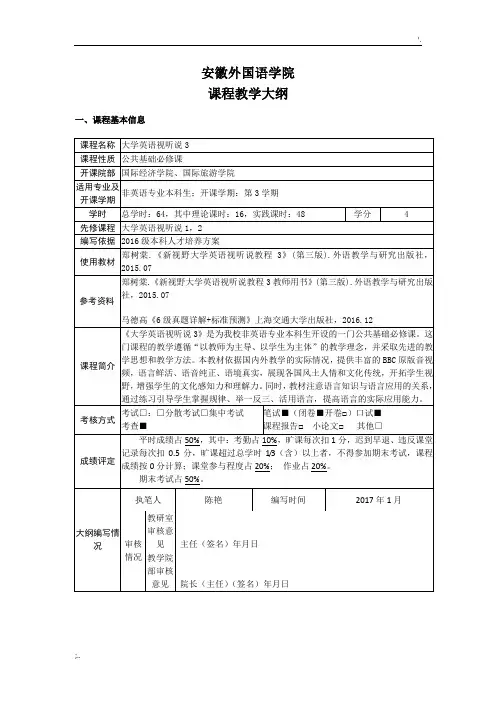
安徽外国语学院课程教学大纲一、课程基本信息二、课程教学目的英语视听说课程的教学目的是培养学生扎实的语言基本功和听说专业技能,即加强学生英语听力能力的同时着重发展学生的英语听说能力。
使学生在今后的工作和社会交往中能用英语有效地进行口头信息交流,同时培养和训练学生自主学习能力,提高综合文化素养,以适应我国社会发展和国际交流的需要,使学生能够真正具有良好的国际交流能力。
三、课程教学要求本课程教学大纲在教学要求上分为一般要求阶段(一年级)和较高要求阶段(二年级),本课程属于较高要求阶段。
现将本课程的教学要求规定如下:1、词汇:通过本课程的学习,学生的词汇量应应达到4500个单词和700个词组,其中2000个单词和500个词组为积极词汇,即要求学生能够在认知的基础上学会熟练运用,包括口头表达以及书面表达两个方面。
2、语法:巩固和加深基本语法知识,提高在语篇水平上运用句法结构的能力。
3、听的能力:能听懂英语讲课内容,能听懂一般性英语谈话和一般性题材讲座。
能基本听懂英语国家慢速英语教学节目,语速为每分钟130词左右,能掌握其中大意,抓住要点和有关细节。
能运用基本的听力技巧帮助领会讲话者的观点和态度。
4、说的能力:能在学习过程中与老师、同学进行交流,并能就某一主题进行讨论。
能就日常话题和来自英语国家的人士进行交谈。
能就所熟悉的话题经准备后作简短发言,表达比较清楚,语音、语调基本正确。
能在交谈中使用基本的会话策略。
四、课程教学内容和学时安排五、教学内容Unit 1 Access to Success1. Teaching ObjectivesTalk about SuccessTake notes by using a keyword outlineRefer to what you said earlierTalk about a challenge / an achievementHave a basic understanding of public speaking2. Key PointsHow to grasp the listening skill: note-taking by using a keyword outlineHow to grasp the speaking skill: refer to what you said earlierImportant and useful words and expressions3. Difficult PointsMastering the listening skill: note-taking by using a keyword outlineMastering the speaking skill: refer to what you said earlierContent1.Opening up2. Listening to the world1) Sharing: How do they feel about trying new things?What stops them from trying new things?What have they achieved in their life that makes them feel proud?Who do they admire in terms of achievements and why?2) Listening: before listening; while listening; after listening3) Viewing: before viewing; while viewing; after viewing3. Speaking for 3communication1).Role-play2).Speaking skills: Referring to what you said earlier3).Group discussion: The most impressive challengea.Get ideasb.Discuss and organize ideasc.Present ideas4. Further practice in listening1) Short conversations2) Long conversation3) Two passages5. Wrapping upUse the following self-assessment checklist to check what you have learned in this unit.6. CET-6 Training: Vocabulary1) The importance of enlarging one’s vocabulary2) Skills for memorizing vocabulary3) Analysis with examples4) CET-6 model listening trainingUnit 2 Emotions speak louder than words1. Teaching ObjectivesTalk about different emotionsGet familiar with the usage of problem-solution pattern.Know some signal words2. Key PointsHow to grasp the listening skill:Predict the theme and relevant vocabulary before you listenGrasp some signal words3. Difficult PointsThe usage of the problem-solution patternThe understanding of the organization of a speechThe usage of organizing ideasContent1.Opening up2. Listening to the world1) Sharing: How are they feeling today? Why?Would you describe yourself as an optimist or a pessimist? Why?What’s the best thing that’s happened to you this year?2) Listening: before listening; while listening; after listening3) Viewing: before viewing; while viewing; after viewing3. Speaking for communication1).Role-play2).Speaking skills: Overall organization of a speech3).Group discussion: The most impressive experiencea.Get ideasb.Discuss and organize ideasc.Present ideas4. Further practice in listening1) Short conversations2) Long conversation3) Two passages5. Wrapping upUse the following self-assessment checklist to check what you have learned in this unit.6. CET-6 Training: Listening for Conversations1) Skills for listening to conversations2) Analysis with examples3) CET-6 model listening trainingUnit 3 Love your neighbor1. Teaching ObjectivesTalk about neighbors and communitiesDistinguish fact from opinion in listeningLearn how to tell a story2. Key PointsTalk about planning a communityKnow the rules of about language use in public speakingUseful expressions3. Difficult PointsHow to grasp the specific informationHow to distinguish fact from opinion in listeningHow to learn public speaking skillsContent1. Opening up2. Listening to the world1) Sharing: Do you know your neighbors? How well do you know them?What do you think makes a good/bad neighbor?2) Listening: before listening; while listening; after listening3) Viewing: before viewing; while viewing; after viewing3. Speaking for communication1).Role-play2).Speaking skills: language in public speaking3).Group discussion: Way of planning a new communitya.Get ideasb.Discuss and organize ideasc.Present ideas4. Further practice in listening1) Short conversations2) Long conversation3) Two passages5. Wrapping upUse the following self-assessment checklist to check what you have learned in this unit.6. CET-6 Training: Listening for Long Conversations1) Skills for listening to long conversations2) Analysis with examples3) CET-6 model listening trainingUnit 4 What’ s the Big Idea?1.Teaching ObjectivesTalk about inventions and creative ideasPredict the theme and relevant vocabulary before you listenPropose ideas and comment on ideas while brainstorming2.Key PointsHow to grasp the listening skill:Predict the theme and relevant vocabulary before you listenHow to grasp the speaking skill: brainstorming3.Difficult PointsLearn to use voice, body language and visual aids in speech deliveryThe understanding of the organization of a speechThe usage of organizing ideasContent1. Opening up2. Listening to the world1) Sharing: What items do they enjoy buying most?What sorts of things do they buy on impulse?What recent product or service do they think is impressive?2) Listening: before listening; while listening; after listening3) Viewing: before viewing; while viewing; after viewing3. Speaking for communication1).Role - play2).Speaking skills: Making guesses3).Group discussion: Your business ideasa.Get ideasb.Discuss and organize ideasc.Present ideas4. Further practice in listening1) Short conversations2) Long conversation3) Two passages5. Wrapping upUse the following self-assessment checklist to check what you have learned in this unit.6. CET-6 Training: Listening for Passages1) Skills for listening to passages2) Analysis with examples3) CET-6 model listening trainingUnit 5 More than a paycheck1.Teaching ObjectivesTalk about different jobsListen for contrastManage a meeting/discussion2.Key PointsHow to master different kinds of jobsHow to get familiar with the topic of managing a meeting3.Difficult PointsHow to grasp the specific informationHow to listen for contrastHow to learn public speaking skillsContent1. Opening up2. Listening to the world1)Sharing: Have you ever considered the potential disadvantages of your dream job? Are you prepared to accept them when you take the job?Suppose you see your dream job advertised. Unfortunately, it asks for several specific skills and you’ve only got some of them. What would you probably?2) Listening: before listening; while listening; after listening3) Viewing: before viewing; while viewing; after viewing3. Speaking for communication1).Role-play2).Speaking skills: Managing a meeting3).Group discussion: Talk about a typical day in lifea.Get ideasb.Discuss and organize ideasc.Present ideas4. Further practice in listening1) Short conversations2) Long conversation3) Two passages5. Wrapping upUse the following self-assessment checklist to check what you have learned in this unit.6. CET-6 Training: Listening for Recordings of Lectures or Talks1) Skills for listening to recordings of lectures and or talks2) Analysis with examples3) CET-6 model listening trainingUnit 6 Histories make men wise1. Teaching ObjectivesTalk about important events and people in historyMake inferencesExpress uncertaintyTalk about an imaginary historyMake an informative speech in chronological or spatial order2. Key PointsHow to master the history of different periodsHow to get familiar making inferencesUseful expressions3. Difficult PointsHow to grasp the specific informationHow to express uncertaintyHow to make an informative speech in chronological or spatial orderContent1. Opening up2. Listening to the world1)Sharing: Do you think life better know than in the past?If you could have lived through a different age or decade, which would you choose and why?2) Listening: before listening; while listening; after listening3) Viewing: before viewing; while viewing; after viewing3. Speaking for communication1)Role-play2)Speaking skills: Expressing uncertainty3)Group discussion:What would have happened if Zheng He had reached the Americas first?a.Get ideasb.Discuss and organize ideasc.Present ideas4. Further practice in listening1) Short conversations2) Long conversation3) Two passages5. Wrapping upUse the following self-assessment checklist to check what you have learned in this unit.6. CET-6 Training: Listening for News Reports1) Skills for listening to news reports2) Analysis with examples3) CET-6 model listening training。