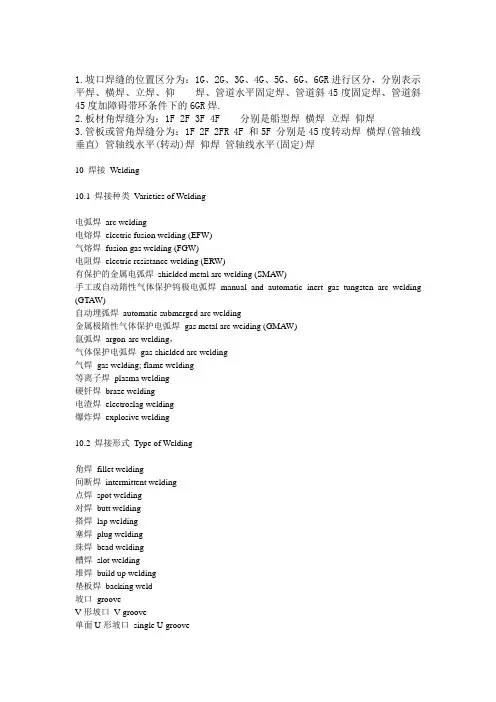
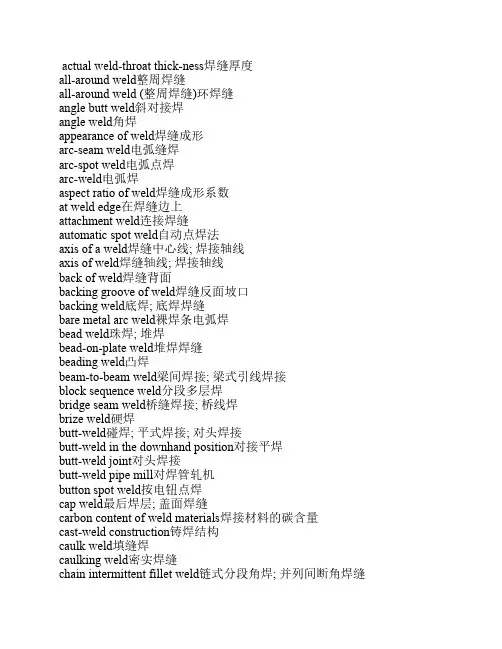
焊接英文翻译
- 格式:docx
- 大小:36.94 KB
- 文档页数:2
焊接英文翻译
Welding is a process of joining two or more metal parts together
by melting and fusing them. It is an essential technique in the
manufacturing and construction industries. Welding is used to
create strong and permanent connections between metal
components, which are crucial for the stability and integrity of
structures and machinery.
There are various types of welding processes, such as arc welding,
gas welding, and resistance welding. Each process has its own set
of tools and techniques. Arc welding, for example, utilizes an
electric arc between an electrode and the workpiece to generate
heat and melt the metals. Gas welding, on the other hand, involves
the combustion of a fuel gas like acetylene and oxygen to create a
high-temperature flame for melting the metals. Resistance welding
uses electric current to heat the metal parts and cause them to fuse
together.
Welding requires a high level of skill and expertise. A welder must
be knowledgeable about different types of metals and their
properties, as well as the appropriate welding techniques for each
material. They need to be able to interpret and follow technical
drawings and specifications, ensuring that the welds meet the
required strength and quality standards.
Safety is a crucial aspect of welding. Welders must wear protective
gear, such as helmets with face shields, gloves, and fire-resistant
clothing, to protect themselves from heat, radiation, and metal
splatter. They also need to follow safety procedures to prevent
accidents, such as electrical shocks or fires.
Welding is used in a wide range of industries. In manufacturing, it
is used to fabricate and assemble metal products, such as
automobiles, appliances, and machinery. In construction, welding
is used to join steel and other metals to create structures like
buildings, bridges, and pipelines. It is also used in shipbuilding,
aerospace, and the oil and gas industry.
Advancements in technology have led to the development of
automated welding systems. These systems use robots and
computer programs to perform welding tasks, increasing efficiency
and precision. They are particularly useful for repetitive and
complex welding operations.
In conclusion, welding is a vital process in the manufacturing and
construction industries. It involves melting and fusing metal parts
together to create strong and permanent connections. Welders
require skill and expertise to ensure that the welds meet the
required standards of strength and quality. Safety is also crucial in
welding, and protective gear must be worn to protect against heat,
radiation, and metal splatter. Welding is used in a wide range of
industries, and automation has improved efficiency and precision
in welding operations.