
英语五官的单词
- 格式:pptx
- 大小:1.97 MB
- 文档页数:12

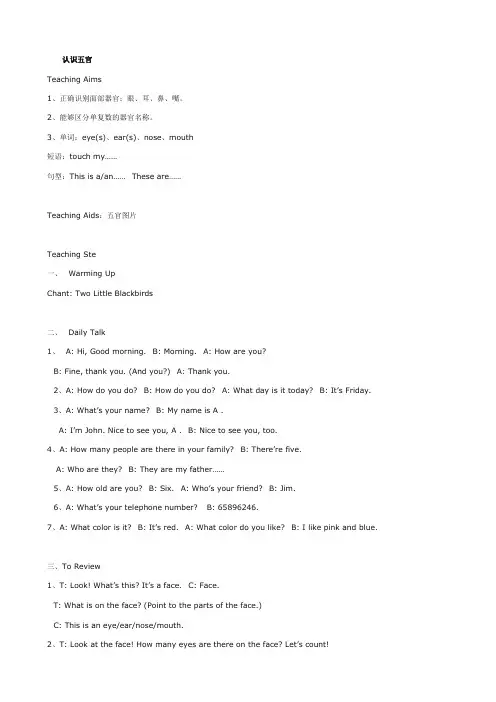
认识五官Teaching Aims1、正确识别面部器官:眼、耳、鼻、嘴。
2、能够区分单复数的器官名称。
3、单词:eye(s)、ear(s)、nose、mouth短语:touch my……句型:This is a/an……These are……Teaching Aids:五官图片Teaching Ste一、Warming UpChant: Two Little Blackbirds二、Daily Talk1、A: Hi, Good morning. B: Morning. A: How are you?B: Fine, thank you. (And you?) A: Thank you.2、A: How do you do? B: How do you do? A: What day is it today? B: It’s Friday.3、A: What’s your name?B: My name is A .A: I’m Jo hn. Nice to see you, A . B: Nice to see you, too.4、A: How many people are there in your family? B: There’re five.A: Who are they? B: They are my father……5、A: How old are you? B: Six. A: Who’s your friend?B: Jim.6、A: What’s your telephone number? B: 65896246.7、A: What color is it? B: It’s red.A: What color do you like? B: I like pink and blue.三、To Review1、T: Look! What’s this? It’s a face.C: Face.T: What is on the face? (Point to the parts of the face.)C: This is an eye/ear/nose/mouth.2、T: Look at the face! How many eyes are there on the face? Let’s count!T&;am C: One, two.C: Two eyes.T: Good. But what’s this? This is an eye/ear.C: This is an eye/ear.T: What are these? These are eyes/ears. C: These are eyes/ears.3、Game1T: What is mi ing? C: An eye/ear. A nose/mouth.T: What are mi ing? C: Eyes/ears.T: An ear mi ing. Right?(Cover two ears with a hand.) C: No. Ears.T: Very good. You’re right./You’re very smart.4、Game2T: Let’s draw the eye/ear/nose/mouth. I say and you draw. For example, if I say:“Draw one eye”. Please draw one eye on this face. OK?5、Game3T: Now, Let’s play another game. Please do as I ask you to. For example, if I say, “Touch your nose”. Please find and touch your nose with your finger and say, “I touch my nose”. OK?T: Touch your eye/eyes.C: I touch my eye/eyes.……T: You can do this game with your friend.四、Song: Eye and Ear。

幼儿园小班英语教案范文五官的单词和句型一、教学内容本节课选自幼儿园小班英语教材第三章《我的身体》,主要详细内容为五官的单词和句型。
涉及的五官单词包括:eye(眼睛)、ear (耳朵)、nose(鼻子)、mouth(嘴巴)和face(脸)。
句型主要围绕“这是我的……”、“我看见……”等进行学习。
二、教学目标1. 让学生掌握五官的英文单词,并能正确发音。
2. 让学生学会使用句型“这是我的……”、“我看见……”进行简单自我介绍和描述。
3. 培养学生对英语的学习兴趣,提高口语表达能力。
三、教学难点与重点1. 教学难点:五官单词的正确发音和句型的运用。
2. 教学重点:让学生熟练掌握五官单词和句型,并能运用到实际情景中。
四、教具与学具准备1. 教具:五官图片、教学卡片、挂图、录音机。
2. 学具:学生用书、练习册、彩色笔。
五、教学过程1. 热身活动(5分钟):播放英文儿歌《Head, Shoulders, Knees and Toes》,引导学生跟唱,活跃课堂气氛。
2. 实践情景引入(5分钟):邀请一位同学上台,用英文描述其五官,引导学生猜测。
3. 新课导入(10分钟):展示五官图片,引导学生学习五官单词,并进行发音纠正。
4. 句型学习(10分钟):通过挂图和教学卡片,教授句型“这是我的……”、“我看见……”,让学生进行模仿和练习。
5. 例题讲解(10分钟):给出一个例题,如“这是我的眼睛(This is my eye)”,引导学生进行句子构造。
6. 随堂练习(10分钟):发放练习册,让学生完成五官单词和句型的练习。
六、板书设计1. 五官单词:eye(眼睛)、ear(耳朵)、nose(鼻子)、mouth(嘴巴)、face(脸)。
2. 句型:This is my……(这是我的……)、I can see……(我看见……)。
七、作业设计1. 作业题目:用英文描述你的五官,并用所学句型进行自我介绍。
2. 答案示例:This is my face. I have two eyes, two ears,a nose and a mouth. I can see the world with my eyes.八、课后反思及拓展延伸1. 课后反思:观察学生在课堂上的表现,了解学生对五官单词和句型的掌握程度,针对问题进行教学调整。

描述人外貌的英语单词short 矮;
tall 高;
overweight 胖;
plump 丰满;
thin 瘦;
skinny太瘦;
slim 苗条;
medium height 不胖不瘦;
tubby 矮胖;
muscular 强壮;
elegantly 优雅;
good-looking 长的好看;
plain 长的一般;
smartly dressed 穿着得体;
well dressed 穿的漂亮;
neatly dressed 衣着干净整洁;
overweight 超重;
thin,slim 瘦;
fat,stout 肥胖的;
slender 苗条的;
blonde 金发;
cury,wavy hair 卷发;
pony tail 马尾;
脸部:freckle 雀斑;
dimple 酒窝;
oval face 鸭蛋脸;
bald 秃顶的;
bobbed短卷发的;
big-featured 五官较大的;double-chinned 双下巴的;high-cheekboned 颧骨很高;slender 苗条的;
sharp-featured 五官分明的;well-featured 五官端正的;pimpled 有粉刺的;
rosy红润的;
freckled 有雀斑的;wrinkled 起皱纹的;
double-faced 两面派的;well-Shaped 好看的;wrinkled 有皱纹的;
bony 瘦骨嶙峋的。

五官的英语单词1800字1. Eye –眼睛2. Ear –耳朵3. Nose –鼻子4. Mouth –嘴巴5. Lips –嘴唇6. Teeth –牙齿7. Tongue –舌头8. Jaw –下巴9. Cheek –脸颊10. Chin –下巴11. Forehead –额头12. Eyebrow –眉毛13. Eyelash –睫毛14. Earlobe –耳垂15. Nostril –鼻孔16. Nasal bridge –鼻梁17. Philtrum –人中18. Gum –牙龈19. Adam's apple –喉结20. Throat –喉咙21. Tonsil –扁桃体22. Palate –上颚23. uvula –腭帆24. Pupil –瞳孔25. Iris –虹膜26. Cornea –角膜27. Retina –视网膜28. Sclera –巩膜29. Optic nerve –视神经30. Eustachian tube –奥斯底管31. Cochlea –耳蜗32. Vestibular system –前庭系统33. Eardrum –鼓膜34. Pinna –耳廓35. Temporal bone –颞骨36. Maxilla –上颚骨37. Mandible –下颖骨38. Zygomatic bone –颧骨39. Nasal bone –鼻骨40. Frontal bone –额骨41. Occipital bone –枕骨42. Cervical vertebrae –颈椎43. Thoracic vertebrae –胸椎44. Lumbar vertebrae –腰椎45. Sacrum –骶骨46. Coccyx –尾骨47. Clavicle –锁骨48. Scapula –肩胛骨49. Humerus –上臂骨50. Radius –桡骨51. Ulna –尺骨52. Carpals –腕骨53. Metacarpals –掌骨54. Phalanges –指骨55. Femur –股骨56. Patella –髌骨57. Tibia –胫骨58. Fibula –腓骨59. Tarsals –跗骨60. Metatarsals –足掌骨61. Phalanges –趾骨62. Temporomandibular joint –颞下颌关节63. Salivary glands –唾液腺64. Hard palate –硬腭65. Soft palate –软腭66. Epiglottis –喉盖67. Glottis –声门68. Vocal cords –声带69. Bronchus –支气管70. Lung –肺71. Trachea –气管72. Diaphragm –横膈膜73. Epidermis –表皮74. Dermis –真皮75. Subcutaneous tissue –皮下组织76. Sweat gland –汗腺77. Hair follicle –毛囊78. Nerve endings –神经末梢79. Cartilage –软骨80. Joint –关节81. Muscle –肌肉82. Biceps –二头肌83. Triceps –三头肌84. Abdominal muscles –腹肌85. Quadriceps –股四头肌86. Hamstring –股二头肌87. Gluteus maximus –臀大肌88. Pectoral muscles –胸肌89. Deltoid muscle –三角肌90. Trapezius muscle –斜方肌91. Latissimus dorsi –背阔肌92. Gastrocnemius –腓肠肌93. Achilles tendon –跟腱94. Spine –脊柱95. Cerebellum –小脑96. Cerebrum –大脑97. Brainstem –脑干98. Pineal gland –松果体99. Pituitary gland –垂体100. Thyroid gland –甲状腺101. Parathyroid gland –甲状旁腺102. Adrenal gland –肾上腺103. Pancreas –胰腺104. Spleen –脾脏105. Liver –肝脏106. Gallbladder –胆囊107. Kidney –肾脏108. Ureter –输尿管109. Bladder –膀胱110. Urethra –尿道111. Esophagus –食道112. Stomach –胃113. Small intestine –小肠114. Large intestine –大肠115. Appendix –阑尾116. Rectum –直肠117. Anus –肛门118. Ovary –卵巢119. Fallopian tube –输卵管120. Uterus –子宫121. Cervix –宫颈122. Vagina –阴道123. Testis –睾丸124. Epididymis –附睾125. Vas deferens –输精管126. Penis –阴茎127. Prostate gland –前列腺128. Seminal vesicle –精囊129. Bulbourethral gland – Cowper腺130. Mammary gland –乳腺。