人教版必修三重点单词短语词组总结
- 格式:docx
- 大小:56.80 KB
- 文档页数:12
必修三
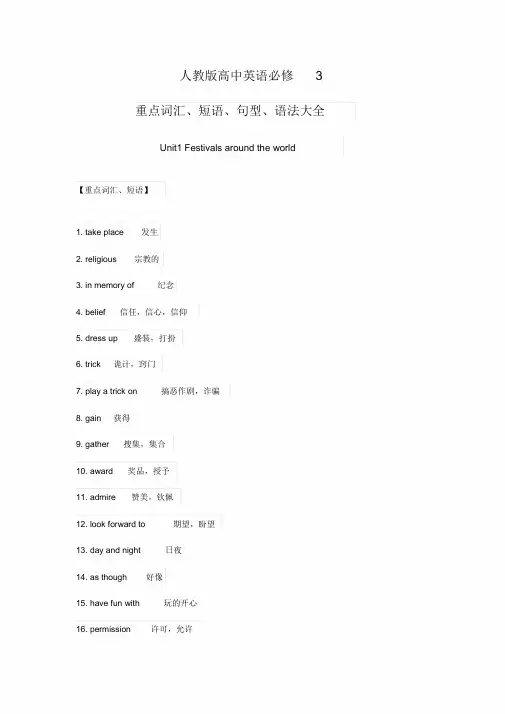
Unit1 Festivals around the world
【重点词汇、短语】
1. take place 发生 2. religious 的
3. in memory of 纪念 4. belief相信,信心,崇奉 5. dress up 盛装,妆扮 6. trick诡计,诀窍 7. play a trick on 搞恶作剧,诈骗
8. gain 获取 9. gather 收集,会合 10. award 奖品,授与 11. admire 赞叹,敬佩 12. look forward to 希望,期望 13. day and night 昼夜 14. as though 仿佛 15. have fun with 玩的高兴 16. permission 同意,同意 17. turn up 出现,出席 18. keep one’s word 守信誉 19. hold one’s breath 屏息 20. apologize 致歉 21. obvious 明显的 22. set off 出发,起程,使爆炸
【重点句型】
1. Please make sure when and where the accident took place.
请查清楚事故是何时何地发生的。
2. Some festival are held to honour the dead, or satisfy a
nd please the ancestors, who could return either to help or to do harm.
还有一些节日,是为了纪念死者、知足或取悦先人,因为(先人们)有可能回到世上帮助他们,也有可能带来危害。 3. In Japan the festival is called
Obon,
when people should go to clean the graves and light incense
in memory of their ancestors.
(非限制性定语从句) 在日本,这个节叫孟兰盆节,在这个节日里,人们要上坟、扫墓、烧香,以怀念
先人。
4. They dress up and try to frighten people. 他 装妆扮去吓 人。
5. If they are not given anything, the children might play
a trick.
假如你什么也不打 孩子,他 可能会愚弄 人。
6. In India there is a national festival on October 2 to
honour Mahatma Gandhi, the leader who helped gain India's in
dependence from Britain.
在印度, 10 月 2 日是 念 哈特 . 甘地的全国性 日,他是帮助印度离开英国
而独立的 袖。
7. The most energetic and important festivals are the ones
that look forward to the end of winter and to the coming
of spring. 最富生气而又最重要的 日,就是告 冬季、迎来春季的日子。
8. The country is covered with cherry tree flowers so that
it looks as though it might be covered with pink snow. 整个国家 都是 花绽放,看上去就像罩上了一 粉 色的雪。
【 法 】
情
定 :情 是一种自己有必定的 、 但要与 原形及其被 一同使用, 增加情 色彩,
表示 人 相关行 或事物的 度和见解, 其可能、 或必需等。
情 数目不多,主要有以下:
can (could), may (might), must, need, ought to, dare (dared)
, shall (should), will (would),have (to) ,had better. 一 . can 和 could 的用法
1. 表示能力或客 可能性, 能够表示 乞降允 。
注意:① could 也可表示 求, 气委宛,主要用于疑 句,不行用于必定句,答 用
can。 ②can 表示能力 , 可用 be able to 取代。
2. 表示惊诧、 疑、不相信的 度。(主要用在否认句、疑 句或惊 句中)
3. “can(could) + have + 去分 ”的疑 或否认形式表示 去 生的行 疑或不必定。 4. 用在疑 句及否认句中,表示惊 ,不相信等。 5. cannot ⋯too... 表示“无 怎 ⋯⋯也不 分”
二 . may和 might 的用法
1. 表示 可。
表示 求、允 , might 比 may的 气更委宛一些,否认回答 ( 口 中常用 ) no , you
can’t . or , yes, please 用 mustn’t表示“不可以够”、“严禁”、“阻挡”之意 ( 拥有 烈严禁的意思 ) 。
用 May I ⋯征 方 可在文体上比 正式,在口气上比 客气。在平时口 中,用 Can
I ... 征 方意 在 代口 中更 常 。
2. 用于祈使句中表示祝福。 3. 表示推 、可能(疑 句不可以用于此意)。 4. “may(might) + have + 去分 ”表示 去 生的行 的推 。
三 . must 和 have to 的用法
1. 表示必 、必需。( must 表示主 多一些而 have to 表示客 多一些)回答 must 引出的 句 ,假如能否认的回答,不可以用 mustn’t ,而要用 needn’t 或 don’t have to 。
2. “must be + 表 ”的 构表示推 , 它的否认或疑 式用 can 取代 must。
3. “must + have + 去分 ”的 构常用在必定句中, 表示 去 生 的行 的推 。它的否认或疑 式用 can 取代 must。 4. have to 的含 与 must 相像,二者常常能够互 使用,但 have to 有各
种形式,随 have 的 化而定。
注意: have to 也可拼做 have got to 。
四 . dare 和 need 的用法
1. need 表示“需要”,作情 , 用于否认句或疑 句中,在必定句 中一般用 must, have to, ought to, 或 should 取代。
注意:needn't + 不定式的达成式“表示本来不用做某事而 上做了某事”
2. dare 作情 ,主要用于疑 句、否认句和条件状 从句中,一般不用在必定句中。
3. dare 和 need 常用作 ,有 、人称和数的 化,所不一样的是,作 ,在必定句中, dare 后边平时接 to 的不定式,在否认和疑 句中, dare 后边可接 to 或不 to 的不定式。
五 . shall 和 should 的用法
1. shall 的用法:
①shall 用于第一人称,表示征采 方的意向。
② shall 用于第一、第三人称疑 句中,表示 人征采 方的意 或向 方 示。
③shall 用于第二、第三人称,表示 人 方命令、警示、允 或威 。
2. should 的用法:
①should 表示 告、建 、命令,其同 是 ought to ;在疑 句中,平时用
should 取代 ought to 。
②Why(or How) + should 构表示 人 某事不可以理解,感觉不测、惊诧
等意思。意为“竟会”。
③“ should + have + 过去分词”构造一般表示义务, 表示应当做到而实质上没有做到,并包括一种埋怨、责怪的口气。
六 . will 和 would 的用法
1. 表示恳求、建议等, would 比 will 委宛客气。 2. 表表示志、梦想和信心。
3. 用“ will be”和“ will(would) + have + 过去分词”的构造表示推
测,主要用于第二、三人称。前者表示对当前状况的推断,后者表示对已经达成的动作或局势的推断。
4. would 可表示过去频频发生的动作或某种偏向。 5. 表猜想或猜想。
七 . ought to 的用法
1. ought to 表示应当。 2. 表示推断。注意与 must 表示推断时的差别:
He must be at home by now. (判定他已到家)
He ought to be home by now. (不十分必定)
This is where the oil must be. (比较坦直)
This is where the oil ought to be. (比较委宛)
3. “ought to + have + 过去分词”表示过去应做某事而实质未做。 ought 和
should 的差别: 1.ought 语气略强。 2.should 较常用。 3.ought 在美国英语顶用的极少,而 should 却相当常用。 4.ought 属正式用语。
八 . used to ,had better , would rather 的用法
1. used to 表示过去的习惯动作或状态,此刻已不存在,在间接引语中,其形式可不变。如: He told us he used to play football when he was young.
2. had better 意为“最好”,后接不带 to 的不定式。 3. would rather 意为“情愿”,表选择,后接不带 to 的不定式。
Unit2 Healthy eating
【重点词汇、短语】
1. diet 平时饮食,节食