
初二when与while时间状语从句
- 格式:ppt
- 大小:1.47 MB
- 文档页数:11


when,while,as显然都可以引导时间状语从句,但用法区别非常大。
一、when可以和延续性动词连用,也可以和短暂性动词连用;而while和as
只能和延续性动词连用。① Why do you want a new job when you’ve got such a good one already?
(get为短暂性动词)你已经找到如此好的工作,为何还想再找新的?
②Sorry,I was out when you called me.(call为短暂性动词)对不起,
你打电话时我刚好外出了。
③Strike while the iron is hot.(is为延续性动词,表示一种持续的状
态)趁热打铁。④ The students took notes as they listened.(listen为延续性动词)
学生们边听课边做笔记。
二、when从句的谓语动词可以在主句谓语动作之前、之后或同时发生;while
和as从句的谓语动作必须是和主句谓语动作同时发生。
1.从句动作在主句动作前发生,只用 when。
①When he had finished his homework,he took a short rest.(finished先发生)当他完成作业后,他休息了一会儿。
②When I got to the airport,the guests had left.(got to后发生)
当我赶到飞机场时,客人们已经离开了。
2.从句动作和主句动作同时发生,且从句动作为延续性动词时,when,while,
as都可使用。
①When /While /As we were dancing,a stranger came in.(dance为延续性动词)当我们跳舞时,一位陌生人走了进来。
②When /While /As she was making a phone call,I was writing a
letter.(make为延续性动词)当她在打电话时,我正在写信。 3.当主句、从句动作同时进行,从句动作的时间概念淡化,而主要表示主句

when, while 和 as 引导时间状语从句的用法
一、when 的用法
如果只从现象来看,when 从句用的最多的是一般过去时,而主句的时态没有限制,根据具体情况而定。
When he was a child he was always trying out new ideas. 他小时候就常常试验一些新的设想。
when she came into my room I was just reading a book.
她走进我房间时,我正在看书。
Were you writing when the teacher came in? 老师进来的时候,你在写信吗?
Sorry,I was out when you called me. 对不起,你打电话来的时候我出去了。
He was on the point of leaving when someone knocked at the
door. 他正要走,这时有人敲门。
I thought of it just when you opened your mouth. 就在你要说话的时候,我也想到了。
I had hardly[scarcely] closed my eyes when someone knocked
at the door. 我刚一闭上眼,就有人在敲门了。
根据以上的例句,我们可以总结出一点:when 从句的A事件,相当于另一个事件B发生的时间点。也就是说,when 从句的重点不在动作本身发生的状态,而只是把它作为一个时间点,所以when 多数情况下用的是一般过去时,则不用正在进行时。因为如果用正在进行时,它表示的就是一段时间而不是一个时间点了。根据这一点,有的文章补充说:when 从句的动词大多是瞬时动词。这种说法也可以参照。
实际上,when 从句也可以有其它的时态,但几乎也不用进行时,因为它也只是作为一个时间参照点。例如:

用作状语的从句叫作状语从句。状语从句用于修饰主句中的动词、形容词或
副词等。时间状语从句是指复合句中充当时间状语的句子,其关联词有before、
after、when、while、as、since、till、until、as soon as等。在这当中,学生容
易混淆when和while的用法,而这两词又恰好是考试高频单词,所以明晰when
与while在引导时间状语从句时的用法异同至关重要。
一、when与while在引导时间状语从句时的相同用法
1. when和while在引导时间状语从句时,它们既可放句首,也可放句中,都
含有“当……时候”“与此同时”之意。例如:
When he was very young, Tan Dun showed an interest in music. 很小的时候,
谭盾就对音乐感兴趣。
I will call you when I’ m ready. 我准备好就给你打电话。
While he was attending junior high, Spud tried out for the school team. 在他上
初中时,斯巴德参加了校队的选拔。
He always listens to the radio while he’ s driving to work. 他开车上班途中总听
广播。
2.在when和while引导的时间状语从句中,用一般现在时表示将来时,简称“主
将从现”,用一般过去时代替过去将来时,简称“主过从过”。例如:
When I get there, I’ ll ring you up. 我到那儿后,给你打电话。(主将从现)
I’ ll ask him about it when he comes. 他来时我要问他这件事。(主将从现)
He jumped up when the phone rang. 电话铃响了,他猛地跳了起来。(主过
从过)
Racing was halted for an hour while the track was repaired. 修理赛道时,车
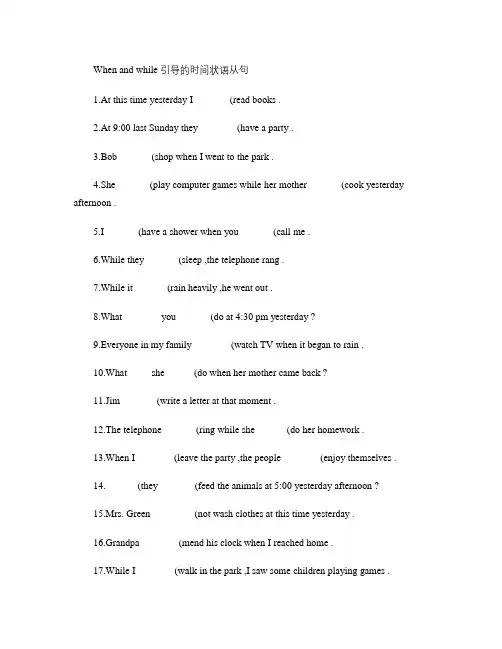
When and while 引导的时间状语从句
1.At this time yesterday I _______(read books .
2.At 9:00 last Sunday they _______ (have a party .
3.Bob ______ (shop when I went to the park .
4.She ______ (play computer games while her mother ______ (cook yesterday
afternoon .
5.I ______ (have a shower when you ______ (call me .
6.While they ______ (sleep ,the telephone rang .
7.While it ______ (rain heavily ,he went out .
8.What _______ you ______ (do at 4:30 pm yesterday ?
9.Everyone in my family _______ (watch TV when it began to rain .
10.What ____ she _____ (do when her mother came back ?
11.Jim _______(write a letter at that moment .
12.The telephone ______ (ring while she ______(do her homework .
13.When I _______ (leave the party ,the people _______ (enjoy themselves .
14.______ (they _______(feed the animals at 5:00 yesterday afternoon ?