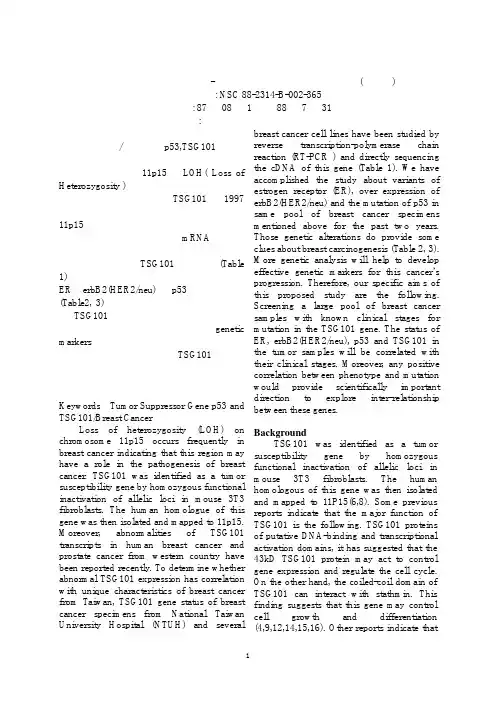
¦æ¬F°|°ê®a¬ì¾Ç©e-û·|±MÃD¬ã¨s-p¹º¦¨ªG³ø§i¥xÆW¨ÅÀù¯f²z¦¨¦]¤§¬ã¨s-§íÀù°ò¦]¦b¨ÅÀù§Î¦¨¤¤¤§-«-n©Ê (²Ä¤T¦~)-p¹º½s¸¹: NSC 88-2314-B-002-365°õ¦æ¦~--: 87¦~08¤ë1¤é¦Ü88¦~7¤ë31¤é¥D«ù¤H : ³\ª÷¥É¥x¤jÂå¾Ç°|¥Í¤Æ©Ò¤¤¤åºK-nÃöÁäµü¡G¨ÅÀù/§íÀù°ò¦]p53,TSG101³\¦hªº¬ã¨s³ø§iÅã¥Ü¦b¨ÅÀù²Ó-M¤¤¦³«Ü°ª¤ñ¨Òªº¬V¦âÅé11p15¤§LOH(Loss of Heterozygosity )Åܲ§¡A Åã¥Ü¦¹°Ï°ì¤§°ò¦]Åܲ§»P¨ÅÀù¤§§Î¦¨¦³Ãö¡F¦ÓTSG101¬O 1997¦~¤~µo ²{¤§§íÀù°ò¦]¡A ¦¹°ò¦]´N ¦ì©ó11p15¡A¦Ó¥B³Ìªñªº³ø¾É«ü¥X ¡A¨ÅÀù²Ó-M¤¤½T¹ê·|§t¦³¦¹°ò¦]¤£¥¿±`ªºmRNA ªí²{¡A ¦]¦¹¦b³o-Ó-pµeùØ¡A §Ú-̥ΨӦۥx¤jÂå°|ªº¤@§å¨ÅÀùÀËÅé°µTSG101ªº¤ÀªR (Table 1)¡A¤S¥Ñ©ó³o§åÀËÅé¡A§Ú-̤w¸g¤ÀªR¹L¨äER¡A erbB2(HER2/neu)¤Îp53ªºªí²{±¡§Î(Table2, 3)¡A±N¨Ó§Ú-Ì¥i¥H¦P®É©Î¤À¶}¨Ó¤ÀªR TSG101¤Î³o¨Ç°ò¦]»PÁ{§É¯fª¬ªº¬ÛÃö©Ê¡A³o±N´£¨Ñ¤@-Ó§ó-ѯS²§©Êªºgenetic markers ¨ÓÀ°§U¤F¸Ñ¦¹Àù¯g¥i¯àªº-P¯f¾÷Âà¡A ¦Ó¥B¥i¥H´£¨Ñ±N¨Ó¬ã¨s T SG101ªº¥Í²z ¥\¯àªº¤è¦V ¡A ¥H¤Î³o ¨Ç°ò¦]¬Û¤¬¶¡ªº§@¥Î¡C -^¤åºK-nKeywords¡G Tumor Suppressor Gene p53 and TSG101/Breast CancerLoss of heterozygosity (LOH) on chromosome 11p15 occurs frequently in breast cancer indicating that this region may have a role in the pathogenesis of breast cancer. TSG101 was identified as a tumor susceptibility gene by homozygous functional inactivation of allelic loci in mouse 3T3fibroblasts.The human homologue of this gene was then isolated and mapped to 11p15.Moreover, abnormalities of TSG101transcripts in human breast cancer and prostate cancer from western country have been reported recently. To determine whether abnormal TSG101 expression has correlation with unique characteristics of breast cancer from Taiwan, TSG101 gene status of breast cancer specimens from National Taiwan University Hospital (NTUH) and several breast cancer cell lines have been studied by reverse transcription-polymerase chain reaction (RT-PCR ) and directly sequencing the cDNA of this gene (Table 1). We haveaccomplished the study about variants ofestrogen receptor (ER), over expression of erbB2(HER2/neu) and the mutation of p53 in same pool of breast cancer specimens mentioned above for the past two years.Those genetic alterations do provide someclues about breast carcinogenesis (Table 2, 3).More genetic analysis will help to developeffective genetic markers for this cancer’sprogression. Therefore, our specific aims ofthis proposed study are the following.Screening a large pool of breast cancer samples with known clinical stages for mutation in the TSG101 gene. The status of ER, erbB2(HER2/neu), p53 and TSG101 in the tumor samples will be correlated with their clinical stages. Moreover, any positivecorrelation between phenotype and mutation would provide scientifically importantdirection to explore inter-relationshipbetween these genes.Background TSG101 was identified as a tumor susceptibility gene by homozygous functional inactivation of allelic loci in mouse 3T3 fibroblasts. The human homologous of this gene was then isolated and mapped to 11P15(6,8). Some previous reports indicate that the major function of TSG101 is the following. TSG101 proteins of putative DNA-binding and transcriptional activation domains, it has suggested that the 43kD TSG101 protein may act to control gene expression and regulate the cell cycle.On the other hand, the coiled-coil domain of TSG101 can interact with stathmin. This finding suggests that this gene may control cell growth and differentiation (4,9,12,14,15,16). Other reports indicate thatTSG101 transcripts are frequently abnormal in human cancer cell, including breast cancer (1,2,3,13,17), prostate cancer (11), and leukemia (5). The major type of abnormality of TSG101 is aberrant splicing but not mutations (7,10). The relaxation of RNA splicing fidelity of TSG101 may be an oncodevelopment marker in cancer. We,therefore, plan to screen the status of TSG101 in a large pool of breast cancer samples that has been analyzed for ER,erbB2(HER2/neu) and p53 alterations in my laboratory. Clinical data including the pathologic stage, histologic type and follow-up will be collected. Then, the statistical analysis will be use to clarity the association between genetic alterations of ER,erbB2(HER2/neu), p53 as well as TSG101and clinical outcome.ResultTo detect the aberrant transcripts of TSG101 gene in breast cancer as well as the normal counterpart.According to the structure of TSG101 gene,two pairs of primer (p1/p2 and p3/p4) have been used to analyze any of the TSG101truncated transcripts by RT-PCR. Further restriction enzyme mapping or sequencing of RT-PCR products have been performed to dissect those truncated transcripts as well.The results were listed in table 3.DiscussionIn this preliminary study the abnormal TSG101 transcripts have been detected in tissues of breast cancers but not normal counterparts. These abnormalities of TSG101may play some role in carcinogenesis of breast. Therefore , clinical data including the pathologic stage, histologic type and fellow-up will be collected. Then, the statistical analysis will be used to clearify the associations between genetic alterations of ER, neu, p53 as well as TSG101 and clinical outcome.Table 1:HER-2/neu Row-P=0.018P53+Column Total56.3%43.7%100% HER-2/neuRow -P=0.031PR+Column Total 56.4%43.6%100%p53Row-P=0.004ER+Column Total74.2%25.8%100%Note:HER-2/neu¡G¡Ï¡÷overexpression¡Ð¡÷low level of expression/no expressionp53¡G¡Ï¡÷ point mutation¡Ð¡÷ wild-typeTable 2:p53 Row-P=0.00193Systemic recurrence+Column Total74.1%25.9%100%HER-2/neuRow -P=0.5617Systemic recurrence +Column Total 56.1%43.9%100%Note:HER-2/neu¡G¡Ï¡÷overexpression¡Ð¡÷low level of expression/no expressionp53¡G + ¡÷ point mutatation¡Ð¡÷ wild-typeSystemic recurrence¡G¡Ï¡÷three year’s follow-up¡Ð¡÷no recurrence on follow-up dateREFERENCES1. Benard J. Ahomadegbe JC. TSG101 and breast ca Ali, I.U., Lidereau, R., Theillet, C. & Callahan, R. Reduction to homozygosity of genes on ncer: a correctly named tumor-suppressor gene? Bulletin du Cancer. 84(12):1141-2, 1997Dec.2. Driouch K. Briffod M. Bieche I. Champeme MH. Lidereau R. Location of several putative genes possibly involved in human breast cancer progression. Cancer Research. 58(10):2081-6, 1998 May 15.3. Hofferbert S. Brohm M. Weber BH. Search for TSG101 germ-line mutations in BRCA1/BRCA2-negative breast/ovarian cancer families Cancer Genetics & Cytogenetics. 102(1):86-7, 1998 Apr 1.4. Koonin EV. Abagyan RA. TSG101 may be the prototype of a class of dominant negative ubiquitin regulators Nature Genetics. 16(4):330-1, 1997 Aug.5. Lin PM. Liu TC. Chang JG. Chen TP. Lin SF. Aberrant TSG101 transcripts in acute myeloid leukaemia. British Journal of Haematology. 102(3):753-8, 1998Aug.6. Lee MP. Feinberg AP. Aberrant splicing but not mutations of TSG101 in human breast cancer. Cancer Research. 57(15):3131-4, 1997 Aug 1.7. Li L. Li X. Francke U. Cohen SN. The TSG101 tumor susceptibility gene is located in chromosome 11 band p15 and is mutated in human breast cancer. Cell.88(1):143-54, 1997.8. Li L. Cohen SN. Tsg101: a novel tumor susceptibility gene isolated by controlled homozygous functional knockout of allelic loci in mammalian cells. Cell.85(3):319-29, 1996 May 3.9. Ponting CP. Cai YD. Bork P. The breast cancer gene product TSG101: a regulator of ubiquitination?. Journal of Molecular Medicine. 75(7):467-9, 1997 Jul.10. Steiner P. Barnes DM. Harris WH. Weinberg RA. Absence of rearrangements in the tumour susceptibility gene TSG101 in human breast cancer Nature Genetics. 16(4):332-3, 1997 Aug.11. Sun Z. Pan J. Bubley G. Balk SP.Frequent abnormalities of TSG101 transcripts in human prostate cancer. Oncogene. 15(25):3121-5, 1997 Dec 18.12. Thomson TM. Khalid H. Lozano JJ. Sancho E. Arino J. Role of UEV-1A, a homologue of the tumor suppressor protein TSG101, in protection from DNA damage. FEBS Letters. 423(1):49-52, 1998 Feb 13. 13. Wang Q. Driouch K. Courtois S. Champeme MH. Bieche I. Treilleux I. Briffod M.Rimokh R. Magaud JP. Curmi P. Lidereau R. Puisieux A. Low frequency of TSG101/CC2 gene alterations in invasive human breast cancers. Oncogene. 16(5):677-9, 1998Feb 5.14. Watanabe M. Yanagi Y. Masuhiro Y. Yano T. Yoshikawa H. Yanagisawa J. Kato S. A putative tumor suppressor, TSG101, acts as a transcriptional suppressor through its coiled-coil domain. Biochemical & Biophysical Research Communications.245(3):900-5, 1998 Apr 28.15. Xie W. Li L. Cohen SN. Cell cycle-dependent subcellular localization of the TSG101protein and mitotic and nuclear abnormalities associated with TSG101 deficiency. Proceedings of the National Academy of Sciences of the United States of America.95(4):1595-600, 1998 Feb 17.16. Zhong Q. Chen Y. Jones D. Lee WH. Perturbation of TSG101 protein affects cell cycle progression. [Journal Article] Cancer Research. 58(13):2699-702, 1998 Jul 1.17. Zhong Q. Chen CF. Chen Y. Chen PL. Lee WH. Identification of cellular TSG101 protein in multiple human breast cancer cell lines. Cancer Research.57(19):4225-8, 1997 Oct 1.Table 3 Truncated transcripts of TSG101 in pair specimens4。


![行政院国家科学委员会专题研究计画成果报告[001]](https://imgs-1438308264.cos.ap-hongkong.myqcloud.com/ce64961179563c1ec5da71ff.webp)