
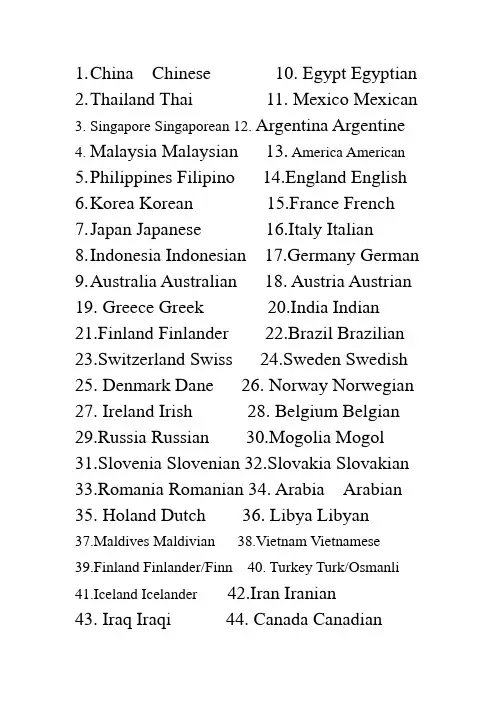
Names of countries
- 格式:doc
- 大小:19.50 KB
- 文档页数:2

中国姓氏和外国姓氏区别英语作文全文共6篇示例,供读者参考篇1The Differences Between Chinese Surnames and Foreign SurnamesHi everyone! My name is Xiao Ming and I'm going to tell you all about the really cool differences between Chinese surnames and the surnames from other countries. Surnames are like your family's last name. It's the name you share with your parents, grandparents, aunts, uncles and cousins.In China, we have some super ancient and interesting surnames. Some Chinese surnames are over 3,000 years old! Can you believe that? The three most common Chinese surnames are Wang, Li and Zhang. Other popular ones are Liu, Chen, Yang, Huang, Zhao and Zhou. My surname is Wang, which means "king" or "ruler." How awesome is that?Chinese surnames are just one part of our full names though. We also have a generational name that only the kids in one family get. And then we have our given name too. So my full name is Wang Da Ming. "Wang" is my surname, "Da" is thegenerational name my parents gave me and my siblings, and "Ming" is my given name that only I have.The really unique thing about Chinese surnames is that there aren't that many of them compared to other countries. Out of all the people in China, which is like 1.4 billion people, we only use about 4,000 different surnames! The rest of the world has wayyyy more variety in their surnames.A lot of Chinese surnames actually come from things in nature or describe a person's looks or profession. For example, the surname "Jiang" means "river" and "Hua" means "flower." How pretty! The surname "Zhang" comes from a word meaning "craftsman" or "carpenter." Maybe someone's ancestor was a really talented builder.In other countries, there's such an endless variety of surnames. Many of them started out describing a person's job, just like in Chinese. The surname "Baker" comes from someone who baked bread. "Miller" is someone who worked at a mill grinding grain. And "Carter" meant they transported goods. So cool!Some foreign surnames also describe what a person looked like physically, kind of like Chinese surnames do too. The surname "Black" probably came from someone who had blackhair. And "Short" makes me think of a small person! The surname "Youngman" seems to come from someone whowas...well...young!But my favorite kinds of foreign surnames are the really crazy, ridiculous ones. Like who would want to be called "Dingleberry?" That just sounds gross! Or how about "Prendraville?" I can barely even say that one. Maybe it's from some funny old language. The surname "Smellie" doesn't smell too good to me! Haha!Foreign surnames can also come from the names of places, which is pretty different from Chinese surnames. Like "England" and "Holland" are just places names that became surnames for people who lived there a long time ago. Or "Park" for someone who lived near a park. Those kinds of surnames don't really exist in Chinese.Another big difference is that a lot of foreign surnames change based on if you're a boy or a girl. Like "Jackson" is a surname for a boy, but for his sister it could be "Jacksondaughter." That doesn't happen at all in Chinese where everyone in the same family just has the same one surname whether you're a boy or a girl.So those are the major differences I can think of between Chinese surnames and foreign surnames. Chinese surnames are ancient, have deep meanings, and there aren't that many compared to other countries. Foreign surnames draw from all kinds of crazy sources like foods, nature, jobs, and places. But aren't they all just super fascinating?Surnames are such an interesting way to learn about a culture and a family's history. I feel so lucky to have such an honored surname like "Wang" that links me to so many generations before me. Maybe I'll give a presentation to my class about Chinese surnames versus foreign surnames. What do you think? I bet my classmates would think it was as interesting as I do! Okay, that's all for now. Thanks for reading my essay!篇2The Differences Between Chinese and Foreign Last NamesHi there! My name is Xiao Ming and I'm going to tell you all about the cool differences between Chinese last names and last names from other countries. It's a really interesting topic that I learned about in school.In China, we put our last name first and then our first name. So my full name is Wang Xiao Ming. Pretty much every Chineseperson has just one syllable for their last name. Some examples are Wang, Li, Zhang, Liu, Chen, Yang and Huang. There are around 500 common last names used in China.The really awesome part is that Chinese last names aren't just random names. A lot of them actually have special meanings! For example, my last name Wang means "king" or "ruler." How cool is that? The Wang family must have been very important and powerful a long time ago. Other last names like Zhang (张) mean "stretch" or "extend", while Huang (黄) means "yellow" and Liu (刘) means "somber" or "brilliant." Knowing the meanings can give you hints about your family's history and background.Chinese last names are also grouped into different categories based on their origins. Some are derived from the names of ancient states or places, like the Zhou surname which comes from the Zhou Dynasty that ruled over 3,000 years ago! Other surnames are job-related, like the last name Jiang which refers to someone who worked with wood or the surname Shi which meant governing official or scholar. There are even surnames that come from describing a person's appearance or characteristics, like the name Bian meaning "pretty" or Xiao meaning "small."In contrast, a lot of foreign last names don't have any special meanings. They are just family names that get passed down. Popular ones are Smith, Johnson, Williams, Jones, Brown and Miller. While these don't really mean anything, some foreign last names did originate from describing a person's job, just like Chinese surnames. For example, Baker could have been someone who baked bread, while Carpenter worked with wood.Another major difference is that a lot of foreign surnames have multiple syllables and can be really long and complicated to pronounce for Chinese people. Examples are Wolmenhausen, Schweinholfer or Zdroblickawitz. Chinese last names only have one syllable so they are simpler. Of course, some foreign last names are short too like Lee or Kim. But in general, Chinese surnames are more compact.Spelling is also quite different between Chinese and foreign last names. We write Chinese surnames using characters, while English last names use the alphabet. Foreign surnames often have funky letter combinations like the "ck" in Lockhart or "ough" inOughterbaughter. I think Chinese surnames written in characters look cooler and more artistic!But one thing that isn't too different is that both Chinese and foreign surnames get passed down from parents to children,keeping the family lineage going. So while the names themselves are quite unique, they both allow you to maintain a connection to your ancestors.There are definitely a lot more differences that I could talk about when it comes to Chinese versus foreign last names, like how we don't have middle names or how Chinese surnames have been around for way longer. But I think you get the main idea - our naming systems are pretty different which makes total sense since China has its own amazing culture and traditions. Learning about names is a fun way to appreciate how diverse the world is. Thanks for reading my essay! Let me know if you have any other questions.篇3Surnames Are Cool!Hi everyone! Today I want to talk about something really interesting - last names! You might be thinking "Boring! Who cares about last names?" But trust me, once you learn about the awesome differences between Chinese surnames and foreign surnames, you'll think they are super cool too!In China, we have some really unique traditions when it comes to surnames. First of all, we put our surnames first! So myname is Wang Michael, not Michael Wang. Isn't that different and special? In English speaking countries and lots of other places, the personal name comes before the family name.Another crazy difference is that in China, we only have a few hundred commonly used surnames. Can you believe that? With over 1 billion people in China, we all share just a few hundred last names! The most common ones are Li, Wang, Zhang, Liu and Chen. If you lined up everyone with those 5 surnames, there would be over 300 million people!On the other hand, in many other countries there are millions and millions of different surnames. Just in the United States alone, there are over 6 million unique last names according to the U.S. Census! Places like Russia, India and Arabic countries also have way more variety in surnames compared to China. How crazy is that?But why is there such a big difference? Well, it all goes back to ancient Chinese history and traditions. You see, in ancient times, only aristocrats and royalty had surnames. Regular people didn't use them at all. Eventually, surnames started spreading from the nobles to commoners, but there were still not that many in use.Chinese surnames also have a lot of meaning behind them. Many come from describing a person's appearance, like Zhang meaning "thick" or Huang meaning "yellow." Others are about a person's character, like Shan meaning "kind" or Xing meaning "fortunate." Pretty cool, right?In contrast, many foreign surnames developed from occupation names, place names, or just describing someone's father. For example, the English surname "Baker" meant someone made bread, while "Cambridge" meant someone was from that city. The Russian name "Ivanov" means "son of Ivan." With so many possibilities, it's no wonder there is more variety worldwide.Even though we only have a limited number of surnames in China, we get pretty creative in trying to make them unique! One popular method is using generational names or name banners. So while I might just be "Wang," my dad could be "Wang the Second" and my grandpa is "Wang the First." We love adding these special titles!Another thing that makes Chinese surnames interesting is that we have different characters representing the same sound. My surname "Wang" can be written as either 王or 汪. Those are two completely separate characters with their own meanings,even though they sound exactly the same when spoken. Isn't that so cool?In many other cultures, the spelling is consistent no matter what. Like the surname "Johnson" always uses those letters, no variations. China having multiple characters for the same sound is a really unique aspect of our surnames.Lastly, in some parts of China, we even have separate surnames for males and females in the same family! For example, the male's surname might be Liang, while the female's is Sheng. This doesn't happen everywhere, but in places like Hunan province it is actually pretty common. Most countries just use the same surname for everyone.So as you can see, there are tons of fun differences when it comes to Chinese surnames versus those from around the world. We have way fewer choices, but also lots of special meaningful customs and variations to make them unique.Surnames might seem boring at first, but they are actually windows into a culture's history, values and traditions. Whether it's the 6 million different last names in the U.S. or the few hundred we use in China, surnames have cool stories to tell. Next time you hear a surname, don't just brush it off as a boring name- appreciate all the fascinating cultural roots and meanings behind it!篇4The Fascinating World of Last NamesHello friends! Today I want to talk about something very interesting - last names. You might be thinking "Last names? How boring!" But trust me, once you learn about the cool differences between Chinese last names and foreign last names, you'll be just as fascinated as I am!First, let's start with Chinese last names. In Chinese, the last name always comes before the first name. So someone like me would say "My name is Wang Xiaoming" instead of "Xiaoming Wang." Isn't that different from English names?Chinese last names are really ancient. Many of them have been around for thousands of years! Some of the most common ones are Wang, Li, Zhang, Liu and Chen. These names often came from things found in nature like plants, animals or landscapes. For example, the last name "Shan" means mountain. How cool is that?Another special thing about Chinese last names is that there aren't that many of them compared to other countries. Out of the entire Chinese population, which is over 1 billion people, about 40% share just 100 last names! Imagine having a classmate with the exact same name as you. That would be so confusing!Now let's talk about foreign last names, which I find just as fascinating. Many foreign last names originated as nicknames that described a person's job, location, or personality traits. For example, the English last name "Baker" literally means someone who baked bread for a living. And "Wilson" means "son of Will." Pretty straightforward!In some cultures, women change their last name when they get married and take their husband's name. But in other cultures, they keep their original last names. In China, the family name is so important that nobody changes it, whether they're a man or woman.Another interesting difference is that while Chinese last names are short (usually just one syllable), many foreign last names are quite long with multiple syllables. Just try saying this Scottish last name: "Featherstonehaugh!" It's a mouthful, isn't it?Some foreign last names are also created by combining two last names together through marriage. Like if someone namedKevin Patel married someone named Ashley Garcia, their new combined last name could be Patel-Garcia or Garcia-Patel. Combining last names isn't really a tradition in Chinese culture.Lastly, let's not forget about fun last names from around the world that make you smile! Like "Burger" (I'm getting hungry just thinking about it), "Cumberbatch" (try saying that three times fast), or "Papademitriou" (I have no idea how to even pronounce this Greek one). If you had a weird last name like that, wouldn't you always get laughs on the first day of school?Well, those are some of the most fascinating differences I've learned about Chinese and foreign last names. Aren't you glad you kept reading? Last names may seem like a little thing, but they actually say a lot about a person's culture, history and identity. The next time you make a new friend, you should ask them about the meaning of their cool last name! Who knows, you might learn something amazing.篇5Here's an essay on the differences between Chinese surnames and foreign surnames, written from the perspective of an elementary school student in English (around 2000 words):Chinese and Foreign Surnames: A Big Difference!Hi everyone! Today, I want to talk about something super interesting – the difference between Chinese surnames and foreign surnames. You might be thinking, "What's the big deal?A surname is just a surname, right?" Well, let me tell you, there's actually a lot more to it! Get ready to have your mind blown!First of all, let's talk about Chinese surnames. In Chinese culture, surnames are like a badge of honor. They represent your family's history, traditions, and even the region your ancestors came from. Pretty cool, huh? Chinese surnames are usually just one or two characters long, like Wang, Li, Zhang, or Chen. And get this – there are only about 4,000 different Chinese surnames in use today! That might sound like a lot, but when you think about how many people live in China, it's actually not that many.Now, let's talk about foreign surnames. Unlike Chinese surnames, which have a long history and cultural significance, foreign surnames can come from all sorts of different places. Some are based on a person's occupation, like Smith (for a blacksmith) or Baker (for someone who bakes bread). Others are derived from place names, like Johnson (son of John) or Greenfield (someone who lived near a green field). And then there are those weird and wacky ones that just sound funny, likeKnickerbacker or Featherstonehaugh (try saying that one five times fast!).Another big difference between Chinese and foreign surnames is how they're passed down. In Chinese culture, surnames are inherited from the father's side of the family. So, if your dad's surname is Wang, yours will be Wang too. But in many other cultures, surnames can be passed down from either the father or the mother's side, or even combined from both parents' surnames.Now, let's talk about the actual writing of surnames. Chinese surnames are written using Chinese characters, which are these beautiful, intricate symbols that have been around for thousands of years. Each character has a specific meaning and pronunciation, and when you put them together, they form words and names. Foreign surnames, on the other hand, are written using the alphabet – you know, those 26 letters we all learn in kindergarten.One thing that's really cool about Chinese surnames is that they often have special meanings or stories behind them. For example, the surname "Li" is said to have originated from a ruler who was so kind and generous that his people called him "ThePlum Tree" (because plum trees provide shade and fruit for everyone). Isn't that a sweet story?On the other hand, foreign surnames can sometimes sound a bit, well, weird or even funny. Like, imagine having the surname "Dingleberry" or "Lipschitz." I'm not sure I'd want to be called that every day!Of course, there are exceptions to these differences too. Some foreign cultures, like Spanish or Italian, also have a tradition of passing down surnames from the father's side. And some Chinese surnames can be pretty long and complicated, like "Zhuangguanxiaoloubanzhuren" (which means "the chief officer in charge of the Zhuang village's granary"). Try fitting that on a nametag!Overall, I think it's really interesting to learn about the differences between Chinese and foreign surnames. It's like getting a little glimpse into different cultures and traditions from all around the world. Plus, it makes for a great conversation starter at parties! "Hey, did you know that the Chinese surname 'Zhang' means 'descendant of a potter'? Cool, right?"Well, that's all I've got for you today, folks. I hope you've learned something new and interesting about surnames. And who knows, maybe one day you'll even get the chance to visitChina and see all those beautiful Chinese characters up close! Until next time, keep exploring and learning about the world around you. It's a big, amazing place out there!篇6Surnames Are So Cool!Hi friends! Today I want to tell you all about surnames. Surnames are the last names that people have. They are really neat and come from all over the world. But did you know that Chinese surnames are quite different from surnames in other countries? Let me explain!In China, we have something called the Hundred Surnames. That means there are just 100 family names that almost every single Chinese person has. Isn't that crazy? The most common ones are Li, Wang, Zhang, Liu, Chen, Yang, Huang, Zhao, Wu and Zhou. My surname is Wang, which means "king" - how cool is that?But in the United States and other Western countries, there are just sooooo many different last names. My American friend Becky's last name is Schonfeldt. Another friend's is Ardianhki. And my teacher Mr. Jones has that super common last name too. There are millions of possibilities for foreign surnames.So why is there such a big difference between Chinese and foreign last names? Well, it all goes back hundreds of years to ancient China. You see, waaaaaay back then, the emperor said there could only be a few main surnames to make things simple. All the surnames came from things like professions, locations, or even characteristics.For example, the surname Li came from the word for "plum." Maybe some families lived where there were a lot of plum trees? Or the surname Wang came from an old word meaning "king" - so those families could have been royal. Isn't that neat?But in Western countries, surnames developed randomly over time from all kinds of places and people. Maybe a surname came from a personal characteristic like Baker or Smith. Or it was a location name like Manchester or Holland. Some came from objects or animals too, like Diamond or Fox. There weren't any rules!Another big difference is how the surnames are written. Chinese surnames are short - only one or two characters. But English surnames can be super long with lots of syllables, like Nguyen or Wojciechowski. Try saying those ten times fast!Chinese surnames always come before the given name too. So my name is Wang Xiaoming. But for English names, the givenname comes first and the surname last - like Mark Twain or Oprah Winfrey.Finally, did you know Chinese surnames get passed down differently than in other countries? In China, children inherit their father's surname, not their mother's. That's why my surname is the same as my dad's. But in America and other places, kids can take either parent's last name, or they can have a combined hyphenated name with both!Isn't it so fascinating how surnames work in different cultures? Whether it's a short Chinese name or a crazy long English one, surnames help identify our families and where we come from. I love learning about the specialness of names.Well, that's all for my essay today! I hope you found it interesting and learned something new about the awesome diversity of surnames across the world. Names are the best - almost as fun as recess and ice cream!。



三年级英语下册听课记录16篇1. Title: My Family- Teacher discussed different family members (father, mother, brother, sister, etc.)- Teacher asked students to describe their own family using new vocabulary- Students practiced speaking sentences about theirfamily members2. Title: Weather- Teacher introduced different types of weather (sunny, rainy, windy, etc.)- Teacher showed pictures of different weather conditions - Students practiced describing the weather using new vocabulary3. Title: Animals- Teacher introduced different types of animals (dog, cat, bird, etc.)- Teacher showed pictures of different animals and asked students to name them- Students practiced saying the names of animals and describing their characteristics4. Title: My School- Teacher taught the names of different places in the school (classroom, library, playground, etc.)- Teacher showed pictures of places in the school and asked students to name them- Students practiced saying the names of places in the school and describing their purposes5. Title: Food- Teacher introduced different types of food (fruit, vegetables, meat, etc.)- Teacher showed pictures of different types of food and asked students to name them- Students practiced saying the names of different types of food and talking about their preferences6. Title: My Daily Routine- Teacher taught different daily activities (wake up, eat breakfast, brush teeth, etc.)- Teacher showed pictures of different daily activities and asked students to name them- Students practiced talking about their daily routine using new vocabulary7. Title: Clothes- Teacher introduced different types of clothes (shirt, pants, shoes, etc.)- Teacher showed pictures of different types of clothes and asked students to name them- Students practiced saying the names of clothes and describing their colors or patterns8. Title: My Home- Teacher taught the names of different rooms in a house (living room, bedroom, bathroom, etc.)- Teacher showed pictures of different rooms in a house and asked students to name them- Students practiced saying the names of rooms in a house and describing their purposes9. Title: Sports- Teacher introduced different types of sports (soccer, basketball, swimming, etc.)- Teacher showed pictures of different sports and asked students to name them- Students practiced saying the names of sports and expressing their preferences10. Title: My Hobbies- Teacher taught different hobbies (reading, drawing, singing, etc.)- Teacher showed pictures of different hobbies and asked students to name them- Students practiced saying the names of hobbies and talking about their own hobbies11. Title: My Country- Teacher discussed different countries and their flags - Teacher showed pictures of different flags and asked students to name the countries- Students practiced saying the names of countries and describing their own country12. Title: Transportation- Teacher introduced different types of transportation (car, bus, train, etc.)- Teacher showed pictures of different types of transportation and asked students to name them- Students practiced saying the names of different types of transportation and talking about their preferences13. Title: My Community- Teacher taught different places in a community (park, supermarket, hospital, etc.)- Teacher showed pictures of different places in a community and asked students to name them- Students practiced saying the names of different places in a community and describing their purposes14. Title: My Favorite Book- Teacher asked students to talk about their favorite book and why they like it- Students practiced describing the plot of their favorite book and expressing their opinions15. Title: My Favorite Animal- Teacher asked students to talk about their favorite animal and why they like it- Students practiced describing the characteristics of their favorite animal and expressing their opinions16. Title: My Dream- Teacher asked students to talk about their dreams and aspirations- Students practiced expressing their dreams and talking about what they want to achieve in the future.。