Physics 12 Formular
- 格式:docx
- 大小:16.22 KB
- 文档页数:2
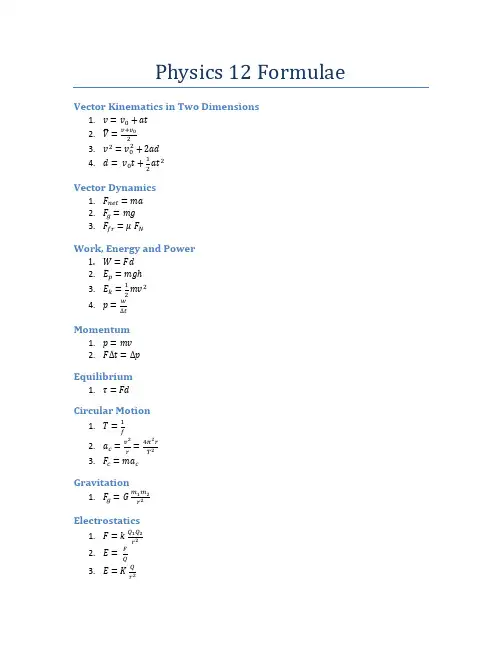

This document is a concise but comprehensive guide to the facts and formulas typically used in the material covered by the SAT Subject physics test.The test is designed to determine how well you have mastered the physics concepts taught in a typical one-year college-prep high school course.This guide is mainly intended as a reference,as opposed to a full tutorial(which would probably be book-length),and so the explanatory material is pretty brief.You can use the guide as a simple formula reference,or as a quick review of the material that you’ve already studied elsewhere.Either way,good luck on your Subject Test!Math StuffAlthough this guide is for the SAT Subject test in Physics,you’ll need to know quite a bit of math.If you’re thinking that you’ll just use your calculator to do the math,don’t forget that calculators are not allowed on the SAT Subject Physics test.Here is a summary of the really important math facts and formulas.Exponentsx a·x b=x a+b (x a)b=x a·bx0=1x a/x b=x a−b (xy)a=x a·y a √x·√Basic Metric PrefixesCommon powers of ten(both positive and negative)have names that come before the metric unit of measurement,i.e.,they are prefixes.The most typically used ones are given below.Prefix Symbol Power of Ten Common Examplenano n10−9nanometermicroµ10−6microsecondmilli m10−3milligramcenti c10−2centimeterkilo k103kilogrammega M106megawattBasic Trigonometrya bcadjacent oppositeh y p ot e nu s eθIn thefirst triangle above,a2+b2=c2(pythagorean theorem)Referring to the second triangle,there are three important functions which are defined for angles in a right triangle:sinθ=oppositehypotenuse“CAH”tanθ=opposite更多资料访问老郑博客SAT Subject Physics Facts&FormulasFor example,velocity is a vector(represented by a boldface v)and is given by a number (say,50m/sec)along with a direction(say,30◦north of east).Mass(m)is just a number (say,80kg),for which a direction doesn’t make any sense,so it is a scalar.We can define components of a vector as the projection(or“shadow”)of the vector on thebelow.x and y axes,as in thefigure ArrayUsing basic trigonometry,v x=v·cosθ(the x-component of v)v y=v·sinθ(the y-component of v)Note from thefigure that v(which is sometimes denoted explicitly by|v|,which means the length of the vector v)is given by v2=v2x+v2y,using the pythagorean theorem.In the example above,v=50m/sec andθ=30◦,so that v x=43m/sec and v y=25m/sec. In this case,the x-component of v is greater than the y-component of v since the direction of v is closer to the x-axis(east)than it is to the y-axis(north).The easiest way to add two vectors is to add their x components to get a total x component, and separately do the same thing for the y components.Then,a new total vector can be made with the two total x and y components,using v2tot=v2x,tot+v2y,tot andθ= tan−1(v y,tot/v x,tot).Graphically,this is the same as the“tip-to-tail”method,as in thebelow.figure ArrayHere,vectors A and B are added by moving B so that its tail is at the tip of A,and thendrawing the vector from the origin to the new tip of B.It should be clear from thefigure that the x components of A and(the shifted)B add up to the x component of the new vector,and similarly for the y components./tutor pg.3SAT Subject Physics Facts&FormulasKinematicsThe following formulas for position x,velocity v,and acceleration a are valid when the acceleration of the object is constant.The initial value of a variable,such as position for example,is given by x i,and thefinal value is given by x f.The change in the variable, such as velocity for example,is given by∆v=v f−v i.There arefive main equations for kinematics which are all valid,but the one or two that you use will depend on the variable that you need and the information that you have.When you don’t have Equation to Use1a∆x=v ave∆t=a(∆t)221v i∆x=v f∆t−更多资料访问老郑博客SAT Subject Physics Facts&Formulasresting on a table is zero:the weight of the book and the force of the table pushing up on the book add to zero.Note that the weight of an object(which is a force)due to gravity is:W=mgwhere W is the weight,m is the mass,and g is the acceleration due to gravity(g is approximately10m/s2at or near the surface of the earth).Friction is a force due to the contact of two rough surfaces against one another.The direction of the friction force is always opposite to the direction of motion(or,in the case of static friction,opposite to the motion that would occur if there were no friction).The magnitude of the friction force is proportional to the normal force holding the two surfaces together.The constant of proportionality is called the coefficient of friction,and is denoted byµ(this symbol is the Greek letter mu).In formula form:f=µNwhere f is the friction force,µis the coefficient of friction,and N is the normal force. If there is no motion between the surfaces,the friction is static,andµ=µs,the static coefficient of friction.In the case of the two surfaces moving against one another,µ=µk, the kinetic coefficient of friction.Generally,µs is larger thanµk;however,the basic formula f=µN remains the same for both cases.MomentumMomentum is defined to be the product of mass and velocity:p=m vwhere p is the momentum,m is the mass,and v is the velocity.Note that the momentum p and velocity v are both vectors,and they are in the same direction,since the mass m is just a positive number.The net force F acting on a mass m for an amount of time∆t produces a change in momentum given by∆p=F∆t.The product F∆t is often called the impulse.Here,the change in momentum is just ∆p=m∆v=m(v f−v i),where v i is the initial velocity and v f is thefinal velocity. Conservation of momentum:if there are no external forces on a system(or,the forces add to zero),then the momentum of a system is conserved,i.e.,the momentum is constant. For example,consider when a riflefires a bullet(in which case the“system”consists of the rifle plus the bullet).Beforefiring,p=0.Since the external forces on the system add to zero(the weight of the rifle is balanced by the person holding it),then p=0afterfiring, also.Therefore,m b v b+m r v r=0and the recoil velocity of the rifle is v r=−(m b/m r)·v b. /tutor pg.5In collisions,momentum is also conserved.For example,suppose two cars(masses m1and m2)collide at velocities v1and v2.Then,their velocities after colliding(v 1and v 2)satisfy the equation m1v1+m2v2=m1v 1+m2v 2.To solve a problem like this for the individual final velocities,more information must be given.For example,if the cars stick together, then thefinal velocity v f can be found by solving m1v1+m2v2=(m1+m2)·v f for v f. Work,Energy,and PowerWork has a very specific meaning in physics.Work is done when a force is applied to an object as it moves a distance.The amount of work done is given by:W=F d cosθwhere W is the work done,in joules(1J=1newton-meter),d is the distance,andθis the angle between the direction of the force and the direction of motion.If the force is in direction of motion,θ=0◦,so cosθ=1and the work is just force times distance, W=F d.If there is no displacement at all(i.e.,d=0),then no work is done.Also,if the force is at right angles to the direction of motion(θ=90◦),again no work is done,since cos90◦=0. Note that work can be negative,for example,ifθ=180◦,then W=−F d and W<0 (cos180◦=−1).The work done by kinetic friction,for example,is always negative since the force of friction is always directed opposite to the direction of motion.The energy of an object can be thought of as the ability of that object to do work.Or, conversely,work must be done by or on an object to change the object’s energy.There are two main kinds of energy.Thefirst is called kinetic energy and is associated with objects that are moving(v=0).The amount of kinetic energy is given by1KE=velocity.The work done by the person is the force applied(mg,to counteract gravity) times the distance(h),which gives W=mgh.This work is“stored”as potential energy in the mass at height h.The mass now has the ability to do work.For example,if the mass is a large boulder at the top of a cliff,the boulder could be used to make a crater in the ground below(by pushing it offthe cliff).The amount of work done by the boulder on the ground would be W=mgh.We can combine the potential and kinetic energy to get the total energy:E=KE+PE.In the absence of forces such as friction,the total energy of an object remains constant(is conserved).For example,suppose the boulder from before is100kg and is on a cliff10m high.The total energy of the boulder is E=KE+PE=0+(100kg)(10m/s2)(10m)= 10000J.Now the boulder is pushed offthe cliff.Just before it hits the ground,E is still10000J.But now,PE=0and KE=10000J.Halfway down the cliff,PE= (100kg)(10m/s2)(5m)=5000J.Since E is still10000J,then we know that KE=5000J. In each case,the velocity could be found by using KE=0.5·m·v2.Power is the rate at which work is done:if a certain amount of work W is done in an elapsed time∆t,the power isWP=on the circle.This mass is under constant acceleration,not because the speed is changing (it isn’t)but because the direction of the velocity is changing(remember that velocity is a vector,and so it has both a magnitude(speed)and a direction).In thefigure above,the force on the mass(F c)along with its acceleration(a c)are shown at eight snapshots in time during the motion of the mass around the circle.Both F c and a c always point directly toward the center of the circle,so in either circle in the above figure,a c could be replaced by F c,and vice versa.The acceleration a c,called“centripetal”acceleration,is given byv2a c=.rThe period T is the time it takes for the object to make one revolution.Given T,the velocity can be found using2πrv=Ifθis the angle between the radial direction and F,then F⊥=F sinθ,so that the torque equation can also be written as:torque=rF sinθ.The perpendicular force F⊥will tend to rotate the wheel in thefigure in the counter-clockwise direction.Angular momentum is the circular equivalent of linear momentum(p=mv),and is given by:L=mvr.For example,L=mvr is the angular momentum of the rotating object in the diagram at the beginning of the section on circular motion.Similarly to regular(linear)momentum,if there are no external torques on a system(or, the torques add to zero),then the angular momentum of a system is conserved,i.e.,the angular momentum is constant.For example,could the Earth just stop spinning in the middle of the night?The biggest force on the Earth is due to the Sun(see the Gravity section below),but that force effectively acts at the center of the Earth,where r=0.This means that the torque due to the force is zero,so there are no external torques on the Earth,and therefore it will just keep on spinning.A little more complicated example is the system of the Earth and the Moon.The Moon (which has a large mass)moves roughly in a circle about the Earth,and so it has angular momentum.The Earth has angular momentum since it is spinning about its own axis once per day(and this includes you,since you are on the surface of the Earth,rotating about the axis).The Moon causes the tides on the Earth,but the drag of the sea sloshing about is gradually slowing down the spin rate of the Earth.The conservation of angular momentum in the Earth-Moon system implies that the angular momentum of the moon must be increasing,namely,the r in the angular momentum(mvr)of the Moon must be getting bigger.In fact,the distance to the moon has been measured to be increasing at roughly4.5cm per year.SpringsA spring is a metal coil which,when stretched,pulls back on the object attached to the end of the spring.When compressed,the spring pushes against the object at the end of the spring.When not stretched or compressed,the spring is at its“natural length”and it doesn’t exert a force on the object at all.The restoring force F s of a spring is proportional to the amount(distance)that the spring is stretched or compressed.If this distance is x,then the restoring force isF s=kx.The formula above is often called“Hooke’s Law”.When a spring is stretched or com-pressed,it has a(stored)potential energy of1PE s=GravityGravity is a force that occurs between objects that have mass.If two masses m1and m2 are separated by a distance r,then the force of gravity between them ism1m2F g=G。
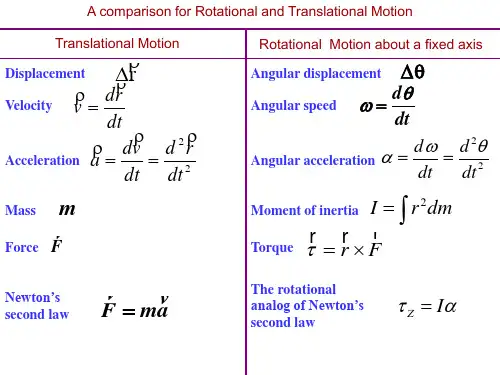
聖馬利亞堂中學物理實驗中四M日期:_____________姓名 : _______________ 組別:_____ 成績:_____________牛頓第二運動定律(Newton’s 2nd Law of Motion)目的 : 利用運動感應器(motion sensor)研究(A) 小車在恆力(constant force)作用下的運動以及力的大小對小車加速度(acceleration)的影響。
(B) 小車在恆力(constant force)作用下,其加速度與質量(mass)之間的關係。
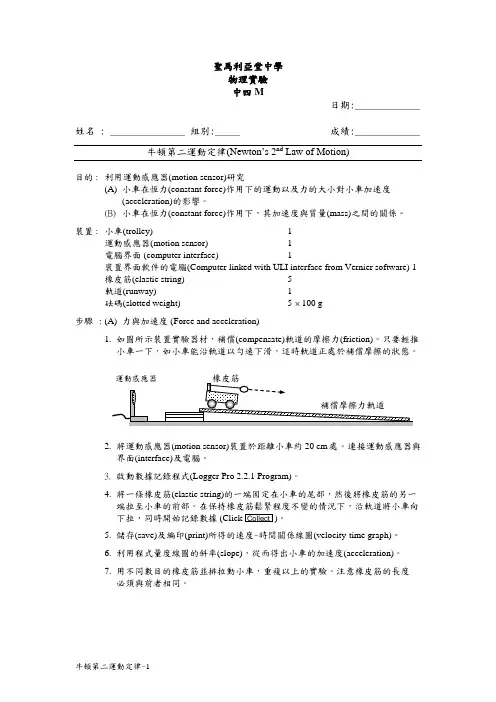
裝置 : 小車(trolley) 1運動感應器(motion sensor) 1電腦界面 (computer interface) 1裝置界面軟件的電腦(Computer linked with ULI interface from Vernier software) 1 橡皮筋(elastic string) 5軌道(runway) 1砝碼(slotted weight) 5 100 g步驟 : (A) 力與加速度 (Force and acceleration)1.如圖所示裝置實驗器材,補償(compensate)軌道的摩擦力(friction)。
只要輕推小車一下,如小車能沿軌道以勻速下滑,這時軌道正處於補償摩擦的狀態。
2. 將運動感應器(motion sensor)裝置於距離小車約20 cm處。
連接運動感應器與界面(interface)及電腦。
3. 啟動數據記錄程式(Logger Pro 2.2.1 Program)。
4.將一條橡皮筋(elastic string)的一端固定在小車的尾部,然後將橡皮筋的另一端拉至小車的前部。
在保持橡皮筋鬆緊程度不變的情況下,沿軌道將小車向下拉,同時開始記錄數據 (Click Collect )。
5.儲存(save)及編印(print)所得的速度-時間關係線圖(velocity-time graph)。