英语国家概况期末复习资料
- 格式:docx
- 大小:22.72 KB
- 文档页数:11
英语国家概况期末复习资料
The United Kingdom of Great Britain and Northern Ireland
Chapter 1 Geography, People and Language
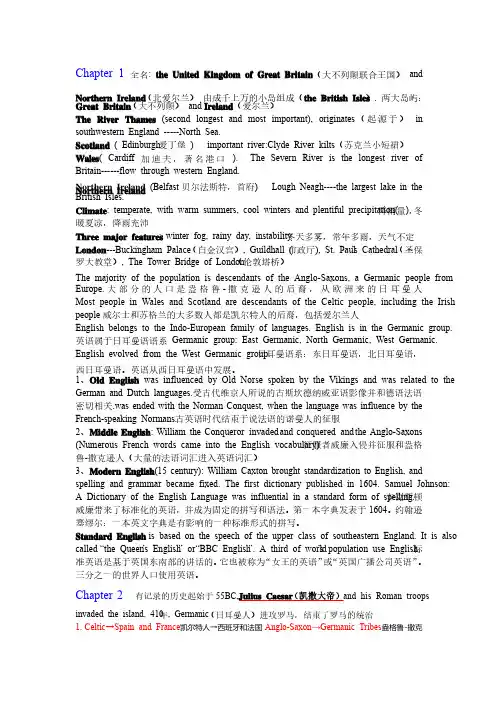
1.The full name: the United Kingdom of Great Britain and
Northern Ireland .
It is made up of many islands collectively known as the British
Isles. Great Britain and Ireland are two main islands of the British
Isles.
2.The River Thames(second longest and most important),
originates in southwestern England -----North Sea.
3.Scotland ( Edinburgh ) important river:Clyde River kilts
4.Wales(Cardiff ). The Severn River is the longest river of
Britain------flow through western England.
5.Northern Ireland (Belfast) Lough Neagh----the largest lake
in the British Isles.
6.Climate: temperate, with warm summers, cool winters and
plentiful precipitation(降雨量) Three major features: winter fog,
rainy day, instability
7.London---Buckingham Palace, Guildhall (市政厅), St.
Paul’s Cathedral, The Tower Bridge of London
8.The majority people of te population is descendants of the
Anglo-Saxons, a Germanic people from Europe.
Most people in Wales and Scotland are descendants of the
Celtic people, including the Irish people
9.English belongs to the Indo-European family of languages.
English is in the Germanic group.
10.Germanic group: East Germanic, North Germanic, West
Germanic. English evolved from the West Germanic group.
11.①Old English: influenced by Old Norse spoken by the Vikings and was related to the German and Dutch languages and
ended with the Norman Conquest, when the language was
influence by the French-speaking Normans.
②Middle English: William the Conqueror invaded and
conquered and the Anglo-Saxons (Numerous French words came
into the English vocabulary)
③Modern English(15 century):William Caxton brought
standardization to English, and spelling and grammar became
fixed. The first dictionary published in 1604. Samuel Johnson: A
Dictionary of the English Language was influential in a standard
form of spelling.
12.Standard English is based on the speech of the upper class
of southeastern England. It is also called “the Queen’s English”
or “BBC English”. A third of world’s population use English.
Chapter 2 History
Roman Period 43-410 Christianity was brought to Britain
Roman Rule 1066-1381 Magna Carta; Black Death
Transition to Modern Age 1455-1688 The war of Roses;
English Renaissance
Rise of Britain Empire 1688-1900 Industrial Revolution;
Colonial Expansion Fall of British Empire 1914-1945 WWI, WWII,
Great Depression
1. Recorded history in Britain began in the year 55BC, when
Julius Caesar and his Roman troops invaded the island. In 410,
Germanic barbarian attack Rome, ending the Roman occupation.
2.Celtic→Spain and France Anglo-Saxon→Germanic Tribes
3. It is believed hat the Norman Conquest of England marked
the establishment of feudalism
4. Henry II began the rule of the House of Anjou(安茹王朝) in
England, also known as the House of Plantagenet(金雀花王朝). He improved the courts of justice, introduce the jury system and
institutionalized common law.
5. The Magna Carta is regarded as the foundation of the
British constitutionalism
6. Henry III wages wars. The outraged nobles, led by Simon
de Montfort, drafted the Provision of Oxford(牛津条约) to limit
the King’s power by calling regular meetings of 15-member
Privy Council(枢密院). Simon de Montfort facilitated the modern
idea of a representative parliament.
7.The Wars of the Roses: the House of York( white rose) and
the House of Lancaster( red rose)→winner. Henry Tudor became
King Henry VII and started the rule of the House of Tudor.
8. In 1584, King Henry VIII issued the Act of Supremacy 《至尊法案》. In 1651, Cromwell destroyed Charles II’s army, which
marked the end of the Civil Wars. In 1660 Parliament decided to
restore Charles II to the throne which put an end to the
Commonwealth.
9. In 1688, Glorious Revolution happened. In 1689,
parliament passed the Bill of Rights.
10.19世纪中期,工业革命完成。
11.The British Empire began with the colonization of
Newfoundland in 1583. By the end of 19th century, the British
Empire included about 1/4 of the global population and the
world’s landmass.
12.South African is the fourth self-government dominion of
the British Empire after Canada, Australia and New Zealand.
13.The Central Powers: mainly Germany, Austria-Hungary,
Turkey
The Allies: mainly France, Great Britain, Russia, Italy
14.The process of decolonization transformed the British