
高中英语语法动词时态.
- 格式:pdf
- 大小:840.25 KB
- 文档页数:10


高中英语语法大全高中英语语法:动词的时态。
(一)动词的时态。
时态动词是谓语动所表示的动作或情况发生时间的各种形式。
英语动词有 16 种时态,但是常用的只有 9 种:一般现在时、一般过去时、一般将来时、现在进行时、过去进行时、现在完成时、过去完。
成时、过去将来时、现在完成进行时。
下面分别介绍。
1、一般现在时的用法(do/does)。
1)表示经常性、习惯性的动作; 表示现在的状态、特征和真理。
句中常用 often, usually, every day, sometimes, every week/year, twice aweek 等时间状语。
例如: a. he goes to school every day. b. he is very happy. earth moves around the sun.。
2)在时间状语从句和条件状语从句中,用一般现在时表示将来。
例如:在时间状语从句和条件状语从句中,用一般现在时表示将来。
例如:a. if you come this afternoon, we’ll have a meeting.b. when i grad uate, i’ll go to countryside.。
3)有时这个时态表示按计划、规定按时间表要发生的动作(句中都带有时间,有时这个时态表示按计划、规定, 按时间表要发生的动作,但限于少数动词状语),但限于少数动词,如:begin, come,。
leave, go ,arrive, start , stop, return,open, close 等。
例如: a. the meeting begins at seven.。
b. the rain starts at nine in the morning.。
4)表示状态和感觉的动词(be, like, hate, think, remember, find, sound 等)常用一般现在进行时。

高三英语语法复习:动词时态讲解动词的时态基本框架:动词时态综述:一、一般现在时表示持久存在的动作或状态,或现在的一段时间内经常发生的动作或存在的状态。
1.一般现在时的构成如果主语是第一人称、第二人称和第三人称复数,由行为动词的原形构成;如果主语是第三人称单数,行为动词要变为第三人称单数形式。
一般现在时的标志性词:①表示经常性、习惯性的动作,常与often,usually,always,sometimes,every day等时间状语连用。
I enjoy swimming, a lot and I love diving.我很喜欢游泳,也很喜欢潜水。
①表示现在的特征或状态。
The shop is open eight hours a day.这家商店每天经营8小时。
Many Chinese young kids are quite familiar with McDonald’s but know little about Peking Opera.许多中国小孩非常熟悉麦当劳,对京剧却知之甚少。
①表示客观事实和普遍真理。
Too much carbon dioxide pollutes the atmosphere.太多的二氧化碳污染了大气层。
Quality comes before quantity.质量重于数量。
(客观真理)(2)表示按时间表、规定、计划或安排将要发生的动作,常用be,go,arrive,leave,start,stay,begin等短暂性动词。
Hurry up!Our class begins at 8 o’clock. There is only 5 minutes left.快点儿,我们8点开始上课。
还剩5分钟了。
The plane leaves at three sharp.飞机3点整起飞。
(3)在时间、条件、方式、让步状语从句中表示将来的动作。
Our guides will have guns with them to scare the animals away if they come too close.如果那些动物靠的太近的话,我们的导游会带上枪来吓跑它们。

⾼中英语语法必备之谓语动词的时态和语态详解⾼中英语动词的时态语态详解在英语中,句⼦不仅有时间状语说明动作发⽣的时间,其谓语动词本⾝也有形式的变化来指⽰时间,这种表明谓语动词发⽣时间的动词形式称为时态。
语态是表现主语和谓语关系的另⼀种动词形式。
⼀动词的时态⼀般说来,发⽣在现在的事情⽤现在的时态进⾏描述;发⽣在过去的事情⽤过去的时态进⾏描述;将要发⽣的事情⽤将来的时态进⾏描述。
英语中的时态共计16种,但常⽤的有11种。
(以动词do 为例)1.⼀般现在时(do/does);2.⼀般过去时(did);3.⼀般将来时( will do/ shall do);4.⼀般过去将来时( would do/should do);5.现在进⾏时( am/is/are doing);6.过去进⾏时(was/were doing);7.将来进⾏时( will/shall be doing);8.现在完成时(have/has done);9.过去完成时( had done);10.将来完成时( will/shall have done);11.现在完成进⾏时( have/has been doing);1.⼀般现在时(1)⼀般现在时是描述现在或经常性的性质、动作或状态的时态常⽤时间状语:sometimes, often, always, usually, seldom,every day / night / week / month / year, in the morning, in the afternoon, in the evening, at night(2)表⽰经常发⽣的动作,习惯性的动作或存在的状态I usually get up at four every morning when it’s still dark.He always goes to work late,which makes his boss angry and disappointed.(3)客观真理,客观存在,科学事实及⾃然现象The sun rises in the east and sets in the west every day.The man who has never been to the Great Wall is not a real man.Trees turn green in spring. Liquid turns into gas when it is hot enough.(4)表⽰格⾔或警句中Pride goes before a fall.Knowledge is power.Practice makes perfect.(5)⼀般现在时表将来表⽰已经计划、安排好了或时间表上所安排,并且⼀定要做的事情。
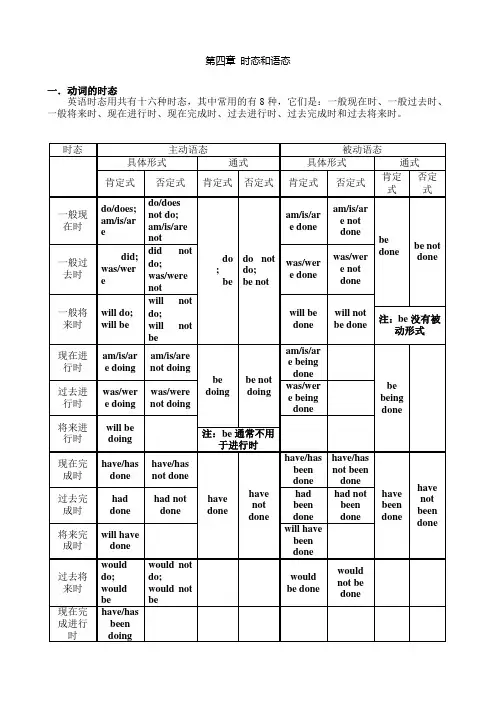
第四章时态和语态一.动词的时态英语时态用共有十六种时态,其中常用的有8种,它们是:一般现在时、一般过去时、一般将来时、现在进行时、现在完成时、过去进行时、过去完成时和过去将来时。
一. 一般现在时.1.构成. be动词:am is are ; 其他动词用动词原形,当主语是第三人称单数时要在谓语动词后加“s”,其变化规则与名词变复数一致。
2.用法. 1). 经常性或习惯性的动作,常与表示频度的时间状语连用。
如usually, always, often, seldom, never, every...,eg. I leave home for school at 7 every morning.I don’t leave home for school at 7 every morning.Do I leave home for school at 7 every morning?He usually gets up early.He doesn’t usually get up early.Does he usually get up early?2) 客观真理,客观存在,科学事实。
eg. The earth moves around the sun.The earth doesn’t move around the sun 否定句Does the earth move around the sun? 疑问句Shanghai lies in the east of China.Shanghai doesn’t lie in the east of China 否定句Does Shanghai lie in the east of China? 疑问句Water boils at 100 centigrade degrees.3) 表示格言或警句中eg. Pride goes before a fall.注意. 此用法如果出现在宾语从句中,即使主句是过去时,从句谓语也要用一般现在时。