
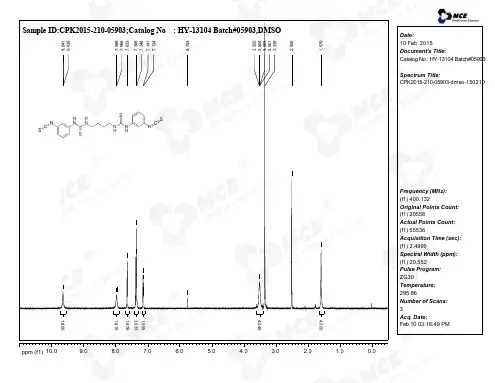
MRS_2578_HNMR_05903_MedChemExpress
- 格式:pdf
- 大小:205.68 KB
- 文档页数:1

本科生练习题一、网络资源检索1.利用百度检索出文献类型是PDF,文献内容是“冠心病”的文献,输入的是什么,检索的结果数量是多少?2. 利用Google查找网页标题中含“创新型大学”一词的页面,输入的是什么,检索结果数量是多少?3. 如何在google上查找造血干细胞的幻灯片?4. 利用google学术搜索查找我校李群伟教授在《泰山医学院学报》上发表的文章,并被引次数最高的文献。
此外,你能得到李教授的院系和邮件联系方式吗?5. 通过Google学术搜索检索论文“抗甲突汤治疗甲亢突眼症的临床疗效观察”被引用情况。
6.在google 或百度中检索关于网页制作的Powerpoint教学课件,给出检索策略和检索命令。
(提示:Powerpoint文件格式为ppt)7. 查找人类首次登月成功的时间、国家、宇航员姓名和宇宙飞船的名称。
8.提供SPECT中英文名称9. 《中华放射学杂志》被引频次最高的论文作者10. 以Google()为例,检索《中国循证医学杂志》上发表的篇名中包含“循证医学”(词组)的文章被引用情况。
要求提供检索词、检索步骤,检索结果数量,抄下被引频次最高一篇论文的题录和引用该文献且被引频次最高的他引文献题录。
11.查找2000年在《中国心理卫生杂志》上发表的心理健康(词组,出现在篇名)文献的被引情况,应使用何种搜索引擎,该如何检索?写出检索词和操作步骤,抄下被引频次最高的文献题录。
12. 你知道王老吉的历史是怎样的?创始人又是谁?你能找到他的图片吗?13.使用high wire press检索2005-至今西咪替丁治疗胃溃疡的文章,写出检索步骤和结果数。
二、中国生物医学文献数据库(CBMdisc)CBMdisc的检索步骤进入数据库系统:双击桌面快捷方式cbmWin2004,在出现的窗口上点击左键,进入CBM数据库,点击窗口右下方的开始键,进入数据库检索系统。
实习题一:检索肝癌的MRI诊断评价1. 进行主题词检索(1)进行MRI的主题词检索。

Inhibitors, Agonists, Screening LibrariesSafety Data Sheet Revision Date:May-24-2017Print Date:May-24-20171. PRODUCT AND COMPANY IDENTIFICATION1.1 Product identifierProduct name :MRS 2578Catalog No. :HY-13104CAS No. :711019-86-21.2 Relevant identified uses of the substance or mixture and uses advised againstIdentified uses :Laboratory chemicals, manufacture of substances.1.3 Details of the supplier of the safety data sheetCompany:MedChemExpress USATel:609-228-6898Fax:609-228-5909E-mail:sales@1.4 Emergency telephone numberEmergency Phone #:609-228-68982. HAZARDS IDENTIFICATION2.1 Classification of the substance or mixtureGHS Classification in accordance with 29 CFR 1910 (OSHA HCS)Acute toxicity, Oral (Category 4),H302Acute aquatic toxicity (Category 1),H400Chronic aquatic toxicity (Category 1),H4102.2 GHS Label elements, including precautionary statementsPictogram No data availableSignal word WarningHazard statement(s)H302 Harmful if swallowed.H410 Very toxic to aquatic life with long lasting effects.Precautionary statement(s)P264 Wash skin thoroughly after handling.P270 Do not eat, drink or smoke when using this product.P273 Avoid release to the environment.P301 + P312 IF SWALLOWED: Call a POISON CENTER or doctor/ physician if you feel unwell.P330 Rinse mouth.P391 Collect spillage.P501 Dispose of contents/ container to an approved waste disposal plant.2.3 Other hazardsNone.3. COMPOSITION/INFORMATION ON INGREDIENTS3.1 SubstancesSynonyms:MRS⁻2578; MRS2578Formula:C20H20N6S4Molecular Weight:472.67CAS No. :711019-86-24. FIRST AID MEASURES4.1 Description of first aid measuresEye contactRemove any contact lenses, locate eye-wash station, and flush eyes immediately with large amounts of water. Separate eyelids with fingers to ensure adequate flushing. Promptly call a physician.Skin contactRinse skin thoroughly with large amounts of water. Remove contaminated clothing and shoes and call a physician.InhalationImmediately relocate self or casualty to fresh air. If breathing is difficult, give cardiopulmonary resuscitation (CPR). Avoid mouth-to-mouth resuscitation.IngestionWash out mouth with water; Do NOT induce vomiting; call a physician.4.2 Most important symptoms and effects, both acute and delayedThe most important known symptoms and effects are described in the labelling (see section 2.2).4.3 Indication of any immediate medical attention and special treatment neededTreat symptomatically.5. FIRE FIGHTING MEASURES5.1 Extinguishing mediaSuitable extinguishing mediaUse water spray, dry chemical, foam, and carbon dioxide fire extinguisher.5.2 Special hazards arising from the substance or mixtureDuring combustion, may emit irritant fumes.5.3 Advice for firefightersWear self-contained breathing apparatus and protective clothing.6. ACCIDENTAL RELEASE MEASURES6.1 Personal precautions, protective equipment and emergency proceduresUse full personal protective equipment. Avoid breathing vapors, mist, dust or gas. Ensure adequate ventilation. Evacuate personnel to safe areas.Refer to protective measures listed in sections 8.6.2 Environmental precautionsTry to prevent further leakage or spillage. Keep the product away from drains or water courses.6.3 Methods and materials for containment and cleaning upAbsorb solutions with finely-powdered liquid-binding material (diatomite, universal binders); Decontaminate surfaces and equipment by scrubbing with alcohol; Dispose of contaminated material according to Section 13.7. HANDLING AND STORAGE7.1 Precautions for safe handlingAvoid inhalation, contact with eyes and skin. Avoid dust and aerosol formation. Use only in areas with appropriate exhaust ventilation.7.2 Conditions for safe storage, including any incompatibilitiesKeep container tightly sealed in cool, well-ventilated area. Keep away from direct sunlight and sources of ignition.Recommended storage temperature:Powder-20°C 3 years4°C 2 yearsIn solvent-80°C 6 months-20°C 1 monthShipping at room temperature if less than 2 weeks.7.3 Specific end use(s)No data available.8. EXPOSURE CONTROLS/PERSONAL PROTECTION8.1 Control parametersComponents with workplace control parametersThis product contains no substances with occupational exposure limit values.8.2 Exposure controlsEngineering controlsEnsure adequate ventilation. Provide accessible safety shower and eye wash station.Personal protective equipmentEye protection Safety goggles with side-shields.Hand protection Protective gloves.Skin and body protection Impervious clothing.Respiratory protection Suitable respirator.Environmental exposure controls Keep the product away from drains, water courses or the soil. Cleanspillages in a safe way as soon as possible.9. PHYSICAL AND CHEMICAL PROPERTIES9.1 Information on basic physical and chemical propertiesAppearance White to off-white (Solid)Odor No data availableOdor threshold No data availablepH No data availableMelting/freezing point No data availableBoiling point/range No data availableFlash point No data availableEvaporation rate No data availableFlammability (solid, gas)No data availableUpper/lower flammability or explosive limits No data availableVapor pressure No data availableVapor density No data availableRelative density No data availableWater Solubility No data availablePartition coefficient No data availableAuto-ignition temperature No data availableDecomposition temperature No data availableViscosity No data availableExplosive properties No data availableOxidizing properties No data available9.2 Other safety informationNo data available.10. STABILITY AND REACTIVITY10.1 ReactivityNo data available.10.2 Chemical stabilityStable under recommended storage conditions.10.3 Possibility of hazardous reactionsNo data available.10.4 Conditions to avoidNo data available.10.5 Incompatible materialsStrong acids/alkalis, strong oxidising/reducing agents.10.6 Hazardous decomposition productsUnder fire conditions, may decompose and emit toxic fumes.Other decomposition products - no data available.11.TOXICOLOGICAL INFORMATION11.1 Information on toxicological effectsAcute toxicityClassified based on available data. For more details, see section 2Skin corrosion/irritationClassified based on available data. For more details, see section 2Serious eye damage/irritationClassified based on available data. For more details, see section 2Respiratory or skin sensitizationClassified based on available data. For more details, see section 2Germ cell mutagenicityClassified based on available data. For more details, see section 2CarcinogenicityIARC: No component of this product present at a level equal to or greater than 0.1% is identified as probable, possible or confirmed human carcinogen by IARC.ACGIH: No component of this product present at a level equal to or greater than 0.1% is identified as a potential or confirmed carcinogen by ACGIH.NTP: No component of this product present at a level equal to or greater than 0.1% is identified as a anticipated or confirmed carcinogen by NTP.OSHA: No component of this product present at a level equal to or greater than 0.1% is identified as a potential or confirmed carcinogen by OSHA.Reproductive toxicityClassified based on available data. For more details, see section 2Specific target organ toxicity - single exposureClassified based on available data. For more details, see section 2Specific target organ toxicity - repeated exposureClassified based on available data. For more details, see section 2Aspiration hazardClassified based on available data. For more details, see section 212. ECOLOGICAL INFORMATION12.1 ToxicityNo data available.12.2 Persistence and degradabilityNo data available.12.3 Bioaccumlative potentialNo data available.12.4 Mobility in soilNo data available.12.5 Results of PBT and vPvB assessmentPBT/vPvB assessment unavailable as chemical safety assessment not required or not conducted.12.6 Other adverse effectsNo data available.13. DISPOSAL CONSIDERATIONS13.1 Waste treatment methodsProductDispose substance in accordance with prevailing country, federal, state and local regulations.Contaminated packagingConduct recycling or disposal in accordance with prevailing country, federal, state and local regulations.14. TRANSPORT INFORMATIONDOT (US)This substance is considered to be non-hazardous for transport.IMDGUN number: 3077Class: 9Packing group: IIIEMS-No: F-A, S-FProper shipping name: ENVIRONMENTALLY HAZARDOUS SUBSTANCE, SOLID, N.O.S.Marine pollutant: Marine pollutant.IATAUN number: 3077Class: 9Packing group: IIIProper shipping name: Environmentally hazardous substance, solid, n.o.s.15. REGULATORY INFORMATIONSARA 302 Components:No chemicals in this material are subject to the reporting requirements of SARA Title III, Section 302.SARA 313 Components:This material does not contain any chemical components with known CAS numbers that exceed the threshold (De Minimis) reporting levels established by SARA Title III, Section 313.SARA 311/312 Hazards:No SARA Hazards.Massachusetts Right To Know Components:No components are subject to the Massachusetts Right to Know Act.Pennsylvania Right To Know Components:No components are subject to the Pennsylvania Right to Know Act.New Jersey Right To Know Components:No components are subject to the New Jersey Right to Know Act.California Prop. 65 Components:This product does not contain any chemicals known to State of California to cause cancer, birth defects, or anyother reproductive harm.16. OTHER INFORMATIONCopyright 2017 MedChemExpress. The above information is correct to the best of our present knowledge but does not purport to be all inclusive and should be used only as a guide. The product is for research use only and for experienced personnel. It must only be handled by suitably qualified experienced scientists in appropriately equipped and authorized facilities. The burden of safe use of this material rests entirely with the user. MedChemExpress disclaims all liability for any damage resulting from handling or from contact with this product.Caution: Product has not been fully validated for medical applications. For research use only.Tel: 609-228-6898 Fax: 609-228-5909 E-mail: tech@Address: 1 Deer Park Dr, Suite Q, Monmouth Junction, NJ 08852, USA。

注射用埃索美拉唑钠的紫外鉴别研究
徐全华;邓云娟;郑敏;陈环
【期刊名称】《海峡药学》
【年(卷),期】2014(26)1
【摘要】目的观察不同溶剂对注射用埃索美拉唑钠最大吸收波长的影响,为紫外鉴别溶剂的选择提供依据.方法使用不同溶剂溶解注射用埃索美拉唑钠,采用紫外分光光度法测定最大吸收波长.结果以不同pH值实验用水、无水乙醇和甲醇为溶剂时最大吸收波长稳定,而以强酸和强碱溶液为溶剂时最大吸收波长发生明显紫移和微弱红移现象.结论水为注射用埃索美拉唑钠紫外鉴别的最适宜溶剂.
【总页数】2页(P75-76)
【作者】徐全华;邓云娟;郑敏;陈环
【作者单位】杭州澳亚生物技术有限公司,杭州,310018;杭州澳亚生物技术有限公司,杭州,310018;杭州澳亚生物技术有限公司,杭州,310018;杭州澳亚生物技术有限公司,杭州,310018
【正文语种】中文
【中图分类】R927.2
【相关文献】
1.注射用果糖二磷酸钠与注射用埃索美拉唑钠存在配伍禁忌 [J], 邹琴;张小洪
2.注射用埃索美拉唑钠在不同溶媒中及与不同药物配伍的稳定性观察 [J], 金纹宇
3.注射用埃索美拉唑钠在不同溶媒及与不同药物配伍的稳定性观察 [J], 张晓方;王
柯涵
4.注射用埃索美拉唑钠与临床常见两种溶媒配伍后的稳定性 [J], 路艳娟
5.醋酸奥曲肽注射液与注射用埃索美拉唑钠存在配伍禁忌 [J], 颜雷雷;张秀霞;董爱淑
因版权原因,仅展示原文概要,查看原文内容请购买。
