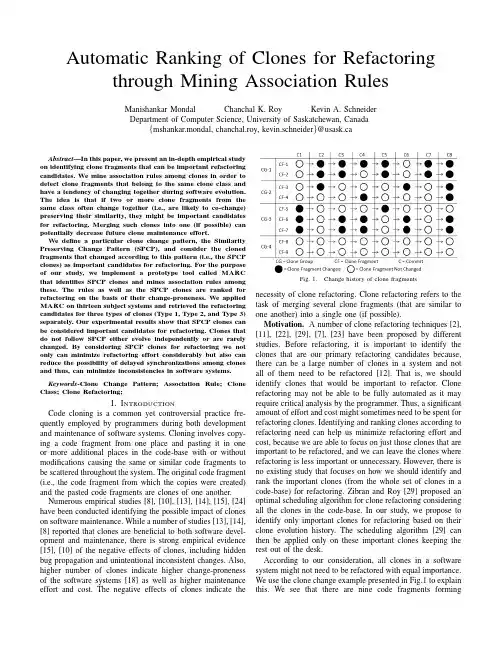
Automatic Ranking of Clones for Refactoring through Mining Association RulesManishankar Mondal Chanchal K.Roy Kevin A.SchneiderDepartment of Computer Science,University of Saskatchewan,Canada{mshankar.mondal,chanchal.roy,kevin.schneider}@usask.caAbstract—In this paper,we present an in-depth empirical study on identifying clone fragments that can be important refactoring candidates.We mine association rules among clones in order to detect clone fragments that belong to the same clone class and have a tendency of changing together during software evolution. The idea is that if two or more clone fragments from the same class often change together(i.e.,are likely to co-change) preserving their similarity,they might be important candidates for refactoring.Merging such clones into one(if possible)can potentially decrease future clone maintenance effort.We define a particular clone change pattern,the Similarity Preserving Change Pattern(SPCP),and consider the cloned fragments that changed according to this pattern(i.e.,the SPCP clones)as important candidates for refactoring.For the purpose of our study,we implement a prototype tool called MARC that identifies SPCP clones and mines association rules among these.The rules as well as the SPCP clones are ranked for refactoring on the basis of their change-proneness.We applied MARC on thirteen subject systems and retrieved the refactoring candidates for three types of clones(Type1,Type2,and Type3) separately.Our experimental results show that SPCP clones can be considered important candidates for refactoring.Clones that do not follow SPCP either evolve independently or are rarely changed.By considering SPCP clones for refactoring we not only can minimize refactoring effort considerably but also can reduce the possibility of delayed synchronizations among clones and thus,can minimize inconsistencies in software systems.Keywords-Clone Change Pattern;Association Rule;Clone Class;Clone Refactoring;I.I NTRODUCTIONCode cloning is a common yet controversial practice fre-quently employed by programmers during both development and maintenance of software systems.Cloning involves copy-ing a code fragment from one place and pasting it in one or more additional places in the code-base with or without modifications causing the same or similar code fragments to be scattered throughout the system.The original code fragment (i.e.,the code fragment from which the copies were created) and the pasted code fragments are clones of one another. Numerous empirical studies[8],[10],[13],[14],[15],[24] have been conducted identifying the possible impact of clones on software maintenance.While a number of studies[13],[14], [8]reported that clones are beneficial to both software devel-opment and maintenance,there is strong empirical evidence [15],[10]of the negative effects of clones,including hidden bug propagation and unintentional inconsistent changes.Also, higher number of clones indicate higher change-proneness of the software systems[18]as well as higher maintenance effort and cost.The negative effects of clones indicatetheFig.1.Change history of clone fragmentsnecessity of clone refactoring.Clone refactoring refers to the task of merging several clone fragments(that are similar to one another)into a single one(if possible).Motivation.A number of clone refactoring techniques[2], [11],[22],[29],[7],[23]have been proposed by different studies.Before refactoring,it is important to identify the clones that are our primary refactoring candidates because, there can be a large number of clones in a system and not all of them need to be refactored[12].That is,we should identify clones that would be important to refactor.Clone refactoring may not be able to be fully automated as it may require critical analysis by the programmer.Thus,a significant amount of effort and cost might sometimes need to be spent for refactoring clones.Identifying and ranking clones according to refactoring need can help us minimize refactoring effort and cost,because we are able to focus on just those clones that are important to be refactored,and we can leave the clones where refactoring is less important or unnecessary.However,there is no existing study that focuses on how we should identify and rank the important clones(from the whole set of clones in a code-base)for refactoring.Zibran and Roy[29]proposed an optimal scheduling algorithm for clone refactoring considering all the clones in the code-base.In our study,we propose to identify only important clones for refactoring based on their clone evolution history.The scheduling algorithm[29]can then be applied only on these important clones keeping the rest out of the desk.According to our consideration,all clones in a software system might not need to be refactored with equal importance. We use the clone change example presented in Fig.1to explain this.We see that there are nine code fragments formingfour groups(CG-1through CG-4).The code fragments in a particular group are clones of one another.The change history (in Fig.1)of these code fragments implies the followings. (1)The clone fragments,CF-1and CF-2in group CG-1,are likely to be related to each other and they have received corresponding changes.In other words,it is likely that the changes were made to these clones focusing on their consistency.The same is also true for the two code fragments CF-6and CF-7in CG-3.(2)It is likely that the clone fragments,CF-3and CF-4in group CG-2,have experienced independent evolution.Because of the independent evolutions,CF-3and CF-4might not be regarded as clones of each other after a particular evolution period.Out of the three clone fragments in group CG-3,clone fragments CF-6and CF-7seem to be related as they received corresponding changes.However,the other clone fragment CF-5seems to have a tendency of independent evolution. (3)The clone fragments,CF-8and CF-9,are not change-prone and it is likely that in future they will exhibit lower change-proneness compared to the others.Thus,these clones are not likely to add change effort during maintenance.The example in Fig.1implies that refactoring clone frag-ments might not always be appropriate,since clones might evolve independently without preserving similarity.Also,if some clone fragments do not change during evolution we might not consider refactoring those clone fragments,since they do not require additional change effort during software evolution.Thus,when clone fragments belonging to the same clone class change consistently during evolution these clone fragments might be important refactoring candidates.More-over,a clone class may contain n clone fragments,however,if it is observed that only a subset of the clone fragments change consistently while others are either evolving independently or are rarely changing we should consider refactoring only those consistently changing clone fragments.If the consistently changing clones can be merged through refactoring we can reduce the effort spent for changing clones.The co-change histories of the clones:(1)CF-1and CF-2in CG-1,and(2) CF-6and CF-7in CG-3indicate that such clone fragments can be identified by mining association rules among clones. Contribution.Focusing on the above discussion we define a particular clone change pattern called SPCP(Similarity Preserving Change Pattern)such that the clone fragments that change following this pattern(i.e.,SPCP clones)are likely to be important candidates for refactoring.We describe SPCP in Section IV.For the purpose of our study,we develop a prototype tool MARC(Mining Association Rules among Clones)that can detect all SPCP clones from a subject system and then mines association rules among SPCP clones.MARC ranks these rules according to their support and confidence values(defined in Section III).According to our investigation on the rules as well as SPCP clones retrieved by MARC, (1)SPCP clones can be important candidates for refac-toring.The clones that do not follow SPCP either evolve independently or are rarely changed during evolution.Thus, we can mainly focus on the SPCP clones forrefactoring.Fig.2.Proposed refactoring step(2)Overall,only7.04%of the clones existing in a code-base are SPCP clones.Also,for each of63.44%of the association rules retrieved by MARC,the corresponding SPCP clones are method clones and also,they belong to the same source codefile.Thus,automatic identification and ranking of SPCP clones can save a considerable amount of time,effort and cost for clone refactoring,because we could leave the remaining 92.96%of the clones in the code-base without refactoring.(3)From our manual analysis on224association rules from all13subject systems(considering the top10rules of each clone-type),for overall64.37%of the association rules we can suggest a standard refactoring technique1.(4)A considerable amount(overall11.64%)of SPCP clones can receive resynchronizing changes.Thus,refactoring of SPCP clones can minimize delayed synchronizations among clone fragments and can minimize unwanted inconsistencies in software systems.The rest of the paper is organized as follows:Section II describes the significance of our study,Section III describes the terminology,Section IV elaborates on the SPCP(similarity preserving change pattern),Section V presents experimental results and discussion,Section VI mentions some threats to validity,Section VII discusses related work,and Section VIII concludes the paper mentioning future work.II.S IGNIFICANCE OF OUR STUDYExisting clone refactoring studies and techniques mainly consider four refactoring steps(cf.Fig.2):(1)detection of clones,(2)scheduling of clones for refactoring(3)analysis of refactoring possibilities on the basis of different cloning situations,and(4)application of selected refactoring.Our study differs in that we propose an additional step after clone detection that involves the analysis of the clone evolution history to determine the clones we should consider as the primary refactoring candidates.According to our expectation, this additional step will minimize the clone refactoring effort and task considerably,because this stepfilters out a significant portion of clones from the refactoring target list based on their change pattern and change-proneness.According to our analysis the excluded clones do not need to be refactored with the same importance as the ones included in the target list, since they either changed rarely or changed independently.III.T ERMINOLOGYTypes of Clones.We conducted our experiment considering exact(Type1)and near-miss clones(Type2and Type3 1Refactoring Techniques:/catalog/clones).If two code fragments are exactly the same disregard-ing comments and indentations,they are Type1clones of each other.Type2clones are syntactically similar code fragments. In general,Type2clones are created from Type1clones because of renaming variables or changing data types.Type3 clones are mainly created because of additions,deletions,or modifications of lines in Type1or Type2clones.Clone Class.A group(i.e.,two or more)of clone fragments that are the same(Type1)or similar(Type2or Type3)to one another form a clone class.Cloned Method.If a method contains cloned(Type1,Type 2,or Type3)lines,we call this method a cloned method.If all lines of a method are cloned lines,then this method is a fully cloned method.If a method contains both cloned and non-cloned lines,we call this method a partially cloned method. Method Clones.If two or more methods are clones(Type 1,Type2,or Type3)of one another,we refer to these as method clones.Method clones are fully cloned methods. Association Rule.An association rule[1]is an expression of the form X=>Y where X is the antecedent and Y is the consequent.Each of X and Y is a set of one or more program entities.The meaning of such a rule in our context is that if X gets changed in a particular commit operation,Y also has the tendency of getting changed in that commit operation.We can determine the confidence or strength of a particular association rule by determining the support of its constituent parts. Support and Confidence.Support is the number of commit operations in which an entity or a group(two or more) of entities changed together.We consider an example of two entities E1and E2.If E1and E2have ever changed together,we can assume two association rules,E1=>E2 and E2=>E1,from them.Suppose,E1changed in four commits:2,5,6,and10.E2changed in six commits:4,6, 7,8,10,and13.Thus,support(E1)=4and support(E2)=6. However,support(E1,E2)=2,because E1and E2changed together in two commits:6,and10.Also,support(E1=>E2) =support(E2=>E1)=support(E1,E2)=2.Confidence of an association rule,X=>Y,determines the probability that Y will change in a commit operation provided that X changed in that commit operation.We determine the confidence of X=>Y in the following way.confidence(X=>Y)=support(X,Y) support(X)(1) From the above example of two entities,confidence(E1=>E2)=support(E1,E2)/support(E1)=2/4=0.5and confidence(E2=>E1)=2/6=0.33.In our experiment we consider those association rules where each of X and Y consist of a single clone fragment from the same clone class. Such a rule can be expressed as x=>y where x and y are two different clone fragments belonging to the same clone class.IV.S IMILARITY P RESERVING C HANGE P ATTERNOur prototype tool,MARC,mines association rules con-sidering those clone fragments that followed a similarity preserving change pattern(SPCP)during evolution.It can also rank these rules on the basis of change-proneness(described in Section IV-D)of the participating clones.We define similarity preserving change pattern in the following way.A.Definition of Similarity Preserving Change PatternIf two clone blocks received either similarity preserving changes or re-synchronizing changes or both during evolu-tion,then we say that these clone blocks follow a similarity preserving change pattern(i.e.,are SPCP clones).Definition of Similarity Preserving Change.We consider two clone blocks CB1and CB2that belong to the same clone class,say CLS1,in revision R i.Suppose,a commit operation C i on R i changes any(one or both)of these clone fragments.If in revision R i+1(created because of commit C i) these two clone blocks,CB1and CB2,again remain in one particular clone class(which might not be CLS1),then we say that CB1and CB2have received a similarity preserving change in commit operation C i.If both of the clone blocks (i.e.,CB1and CB2)change preserving their similarity in such a commit then we call this change a similarity preserving co-change(SPCO).If the SPCP of two clone blocks contains SPCOs,then it is likely that the participating clone blocks have changed consistently(evaluated in Section V-A).Definition of Re-synchronizing Change.Suppose,two clone blocks CB1and CB2belong to the same clone class, CLS1,in revision R i.The commit C i on revision R i modified any of these clone blocks in such a way that CB1and CB2 could not be considered as clones of each other in revision R i+1(i.e.,CB1and CB2may diverge into two different clone classes or one or both of these might not be regarded as a clone fragment).However,in a later commit operation, say C i+n where n>=1,any one or both of CB1and CB2 changed in such a way that CB1and CB2become clones of each other(they converged into one clone class)again.Such a converging change followed by a diverging change is termed as a re-synchronizing change in our experiment.B.Example of a Similarity Preserving Change Pattern Fig.3contains an SPCP followed by the clone blocks,CB1 and CB2.As indicated in thefigure,these clone blocks belong to two methods M1and M2respectively.We see that in each of the commit operations,C2to C7,the clone blocks CB1 and CB2received similarity preserving change.In commit C1,none of the clone blocks were changed.We now consider the commit operation C2.Before this commit both of the clone blocks(CB1and CB2)belonged to the clone class CLS1.After this commit,the clone blocks belonged to CLS2.Although CLS1and CLS2are different clone classes,we see that before or after this commit operation both clone blocks belonged to a single clone class.Thus,CB1and CB2preserved their similarity after commit C2.In other words,CB1and CB2 received a similarity preserving change in commit C2.We also see that these two clone blocks received similarity preserving change s in each of the commits C3to C7.Moreover,the similarity preserving changes in commits C2,C5,C6,and C7,are SPCOs(similarity preserving co-changes).Finally, the changes in commits C8to C10can be considered as anFig.3.Similarity Preserving Change Pattern (SPCP)example of re-synchronizing change.Because of the change in C8,CB 2diverged into a different clone class,CLS5,and thus,CB 1and CB 2could not be considered as clones of each other.However,the change in commit C10is a converging change because,both of the clone blocks again converged into a single clone class after this commit.C.Mining Association Rules Considering SPCPIn this experiment,we consider clones residing in methods.Thus,both fully cloned and partially cloned methods have been investigated.For a particular subject system,we collect all of its revisions (mentioned in Table I),then extract the methods in each revision using CTAGS,and then deter-mine method genealogies following the technique proposed by Lozano and Wermelinger [15].We detect clones in each revision using NiCad [5]and then map the clones to the already detected methods of the corresponding revisions.As method genealogies are already detected,after clone mapping we can easily track the evolution of each clone fragment.Finally,we detect changes between every two consecutive revisions and map these changes to the methods as well as clones located inside the methods.For the details of these steps and NiCad setup we refer the readers to our earlier work [17].Extraction of Association Rules.After the preliminary steps we determine all possible pairs of clones.A possible pair of clones consists of two clone fragments CF 1and CF 2from the same clone class such that they together followed an SPCP during the evolution and are alive in the last revision.As we map clones to methods,CF 1and CF 2reside in methods.From such a clone pair we can determine two association rules:CF 1=>CF 2,and CF 2=>CF 1.According to the definition,these two rules have the same support value.However,their confidences can be different.We determine support by the number of similarity preserving co-changes (SPCOs)in the SPCP followed by the clone fragments in a rule.We extract all association rules with a minimum support of 1.D.Ranking of Association RulesAccording to our consideration and discussion in the in-troduction,if a rule detected by our prototype tool has a higher support value (i.e.,higher SPCO count)compared to the others,we should assume a higher priority for refactoringthe associated clone fragments.Our decision of ranking con-sidering the support value is reasonable from two perspectives.(1)Higher support value (i.e.,higher SPCO count)for a rule (consisting of two SPCP clone fragments)indicates a higher likelihood that the participating clone fragments have changed consistently during evolution.The underlying assumption is that in a similarity preserving co-change (i.e.,in a SPCO),the two participating SPCP clone fragments generally change consistently.We empirically evaluate this in Section V-A.Intuitively,if two clone fragments have a tendency of changing consistently,then changes in one fragment in a particular commit generally require corresponding changes to the other one in that commit.(2)Higher support value for a rule is an evidence that the corresponding SPCP clones have exhibited higher change-proneness (i.e.,changed in higher number of commits)during the past evolution compared to the other SPCP clones in other rules.Thus,considering the existing evolution history we rank the association rules according to the decreasing order of change-proneness of the corresponding SPCP clones.As it is difficult to be certain about the future change-proneness of the rules as well as SPCP clones,our decision of ranking relying on the past history is reasonable.We assume higher ranks for those rules as well as SPCP clones that exhibited higher change-proneness in the past.However,higher support might also be an indicator of higher change-proneness of the associated SPCP clones in future.We do not investigate this issue (i.e.,future change-proneness)in this research work.E.Finding Groups of Refactoring CandidatesEach rule consists of two SPCP clones.This is also possible that more than two clone fragments from the same class are preserving their similarity during evolution following a similarity preserving change pattern (SPCP).Thus,this is convenient to determine groups of refactoring candidates from these rules where a group contains two or more clones (from the same clone class)and all the clones in a group have evolved following a SPCP.Suppose two clone blocks,CB1and CB2,formed a rule because they followed a SPCP.If there is another rule consisting of the clone blocks CB2and CB3(CB2is common in these two rules),then we can form a group consisting of CB1,CB2,and CB3,because according to the conditions in Section IV-A these three clone blocks togetherFig.4.Rules of Type3clones sorted in decreasing order of support values followed a SPCP.Focusing on this fact,MARC determines groups of refactoring candidates.We term each group as a SPCP clone-class.In Table II we report the count of groups for each subject system considering each clone-type.F.Tool SupportWe have developed our prototype tool such that for a particular clone-type of a particular subject system,it generates two XMLfiles.Onefile contains the ranked rules and the other one contains the SPCP clone groups merging these rules. While each rule in thefirstfile contains only two SPCP clones,a group in the secondfile may contain more than two SPCP clones.For each SPCP clone(whether in a rule or in a group)we include the starting and ending line numbers of the clone fragment,the name of the method containing the clone fragment,and the starting and ending line numbers of this method considering the last(i.e.,the latest)revision so that we can easily trace the clone fragment for refactoring in the latest revision of the candidate software system.Our prototype tool is now available[16]with instructions on how to use it. The six XMLfiles containing the association rules and groups of three types of SPCP clones of our subject system Freecol are also available on-line[16].In order to assist in analyzing the evolution of SPCP clones,our tool also shows important information regarding the ranked rules including(i)the list of commits where the SPCOs occurred,(ii)whether the participating clone blocks are method clones,(iii)whether the clones belong to the same file,(iv)the support and confidence values,(v)thefile paths and starting and ending line numbers of the clone blocks and container methods in the revision where the last SPCO occurred.Such a ranking with all information regarding the SPCP clones is presented in Fig.4that shows the top two rules of total481rules retrieved for Type3case of Carol.V.E XPERIMENTAL R ESULTS AND D ISCUSSIONWe applied our prototype tool MARC on each of the thirteen subject systems listed in Table I and detected all SPCP clones and association rules&groups formed by these SPCP clones considering three clone-types(Type1,Type2, and Type3)separately.We manually examined the changes occurred to the SPCP clones.According to our observation, implementation of the changes(similarity preserving change s and resynchronizing change s)required proper analysis by the responsible programmers.The changes were not tool generatedTABLE ISUBJECT SYSTEMSSystem Domain LOC Revisions Javafreecol Game91,6261950jEdit Text Editor1,91,8044000Plandora Project Management94,07673Carol Game25,0921699OpenYMSG Yahoo Messenger15,553297 CCtags Code Def.Generator33,270774QMail Admin Mail Management4,054317GNUMakeUniprocAuto-build Systemfor C/C++Projects68,095863 C#MonoOSC Formats&Protocols14,883355 GreenShot Multimedia37,628999Python Pyevolve Artificial Intelligence8.809200 Ocemp Game57,098438Noora Development Tool14,862140 and thus,these were not just reformatting or code transforma-tions(e.g.,replacement of for loops by for-each loops).In the following subsections and also in Fig.6we have mentioned and explained such changes.By analyzing our experimental results we answer the followingfive research questions.RQ1.Can we minimize clone refactoring effort and cost by considering SPCP clones for refactoring?RQ2.Are the changes occurring to the clone fragments in SPCOs(similarity preserving co-changes)consistencyensuring changes?RQ3.Can SPCP clones be candidates for refactoring?RQ4.What are the characteristics of the clones that change following similarity preserving change pattern(SPCP)? RQ5.What ratio of the SPCP clones do receive resynchro-nizing changes?Statistics of the important refactoring candidates:Table II shows the statistics of the clone fragments that followed SPCP.We regard these cloned fragments as the important refactoring candidates.For each type of clones of a particular subject system we determine the followings considering all revisions:(1)Number of clone classes per revision(CC),(2) Number of clone fragments per revision(CF),(3)Number of SPCP clones that is,the number of clone fragments that followed similarity preserving change pattern during evolution (SCF),(4)Number of SPCP clone-classes(SCC),(5)The percentage of SPCP clones(PSCF),and(6)Number of association rules formed by the SPCP clones(CR).These six measures for each clone type are presented in Table II.Look-ing at the percentages(PSCF)of the cloned fragments that followed SPCP(i.e.,the important candidates for refactoring) we realize that the number of important refactoring candidates can be considerably smaller compared to the total number of clone fragments in a system.From Table II,for each clone type,we also determined the overall percentages of the SPCP clones(denoted by Overall-PSCF)considering all subject systems according to the following equation.Overall-PSCF T i=∑for all systems SCF T1∑for all systems CF T1(2) Here,T i(i=1,2,or3)denotes a particular clone-type (Type1,Type2,or Type3),SCF T i denotes the numberTABLE IIS TATISTICS REGARDING THE IMPORTANT CLONED FRAGMENTS (THE SPCP CLONES )RETRIEVED BY MARCType 1Type 2Type 3System CCCFSCC SCF PSCF CR CC CF SCC SCF PSCF CR CCCFSCC SCFPSCF CR J a v aFreecol 93251275622.313195259286324.32492557997818022.52147jEdit 151********.187115531276211.6746399200951108 5.3764Plandora 77297510 3.365160633240.63238117481948 2.7444Carol 31154155133.113930185175831.3580693002212742.33481OpenYMSG 10243833.3371022000.004011271614.2810CCtags 11293620.68319464817.39456168153319.6421QMailAdmin 15493612.243114312 4.65113774810.384GNUMake Uniproc 14430836 1.9432869000.005719925 2.513C #MonoOSC 4213628.573361233.33192381773.9110GreenShot 16837924 1.05236141112215.601167279153211.4619P y t h o n Pyevolve 52117000.0013543611.113251234118.9413Ocemp 1950000.002460000.006116736 3.593Noora 4311441815.7837840000.00261263107.9412CC =Number Clone Classes CF =Number of cloned fragments SCC =Number of SPCP Clone classes CR =Count of Rules SCF =Number of cloned fragments that followed SPCP (i.e.,the SPCP clones)PSCF =Percentage of SPCPclonesFig.5.Overall percentages of cloned fragments that followed SPCPof SPCP clones of a particular type (T i )of a particular subject system,and CF T i stands for the total number of clones of type T i in a particular system.We also calculate the overall percentage of SPCP clones considering all subject systems and all clone-types in a similar way.These overall percentages (Overall-PSCFs)are shown Fig. 5.From this graph it is clear that a considerable amount (i.e.,97.05%,89.13%,90.2%,and 92.96%for Type 1,Type 2,Type 3,and overall case respectively)of clone fragments (i.e.,the clone fragments that did not follow SPCP)can be filtered out from our consideration during refactoring because,these cloned fragments either evolved independently or rarely changed.This reduction in the number of considerable refactoring candidates can minimize refactoring effort and cost.We answered the following four research questions by analyzing the SPCP clones and rules retrieved by MARC.A.Answer to research question RQ 1:Are the changes oc-curring to the clone fragments in SPCOs (similarity preserving co-changes)consistency ensuring changes?To answer this question we manually analyzed 485SPCOs occurred in the SPCPs of 150rules (considering Type 3case of Carol)involving 73SPCP clones.For each of 100rules,the support value (SPCO count)was greater than 1(highest support =7).Each of the remaining rules had a support of 1.We know that the clone blocks in each of the rules retrieved by MARC followed an SPCP.The support value of a rule is equal to the number of SPCOs in the SPCP of the rule.While examining the SPCP of a rule our tool stores:(1)The list of commit(s)where the SPCO(s)occurred.(2)Start and end line numbers of each of the participating clone blocks before and after every commit in the above list.Suppose the clone blocks regarding a particular rule are CB 1and CB 2respectively and they received an SPCO in commit C i applied on revision R i .Then,for each of these clone blocks we collect the snapshot in revision R i and the snapshot in revision R i +1using the line numbers.For each clone block we determine the differences of the correspond-ing snapshots.Then,we manually compare the changes that occurred to CB 1with those that occurred to CB 2and decide whether the changes were consistent or not.Investigation details.Among 485SPCOs that we analyzed manually,in 477SPCOs (98.35%),the changes to the par-ticipating clone blocks (i.e.,SPCP clones)were consistent.According to our observation,in each of these 477SPCOs,the corresponding lines (the same or similar lines)of the two participating SPCP clones were changed in the same or similar way.Thus,the changes in these 477SPCOs can be termed as consistency ensuring changes to clones.In each of the remaining eight SPCOs,the changes to the clone blocks were not consistent.However,the associated clone blocks still preserved their similarity even after these eight SPCOs.An example of the consistency ensuring changes that oc-curred to two clone blocks (corresponding to a rule)in an SPCO on commit 51of Carol is presented in Fig.6.The method bind and the method destroySubcontext in Fig.6are Type 3clones (full method clone)of each other according to the clone detection results of NiCad.From Fig.4we see that the rule consisting of these two clone blocks has a support of 7.That is,these two clone blocks received seven SPCOs (i.e.,similarity preserving co-changes)in their SPCP (i.e.,similarity preserving change pattern).These SPCOs occurred in commits:42,51,54,58,91,153,and 156respectively.The details of the co-changes in commit 51(Fig.6)demonstrate that the changes occurred to the two clone blocks (i.e.,method clones),bind and destroySubcontext ,are consistent.As demonstrated in the figure,almost the same if-blocks were added just after the first line in each of these method clones in revision 52.The only differences in these two if-blocks are in the method names and parameters.Also,lines 9to 12(in revision 51)in each of the method clones were changed in。