广东实验中学2014-2015学年高一下学期期中考试英语试
- 格式:doc
- 大小:187.39 KB
- 文档页数:24
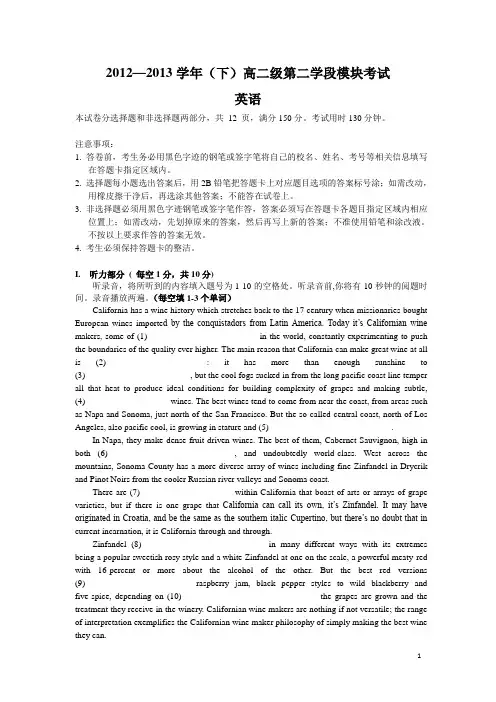
广东实验中学2014—2015学年(下)高一级模块三测试
英 语
本试卷分选择题和非选择题两部分,共11页,满分150分;考试用时120分钟。
注意事项:
1. 答卷前,考生务必用黑色字迹的钢笔或签字笔将自己的姓名、考号等相关信息填写在答题卡指定区域内。
2. 选择题每小题选出答案后,用2B铅笔把答题卡上对应题目选项的答案标号涂黑;如需改动,用橡皮
擦干净后,再选涂其他答案;不能答在试卷上。
3. 非选择题必须用黑色字迹钢笔或签字笔作答,答案必须写在答题卡各题目指定区域内相应位置上;如需
改动,先划掉原来的答案,然后再写上新的答案;不准使用铅笔和涂改液。不按以上要求作答的答案无效。
4. 考生必须保持答题卡的整洁,考试结束后,将答题卡和答题卷一并交上。
I 听力(共两节,满分20分)
第一节 听力理解(5段对话,共15小题;每小题1分,满分15分)
每段播放两遍。各段后有几个小题,各段播放前每小题有5秒钟的阅题时间。请根据各段播放内容及相关小题,在5秒钟内从题中所给的A、B、C项中,选出最佳选项,并在答题卡上将该项涂黑。
听第一段对话,回答第1—3题。
1. How will Kate travel to New York?
A. By car. B. By train. C. By bus.
2. Where is Laura from?
A. New York. B. Vermont. C. We don't know.
3. What do we know about Kate?
A. She will go to New York with Jack's roommate.
B. She invites Jack to go with her to New York.
C. She has never been to New York.
听第二段对话,回答第4—6题。
4. What is the probable relationship between the two speakers?
A. Old friends.
B. Passenger and taxi driver.
C. Pedestrian and policeman.
5. What do we know about going by North-south Elevation Bridge?
A. It should be faster but the distance will be longer.
B. It should be faster and the distance will be the same.
C. It should be slower but the distance will be shorter.
6. If the cab covers 21 kilometers to get to People's Square, how much should the woman pay?
A. 10 yuan. B. 50 yuan. C. 62 yuan.
听第三段对话,回答第7—9题。
7. Why are Sandra's parents shocked about Sandra's rapid fall?
A. Because they have great concern about what she is doing.
B. Because she has been excellent until recently.
C. Because she has always been underachieved.
8. Which of the following extra-curricular activities does Sandra not take part in?
A. Being captain of the school basketball team.
B. Learning the clarinet(单簧管)and piano.
C. Working part-time as an editor for a newspaper.
9. What is the teacher's suggestion for Sandra in the end?
A. Quit all these extra-curricular activities.
B. Reduce the amount of the extra-curricular activities.
C. Her parents should take over more responsibilities.
听第四段独白,回答第10—12题。
10. What does the speaker mainly talk about?
A. The growth of the publishing industry.
B. The history of papermaking.
C. The use of paper in the 19th century.
11. Why did the paper industry need a new source of fiber in the early 1800' s?
A. Publishers wanted higher quality paper.
B. Paper made from rags deteriorated(变质)too quickly.
C. The supply of rags was not enough.
12. According to the speaker, what problem do libraries face?
A. Many of their books are in poor condition.
B. They have to import most of the paper they use.
C. They don't have enough space to store government documents.
听第五段对话,回答第13-15题。
13. What are the two speakers talking about?
A. Presentation topic. B. Painters' adventure. C. Art collection.
14. What do we know about Emily Cart?
A. She is going to give a presentation next week.
B. She has a sense of adventure as a painter.
C. Canadian as she is, she was born in the USA.
15. What can we learn from the conversation?
A. The man thinks highly of the woman' s choice.
B. Emily Cart has a good collection of female painters.
C. The woman is going to give the presentation this afternoon.
第二节 听取信息(共5小题;每小题1分,满分5分)
听下面一段对话,请根据题目要求,从所听到的内容中获取必要的信息,填入答题卡标号为16—20的空格中。听录音前,你将有10秒钟的阅题时间。录音读两遍。
Memory of A Party
Time Last year
What to dress In best clothes, but everyone else was in 16
The way to the party Got lost, and took a long time to get there
What to take for the party Nothing, but everyone else with bottles of 17
After the party Got a 18 on the car
On the way home No 19 in the car
The worst thing to suppose There was 20 just across the road, needn't use the car
II. 单项填空(共5小题;每小题1分,满分5分)
阅读下面的句子,根据句子意思从各题所给的A、B、C、D选项中选出最佳选项,使句子完整通顺,并在答题卡上将该项涂黑。
21. The boss said to the secretary, “If you work well, you ______ have a rise.”
A. must B. ought to C. would D. shall
22. Could I speak to ______ is in charge of International Sales please?
A. who B. what C. whoever D. whatever
23. News came from the school office ______ Wang Lin had been admitted to Peking University.
A. which
B. that
C. what D. where
24. —I didn’t go to work yesterday because my car broke down.
—You ______ mine. I wasn’t using it then.
A. might borrow
B. could have borrowed
C. ought to borrow
D. must have borrowed