
人教版高中英语必修1Unit 2课文讲解
- 格式:pptx
- 大小:86.58 KB
- 文档页数:16
Unit 2 English around the world
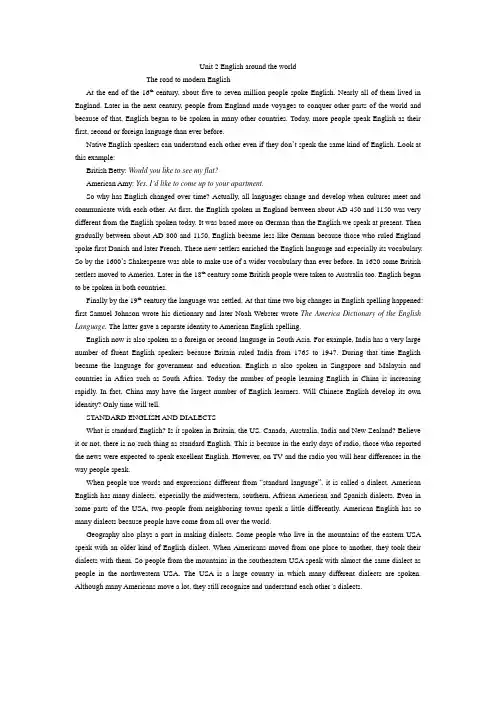
The road to modern English
At the end of the 16th century, about five to seven million people spoke English. Nearly all of them lived in
England. Later in the next century, people from England made voyages to conquer other parts of the world and
because of that, English began to be spoken in many other countries. Today, more people speak English as their
first, second or foreign language than ever before.
Native English speakers can understand each other even if they don’t speak the same kind of English. Look at
this example:
British Betty: Would you like to see my flat?
American Amy: Yes. I’d like to come up to your apartment.
So why has English changed over time? Actually, all languages change and develop when cultures meet and
communicate with each other. At first, the English spoken in England between about AD 450 and 1150 was very
Unit1 Cultural relics
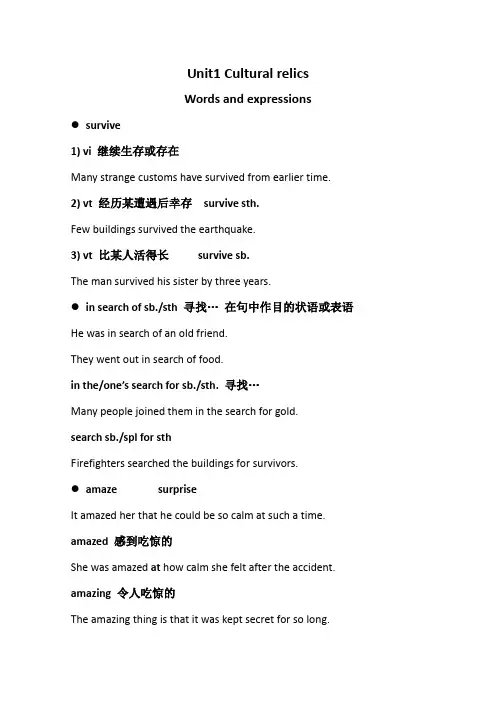
Words and expressions
survive
1) vi 继续生存或存在
Many strange customs have survived from earlier time.
2) vt 经历某遭遇后幸存 survive sth.
Few buildings survived the earthquake.
3) vt 比某人活得长 survive sb.
The man survived his sister by three years.
in search of sb./sth 寻找… 在句中作目的状语或表语
He was in search of an old friend.
They went out in search of food.
in the/one’s search for sb./sth. 寻找…
Many people joined them in the search for gold.
search sb./spl for sth
Firefighters searched the buildings for survivors.
amaze surprise
It amazed her that he could be so calm at such a time.
amazed 感到吃惊的
She was amazed at how calm she felt after the accident.
amazing 令人吃惊的
The amazing thing is that it was kept secret for so long.
design
She came to London in 1960 to study fashion design.
The experiment is designed to test the new drug.
Unit 1 Cultural Relics
教学内容
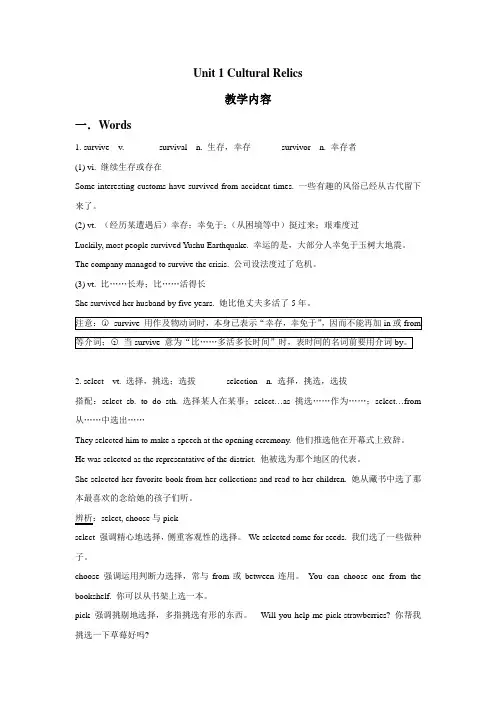
一.Words
1. survive v. survival n. 生存,幸存 survivor n. 幸存者
(1) vi. 继续生存或存在
Some interesting customs have survived from accident times. 一些有趣的风俗已经从古代留下来了。
(2) vt. (经历某遭遇后)幸存;幸免于;(从困境等中)挺过来;艰难度过
Luckily, most people survived Yushu Earthquake. 幸运的是,大部分人幸免于玉树大地震。
The company managed to survive the crisis. 公司设法度过了危机。
(3) vt. 比„„长寿;比„„活得长
She survived her husband by five years. 她比他丈夫多活了5年。
注意:○1 survive 用作及物动词时,本身已表示“幸存,幸免于”,因而不能再加in或from等介词;○2 当survive 意为“比„„多活多长时间”时,表时间的名词前要用介词by。
2. select vt. 选择,挑选;选拔 selection n. 选择,挑选,选拔
搭配:select sb. to do sth. 选择某人在某事;select…as 挑选„„作为„„;select…from
从„„中选出„„
They selected him to make a speech at the opening ceremony. 他们推选他在开幕式上致辞。
He was selected as the representative of the district. 他被选为那个地区的代表。
She selected her favorite book from her collections and read to her children. 她从藏书中选了那本最喜欢的念给她的孩子们听。
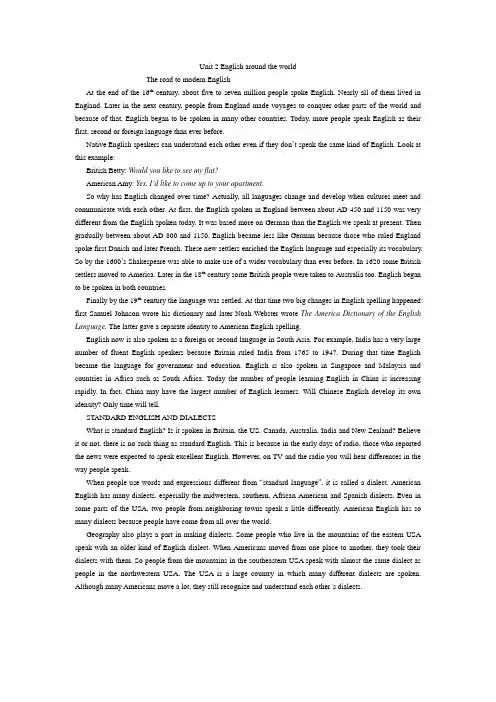
Unit 2 English around the world
The road to modern English
At the end of the 16th century, about five to seven million people spoke English. Nearly all of them lived in
England. Later in the next century, people from England made voyages to conquer other parts of the world and
because of that, English began to be spoken in many other countries. Today, more people speak English as their
first, second or foreign language than ever before.
Native English speakers can understand each other even if they don’t speak the same kind of English. Look at
this example:
British Betty: Would you like to see my flat?
American Amy: Yes. I’d like to come up to your apartment.
So why has English changed over time? Actually, all languages change and develop when cultures meet and
communicate with each other. At first, the English spoken in England between about AD 450 and 1150 was very