Extrinsic calibration of a single line scanning lidar and a camera
- 格式:pdf
- 大小:1.35 MB
- 文档页数:7
Kiho Kwak, Daniel F. Huber, Hernan Badino, and Takeo Kanade
Abstract— Lidar and visual imagery have been broadly utilized in computer vision and mobile robotics applications because these sensors provide complementary information. However, in order to convert data between the local coordinate systems, we must estimate the rigid body transformation between the sensors. In this paper, we propose a robustweighted extrinsic calibration algorithm that is implemented easily and has small calibration error. The extrinsic calibration parameters are estimated by minimizing the distance between corresponding features projected onto the image plane. The features are edge and centerline features on a v-shaped calibration target. The proposed algorithm contributes two ways to improve the calibration accuracy. First, we use differnt and a line feature according to the correspondence accuracy of the features. Second, we apply a penalizing function to exclude the influence of outliers in the calibration data sets. We conduct several experiments to evaluate the performance of our extrinsic calibration algorithm, such as comparison of the RMS distance of the ground truth and the projected points, the effect of the number of lidar scan and image, and the effect of pose and range of the calibration target. In the experiments, we show our extrinsic calibration algorithm has calibration accuracy over 50% better than an existing state of the art approach. To evaluate the generality of our algorithm, we also colorize point clouds with different pairs of lidars and cameras calibrated by our algorithm.
Kiho Kwak, Daniel F. Huber, Hernan Badino, and Takeo Kanade are with Carnegie Mellon University, Pittsburgh, PA 15213, USA {kkwak,
impossible to determine which lidar point is being observed. Another challenge is that some types of features, such as intensity edges, can only be detected in one sensor modality. Finally, the single line lidars that our algorithm calibrates can measure only 1D structure in the imaging plane. To address this problem, researchers have proposed using constraints derived from lines and depth edges, rather than points [7], [8], [9]. In these previous works, two types of 3D features are commonly used: points lying at depth edges and points lying on 3D corners. Intensity edges are often used as image-based features. The extrinsic calibration parameters may be obtained by minimizing the distance between corresponding features either projected onto the image plane or in 3D. Our extrinsic calibration algorithm follows this basic procedure. We use a calibration target consisting of two planes in a v-shape (Fig. 1). We collect images of the laser line intersecting the target with different poses and at different ranges. Our 3D features consist of the 3D depth edges on both sides of the target and the 3D corner in the center. Image features are intensity edges extracted from both edges and the centerline of the target. We estimate the extrinsic parameters by minimizing the distance between the 3D features projected on the image plane and the corresponding image edge features. II. P REVIOUS W ORK There are several approaches to estimate the extrinsic parameters between a lidar and a camera. These approaches can be classified based on whether the correspondences are measured in same modality or in separate modalities. The first approach is to directly search for correspondences with a sensor that can observe the lidar beam. If the camera is an IR camera, it is possible to detect the lidar spots on the image directly. Calibration targets, such as poles or
2011 IEEE/RSJ International Conference on Intelligent Robots and Systems September 25-30, 2011. San Francisco, CA, USA
Extrinsic Calibration of a Single Line Scanning Lidar and a Camera
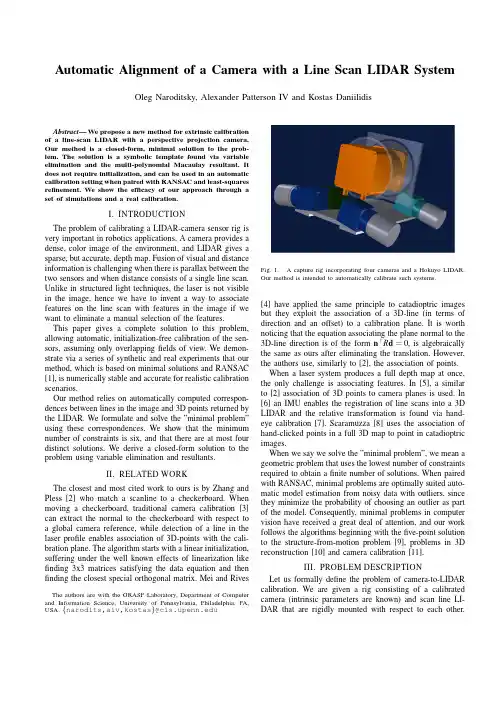
Fig. 1. The relative pose between the line scanning lidar and the camera is estimated using features extracted from images of a v-shaped target.
I. I NTRODUCTION Lidar and visual imagery are broadly utilized in computer vision and mobile robotics applications because these sensors provide complementary information [1], [2], [3]. Generally, the sensors must be calibrated in order to convert data between the local coordinate systems of the sensors. Calibration can be divided into two parts: intrinsic calibration, in which the sensors’ intrinsic parameters, such as focal length, skew parameter, and image center, are estimated; and extrinsic calibration, in which the rigid body transformation between the sensors is estimated. In this paper, we address the problem of extrinsic calibration between a lidar and a camera. The extrinsic calibration problem can be solved by directly finding corresponding features in the lidar and camera data [4], [5], [6]. However, finding such correspondences is difficult for several reasons. First, the lidar spot usually cannot be seen directly in the image, since lidar typically operates outside the visual spectrum. Although the spot can be seen with special purpose equipment, such as an infrared camera or scope, most lidars cannot be controlled, making it
Abstract— Lidar and visual imagery have been broadly utilized in computer vision and mobile robotics applications because these sensors provide complementary information. However, in order to convert data between the local coordinate systems, we must estimate the rigid body transformation between the sensors. In this paper, we propose a robustweighted extrinsic calibration algorithm that is implemented easily and has small calibration error. The extrinsic calibration parameters are estimated by minimizing the distance between corresponding features projected onto the image plane. The features are edge and centerline features on a v-shaped calibration target. The proposed algorithm contributes two ways to improve the calibration accuracy. First, we use differnt and a line feature according to the correspondence accuracy of the features. Second, we apply a penalizing function to exclude the influence of outliers in the calibration data sets. We conduct several experiments to evaluate the performance of our extrinsic calibration algorithm, such as comparison of the RMS distance of the ground truth and the projected points, the effect of the number of lidar scan and image, and the effect of pose and range of the calibration target. In the experiments, we show our extrinsic calibration algorithm has calibration accuracy over 50% better than an existing state of the art approach. To evaluate the generality of our algorithm, we also colorize point clouds with different pairs of lidars and cameras calibrated by our algorithm.
Kiho Kwak, Daniel F. Huber, Hernan Badino, and Takeo Kanade are with Carnegie Mellon University, Pittsburgh, PA 15213, USA {kkwak,
impossible to determine which lidar point is being observed. Another challenge is that some types of features, such as intensity edges, can only be detected in one sensor modality. Finally, the single line lidars that our algorithm calibrates can measure only 1D structure in the imaging plane. To address this problem, researchers have proposed using constraints derived from lines and depth edges, rather than points [7], [8], [9]. In these previous works, two types of 3D features are commonly used: points lying at depth edges and points lying on 3D corners. Intensity edges are often used as image-based features. The extrinsic calibration parameters may be obtained by minimizing the distance between corresponding features either projected onto the image plane or in 3D. Our extrinsic calibration algorithm follows this basic procedure. We use a calibration target consisting of two planes in a v-shape (Fig. 1). We collect images of the laser line intersecting the target with different poses and at different ranges. Our 3D features consist of the 3D depth edges on both sides of the target and the 3D corner in the center. Image features are intensity edges extracted from both edges and the centerline of the target. We estimate the extrinsic parameters by minimizing the distance between the 3D features projected on the image plane and the corresponding image edge features. II. P REVIOUS W ORK There are several approaches to estimate the extrinsic parameters between a lidar and a camera. These approaches can be classified based on whether the correspondences are measured in same modality or in separate modalities. The first approach is to directly search for correspondences with a sensor that can observe the lidar beam. If the camera is an IR camera, it is possible to detect the lidar spots on the image directly. Calibration targets, such as poles or
2011 IEEE/RSJ International Conference on Intelligent Robots and Systems September 25-30, 2011. San Francisco, CA, USA
Extrinsic Calibration of a Single Line Scanning Lidar and a Camera
Fig. 1. The relative pose between the line scanning lidar and the camera is estimated using features extracted from images of a v-shaped target.
I. I NTRODUCTION Lidar and visual imagery are broadly utilized in computer vision and mobile robotics applications because these sensors provide complementary information [1], [2], [3]. Generally, the sensors must be calibrated in order to convert data between the local coordinate systems of the sensors. Calibration can be divided into two parts: intrinsic calibration, in which the sensors’ intrinsic parameters, such as focal length, skew parameter, and image center, are estimated; and extrinsic calibration, in which the rigid body transformation between the sensors is estimated. In this paper, we address the problem of extrinsic calibration between a lidar and a camera. The extrinsic calibration problem can be solved by directly finding corresponding features in the lidar and camera data [4], [5], [6]. However, finding such correspondences is difficult for several reasons. First, the lidar spot usually cannot be seen directly in the image, since lidar typically operates outside the visual spectrum. Although the spot can be seen with special purpose equipment, such as an infrared camera or scope, most lidars cannot be controlled, making it