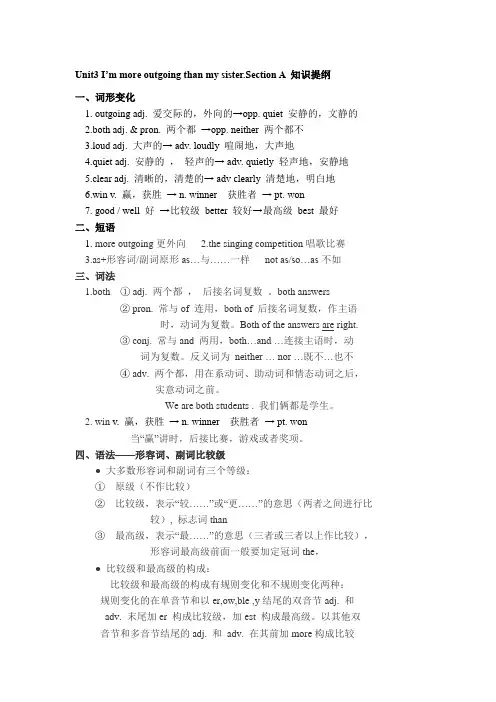
人教八年级英语上册Unit-3教学重点归纳
- 格式:doc
- 大小:28.00 KB
- 文档页数:5
八年级英语上册Unit 3教学重点归纳
Unit 3 I’m more outgoing than my sister.
1,比较级,最高级变化规则
一般在词尾+ er或est;以e 结尾的加r或st;重读闭音节双写辅音字母+ er或est;辅音字母+y结尾的,改y为i+ er或est;多音节词和部分双音节词,加more或most。
不规则变化见书本P114
2,比较级用法
基本句型:主语+be+比较级+than+比较对象
两者相比较用比较级 eg:Who do you think is more outgoing,Lily or Lucy?
Very,more,quite,so,too等修饰原级;much,a little,a lot,a bit,far ,even等修饰比较级
eg:I’m much/ a little / a lot / a bit /far more outgoing than my sister.
I’m even worse now.
不能与人或事物自身相比较
eg:He is taller than any other student in his class.
China is larger than any country in Africa.
比较对象要一致(that代替不可数名词,those代替可数名词复数,所有格,ones)
eg:The weather in Harbin is much colder than that in Wuhan.
The students of Class One study harder than those of Class Two.
My bike is newer than Tom’s.
比较级中出现of the two/ twins结构时,adj比较级前要+the,不可用than
Eg:Tom is the taller of the two brothers.
“get/ become+ 比较级+and +比较级”表示“变得越来越……”(多音节或部分双音节用“more and more+原级)
Eg: It gets warmer and warmer when spring comes.
You’re getting more and more beautiful.
“the+比较级……,the+比较级……”表示“越……,就越……”
Eg: The more you exercise, the stronger you will be.
“As…as”中间接原级,表示“与…一样”,否定为“not as/ so…as”表示“不如” Eg: He is as tall as his father.
He is not as/ so tall as his father.
“比较级+than”(more/ less +原级+than)与“not as/ so…as”可以互换
Eg: I’m taller than you. Chinese is more important than Biology.
You’re shorter than me. Biology is less important than Chinese
You’re not as/ so tall as me. Biology is not as/ so important as Chinese
比……大/多/长/宽几倍,用“主语+be+……times+比较级+than+比较对象”
Eg: Our classroom is twice larger than yours.
重几斤,高几公分,大几岁……,用“主语+be+数量词+比较级+than+比较对象”
Eg: I’m six years older than you.
3,loudly大声地,响亮地(多含噪音之意)
aloud大声地,出声地(强调出声)read aloud call aloud for help
loud大声地,高声地,常与speak,shout,laugh,talk连用
响亮的,大声的 loud voice
4,fast强调速度快 run/ drive fast
quickly强调动作、行动快
soon 强调时间间隔短
5,competition体育,书法,朗读,音乐等比赛
match 体育竞技比赛,球类比赛
race 速度方面的竞赛,赛跑,赛龙舟等
6,win+比赛,奖项
beat+人,团队
7,ago 以前,用于一般过去时,放在一段时间后
before 在……以前,通常用于完成时,放在时间点或事件之前
8,the same as→be different from be similar to =be like
9,be good at+ V-ing=do well in 擅长于
be good for 对…有益 (be bad for对…有害)
be good to 对…友好 (good 可用friendly,nice,kind替换)
be good with和…相处好=get on/ along well with
10,true/ truly 指故事、说法、答案等与标准事实、实际情况相符 real/ really 指人或事客观存在,不是想象的
11,take care of=look after照顾
care for 照料、关心某人,喜欢某人、某物
care about 关心,计较,在乎
12,make sb do sth
make sb/ sth +adj make me happy
make sb +n. We made him monitor.
make sb +过去分词 She spoke aloud to make herself heard.
make it 约定时间,做成某事,及时抵达 Let’s make it at 10:00.
Don’t worry. He’ll make it.
13,both 位置:行前be 后
both of them/ us=they/ we both
both 作主语,谓语动词用复数
not both为部分否定,全部否定要用either…not或者neither
both…and…=not only…but(also)… 否定为:neither…nor
14,be popular with sb受某人欢迎 be popular in/ at在某地受欢迎
15,it is +adj+for sb +to do sth (adj修饰to do sth)It is important for me to learn English.
it is +adj+of sb +to do sth (adj修饰sb) It is kind/ friendly/ nice of you to help me.
16,bring out使显现出
17,share sth with sb和某人分享
18,other “其他的,另外的”,后接名词复数,有时other+n复数=others
another “又一(个),另一(个)”,泛指总数为三个或三个以上中的任意一个,后接名词单数。
the other“(两者中的)另一个”,常与one连用,“one…the other…”表示“一个…,另一个…”
19,heart learn sth by heart用心记 lose heart灰心
20,break the law/ rules/ world record违法/违规/打破世界纪录
Break off 打断 break away from摆脱,脱离 break into破门而入 break in插嘴
Break down出故障 break out爆发 break up散火 break one’s words食言
Have a break/ rest休息会儿 21,laugh发笑 laugh at 嘲笑
Smile微笑 smile at对…微笑
22,定语从句:在复合句中修饰名词或代词的从句叫定语从句。被定语从句修饰的名词或代词叫做先行词。引导定语从句的词称为关系词。关系词位于先行词和定语从句之间,起联系作用,同时又作定语从句的一个成分。
定语从句的关系词引导定语的关系代词有:that, who (whom, whose), which; 关系副词(在定语从句中只能作状语,且不能省略)有:when, where, why等。关系词的选择主要取决于两个因素:(1)先行词是什么(2)先行词在定语从句中作什么成分。
●关系代词(that,who,which,whose,whom)引导的定语从句。
①that/ who在从句中作主语,先行词为人。
Eg:The girl that/ who is reading is my sister.
②that/ which在从句中作主语或宾语,先行词为物。
Eg:The book that/ which is on the desk belongs to Tom.(主)
He came back for the book that/ which he had forgotten.(宾)
③whose在从句中作定语,先行词为人或物。
Eg:This is the pencil whose point is broken.
That is the girl whose mother died two years ago.
④whom/ that在从句中作宾语,先行词为人。
Eg:The girl whom/ that I spoke to is my cousin.
●关系副词(when/ where/ why)引导的定语从句。
①When在从句中作时间状语,其先行词是表示时间的词(day/ year/ season等)。
例如:我永远不会忘记我入团的那一天。I shall never forget the day______I joined the League.
解放军战士在人们最需要的时刻来到。
The PLA men come at the time ________ the people need them most.
②Where在定语从句中作地点状语,其先行词是表示地点的词(place/ town/ home/ house)
例如:你还记得我们初次见面的地方吗?Do you still remember the place ____we first met?