高考必考英语单词
- 格式:docx
- 大小:17.56 KB
- 文档页数:5
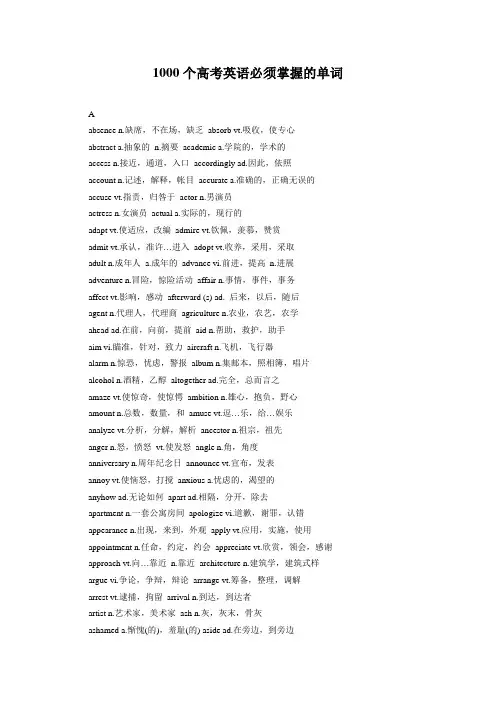
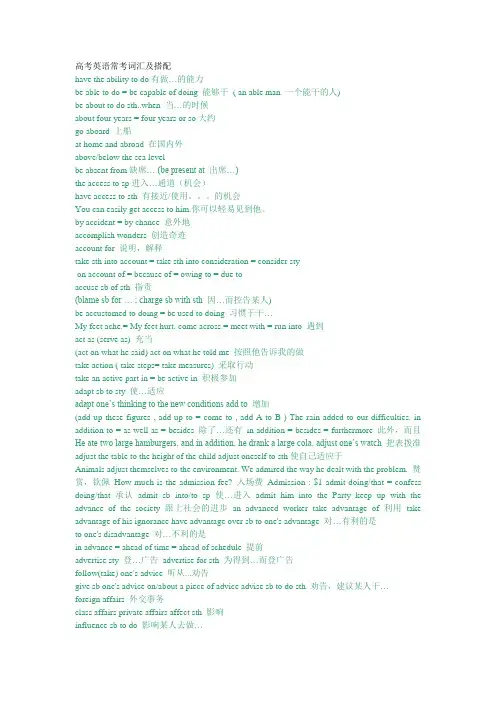
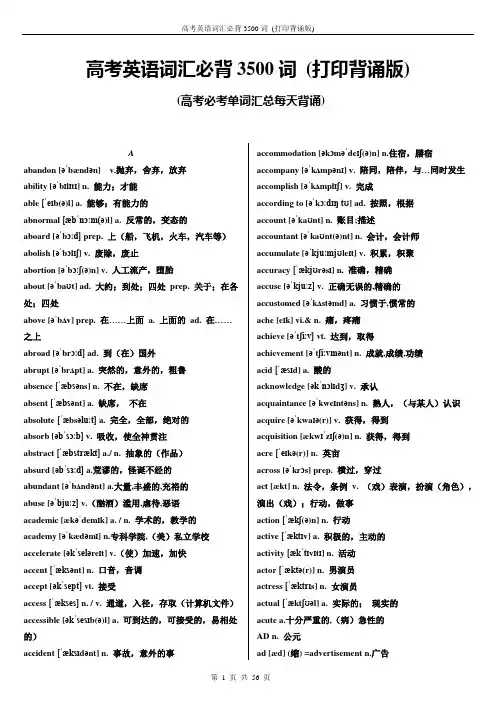
高考必考英语单词
一、基础词汇
1. abandon
1. 词性:动词,意为 “放弃;遗弃;抛弃”。
2. 例句:Don't abandon yourself to despair.(不要自暴自弃。)
2. ability
1. 词性:名词,意为 “能力;才能”,复数形式为 abilities。
2. 例句:He has the ability to solve this problem.(他有能力解决这个问题。)
3. able
1. 词性:形容词,意为 “能够的;有能力的”,be able to do
sth. 表示 “能够做某事”。
2. 例句:I am able to speak English fluently.(我能够流利地说英语。)
4. abroad
1. 词性:副词,意为 “在国外;到国外”。
2. 例句:He has studied abroad for three years.(他在国外学习了三年。)
5. absence
1. 词性:名词,意为 “缺席;不在”。
2. 例句:His absence from the meeting surprised us.(他缺席会议让我们很惊讶。)
6. absent
1. 词性:形容词,意为 “缺席的;不在场的”,be absent from
表示 “缺席……”。
2. 例句:He was absent from school yesterday.(他昨天旷课了。)
7. absolute
1. 词性:形容词,意为 “绝对的;完全的”。
2. 例句:There is no absolute truth.(没有绝对的真理。)
8. absorb
1. 词性:动词,意为 “吸收;吸引;使全神贯注”,be absorbed
in 表示 “全神贯注于……”。
2. 例句:Plants absorb carbon dioxide.(植物吸收二氧化碳。)
3. 例句:He was absorbed in reading.(他全神贯注于阅读。)
9. abstract
1. 词性:形容词,意为 “抽象的;深奥的”;也可作名词,意为 “摘要;抽象概念”。
2. 例句:This is an abstract concept.(这是一个抽象概念。)
3. 例句:Please write an abstract of this article.(请写这篇文章的摘要。)
10. abundant
• 词性:形容词,意为 “丰富的;充裕的”,be abundant in 表示 “富含……”。
• 例句:Our country is abundant in natural resources.(我们国家自然资源丰富。)
二、高频词汇
1. access
• 词性:名词,意为 “通道;入口;接近(或进入、享用)的机会”;也可作动词,意为 “进入;使用;获取”。
• 例句:The only access to the village is by boat.(去那个村庄的唯一途径是乘船。)
• 例句:You can access the Internet in the library.(你可以在图书馆使用互联网。)
2. accident
• 词性:名词,意为 “事故;意外遭遇”,by accident 表示 “偶然地”。
• 例句:He had an accident on his way to school.(他在上学路上出了事故。)
• 例句:I met her by accident in the supermarket.(我在超市偶然遇见她。)
3. accommodation
• 词性:名词,意为 “住处;膳宿”,常用复数形式。
• 例句:The hotel provides good accommodation.(这家酒店提供良好的膳宿。)
4. accompany
• 词性:动词,意为 “陪伴;陪同;与…… 同时发生;为……
伴奏”。
• 例句:I will accompany you to the hospital.(我将陪你去医院。)
• 例句:Thunder often accompanies lightning.(雷声常常伴随着闪电。)
5. accomplish
• 词性:动词,意为 “完成;实现;达到”。
• 例句:He has accomplished his task successfully.(他成功地完成了他的任务。)
6. account
• 词性:名词,意为 “账户;账目;叙述;解释”;也可作动词,意为 “认为;把…… 视为;解释;说明(原因等)”,account
for 表示 “解释;占(比例)”。
• 例句:I have an account in this bank.(我在这家银行有一个账户。)
• 例句:He gave an account of his trip.(他讲述了他的旅行经历。)
• 例句:How do you account for your absence?(你如何解释你的缺席?)
• 例句:Girls account for 40% of the students in our class.(女生占我们班学生的 40%。)
7. accumulate
• 词性:动词,意为 “积累;积聚;堆积”。
• 例句:He has accumulated a large fortune.(他积累了一大笔财富。)
8. accuracy
• 词性:名词,意为 “准确(性);精确(性)”。
• 例句:The accuracy of this measurement is very high.(这个测量的准确性很高。)
9. accurate
• 词性:形容词,意为 “准确的;精确的”。
• 例句:This is an accurate report.(这是一份准确的报告。)
10. accuse
• 词性:动词,意为 “控告;指责;谴责”,accuse sb. of sth. 表示
“控告某人某事;指责某人某事”。
• 例句:He was accused of stealing.(他被指控偷窃。)