
一般过去式的特殊疑问句
- 格式:ppt
- 大小:871.00 KB
- 文档页数:13


【巩固练习】
Ⅰ.单项选择。
1.-_____ is your dictionary?
- 10 Yuan.
A. How much B. How many C. What D. Whose
2.-_______ subjects do you have ?
- Seven.
A. How long B. How many C. How much D. How far
3.-_______ do you like best?
- I like math best.
A. Which subject B. What food C. What color
D.Which sport
4. - ________ do you like science?
-________it’s interesting.
A. Why; So B. What; Because C. Why; Because D. How;
Because
5. When _______the girl ________ her homework?
A. does; does B. does; do C. do; does D. do; do
6. —Does he want to go to a movie?
— _______. A. Yes, he does B. No, he does C. Yes, he doesn’t D.
Yes, she is
7. -_______ kind of movies do you like?
- I like comedies very much.
A. What’s B. How C. What D. Why
8. - ______ are these bananas?
(完整word版)一般过去时及特殊疑问句
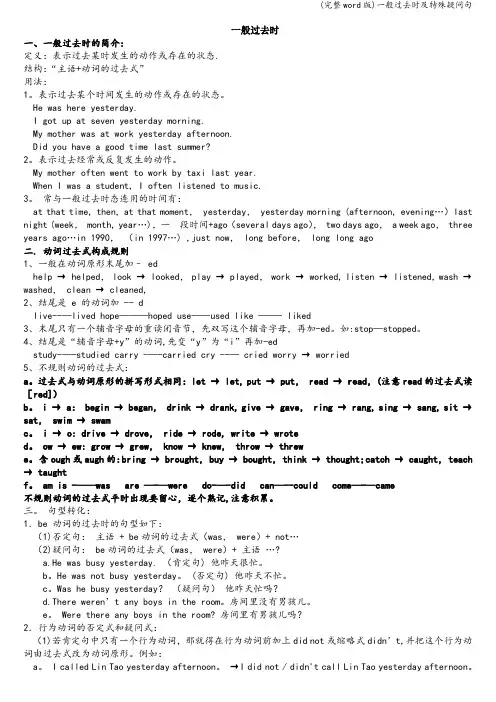
一般过去时
一、一般过去时的简介:
定义:表示过去某时发生的动作或存在的状态.
结构:“主语+动词的过去式”
用法:
1。表示过去某个时间发生的动作或存在的状态。
He was here yesterday.
I got up at seven yesterday morning.
My mother was at work yesterday afternoon.
Did you have a good time last summer?
2。表示过去经常或反复发生的动作。
My mother often went to work by taxi last year.
When I was a student, I often listened to music.
3。 常与一般过去时态连用的时间有:
at that time, then, at that moment, yesterday, yesterday morning (afternoon, evening…)last
night (week, month, year…),一 段时间+ago(several days ago), two days ago, a week ago, three
years ago…in 1990, (in 1997…) ,just now, long before, long long ago
二. 动词过去式构成规则
1、一般在动词原形末尾加– ed
help → helped, look → looked, play → played, work → worked, listen → listened, wash →washed, clean → cleaned,
2、结尾是 e 的动词加 -- d
live--—lived hope———hoped use-—-used like ——- liked

一般过去式The past Indefinite tense
一、概念:1、过去的状态:
肯定句:主语+ was/were+(形容词、名词、介词短语)。
否定形式:主语+ was/were +not +(形容词、名词、介词短语)。
一般疑问句形式:was/were+主语+(形容词、名词、介词短语)
Yes,主语+was/were. No,主语+wasn’t/weren’t.
特殊疑问句句式:疑问词+ was/were+主语+(形容词、名词、介词短语)
* 单数三人成和I 用,was;复数人称和you 用were。
2、过去习惯性、经常性的动作、行为:
肯定句:主语+ V过去式 +宾语 +时间状语、地点状语。
否定形式:主语+ did +not +宾语 +时间状语、地点状语。
一般疑问句形式:Did +主语 + V原型 +宾语 +时间状语/地点状语
Yes,主语+did. No,主语+didn’t
特殊疑问句句式:疑问词+Did +主语 + V原型 +宾语 +时间状语/地点状语
二、四种时间状语:
① yesterday及相关短语。
例如:yesterday morning/afternoon/evening ,the day before yesterday,
② “last+ 时间状语”构成的短语。
例如:last Monday .../last night/month/spring/year 昨晚/上个月/去年春天/去年。
③ “一段时间+ago”组成的短语。
例如:three days ago 三天以前 four years ago四年以前。
④ “介词+ 时间名词”组成的短语。
例如:in 1999 在1999年;on the morning of December 25th 在12月25号早上。
还有一些过去时常用的时间状语:

一般过去时的全面讲解
01、一般过去时的基本结构
1. 肯定句形式:主语+动词过去式+其他
例: I was an English teacher one year ago. 一年前我是一名英语老师。
I bought a yellow dress yesterday afternoon. 昨天下午我买了一条黄裙子。
2. 否定句形式:①was/were+not;
②在行为动词前加didn't,同时还原行为动词
例:I wasn't an English teacher one year ago. 一年前我不是一名英语老师。
I didn't buy a yellow dress yesterday afternoon. 昨天下午我没买一条黄裙子。
3. 一般疑问句:①was/were提到句首;②Did+主语+动词原形+其他?
例:Were you an English teacher one year ago? 一年前你是一名英语老师吗?
Did you buy a yellow dress yesterday afternoon? 昨天下午你买了一条黄裙子吗?
4. 特殊疑问句:特殊疑问词+一般疑问句
例:What were you one year ago? 一年前你是做什么的?
When did you buy a yellow dress? 你什么时候买了一条黄裙子?
02一般过去时的基本用法
1. 表示在过去某个时间所发生的动作或所处的状态(与现在无关) 。常与yesterday, last
week, in 1989, just now, a moment ago, the other day等过去具体时间状语连用。
He was here just now. 他刚才还在这里。
What did you do yesterday? 你昨天做了什么事?
2. 在过去一段时间内的经常性或习惯性动作。