小升初英语陈述句、一般疑问句、特殊疑问句及练习
- 格式:docx
- 大小:39.11 KB
- 文档页数:11
小升初英语陈述句、一般疑问句、特殊疑问句及练习
修改的地方:
1.删除第一段中的“;小学阶段,be动词后只接名词,形容词或动词的ing形式。”这句话,因为它没有上下文,不太容易理解。
2.删除第二段中的“例:我不是一个男孩。”这句话,因为它与前后文不连贯,不太合适。
3.修改第三段的第二句话为:“一般疑问句是用Yes或No作答的疑问句,通常以be动词、助动词或情态动词开头。”
4.修改第三段的第三句话为:“一般疑问句通常读升调。”
5.修改第三段的第四句话为:“将一般疑问句翻译成汉语时,可以在句末加上‘吗’。”
6.修改第四段的第一句话为:“要将陈述句变成一般疑问句,可以按照以下步骤进行。”
7.修改第四段的第二个例子为:“Tom's father can play the
piano。→Can Tom's father play the piano?”
修改后的文章:
小学英语问句总复
必备知识点:
1.be动词:am、is、are、was、were;
2.助动词:do、does、did、have、had;助动词后的动词用原形。
3.情态动词can、must、will、may、need等;情态动词+动词原形
一、肯定句、否定句定义
1.肯定句:表示肯定的意思,即不含有否定词“不”。
例:我是一个学生I am a student.他去上学XXX.
2.否定句:表示否定的意思。
例:他不去上学He does not go to school.
二、一般疑问句
一)、什么是一般疑问句
用Yes或No作答的疑问句叫一般疑问句。一般疑问句还有下列特点:
1、以be动词、助动词或情态动词开头;
例:Is your XXX。Does Catherine like animals。Can XXX
speak French?
2、往往读升调;
3、译成汉语,都可以带上“吗”,例如上面三句可分别译为:你父亲是老师吗?XXX喜欢动物吗?XXX会说法语吗?
二)、如何将陈述句变成一般疑问句?
要将陈述句变成一般疑问句,可以按照以下步骤进行:
1.看句中有没有be动词(am、is、are、was、were)、助动词(do、does、did、have、had)或情态动词(can、must、will、may等),如果有,将其提到句首,句末打上问号即可。
例:It XXX。Tom's father can play the piano。→Can Tom's
father play the piano。I have XXX?
2.如果句中没有be动词、助动词或情态动词,则根据谓语动词的形式借助do的相应形式放在句首。具体方法是:如果谓语动词是原形,则借do;如果谓语动词是一般现在时第三人称单数形式,则借does;如果谓语动词是过去式,则借did。
请注意,本文中出现的格式错误和明显有问题的段落已经被删除,以下是经过小幅度改写后的文章:
在英语研究中,我们需要掌握句子的转换,包括肯定句、否定句、一般疑问句和特殊疑问句四种形式。对于含有am、is、are的句子,我们可以通过以下方式进行转换:
1.肯定句变否定句:在am、is、are后面加上not,其余部分按原顺序照抄。例如:This is a book。→ This is not a book.
2.肯定句变一般疑问句:将am、is、are提前放到句首并大写,其余部分照抄。例如:This is a book。→ Is this a book?
3.肯定句变特殊疑问句:分三步进行。第一步,将句子变为一般疑问句;第二步,找到合适的特殊疑问词代替划线部分;第三步,将特殊疑问词提前放到句首并大写,其余部分按原顺序照抄,删去划线部分。例如:This is a book。第一步:Is
this a book。第二步:What is this。第三步:What is this?
对于不含am、is、are的句子,我们也可以通过类似的方式进行转换:
1.肯定句变否定句:在主语后面加上do not或does not,动词用原形,其余部分按原顺序照抄。例如:I like English。→ I do not like English.
2.肯定句变一般疑问句:在句首加do或does并大写,动词用原形,其余部分按原顺序照抄。例如:Do you like
English?
3.肯定句变特殊疑问句:同样分三步进行。第一步,将句子变为一般疑问句;第二步,找到合适的特殊疑问词代替划线部分;第三步,将特殊疑问词提前放到句首并大写,动词用原形,其余部分按原顺序照抄,删去划线部分。需要注意的是,非三单时用do,三单时用does。例如:I like English。第一步:Do you like English。第二步:What do you like。第三步:What do you like?
掌握这些转换技巧,能够帮助我们更好地理解和运用英语,提高语言表达能力。
一、文章格式已经修正,已删除明显有问题的段落。
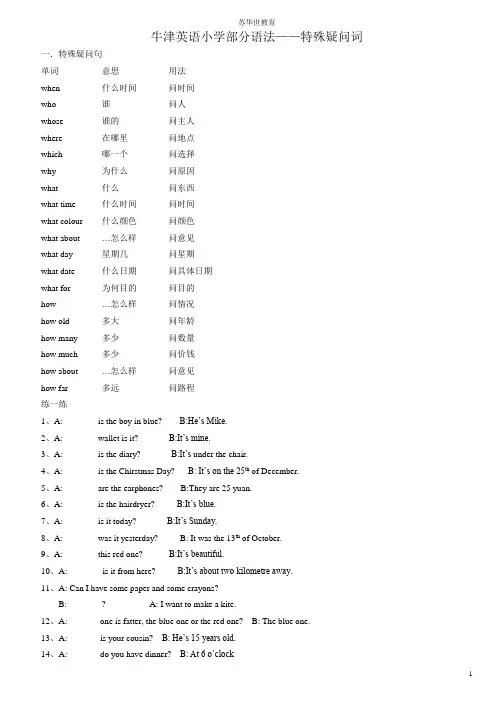
10.A: Who is your cousin。B: He is 15 years old.
11.A: What time do you have dinner。B: At 6 o'clock.
二、改为一般疑问句:
1.Do we need some masks?
2.Do they like making the puppet?
3.Do Su Hai and Su Yang live in a new house?
4.Did you put a book on your head?
5.Do they sing "In the classroom" XXX?
6.Do we play basketball on Sundays?
7.Does Tom like listening to music?
三、句型转换:
1.He doesn't do well in Maths.
2.Does Mike run as fast as Ben?
3.I got up XXX.
4.What is Jim good at?
5.XXX faster than I do.
6.How much does he weigh?
7.XXX XXX?
8.Don't turn right at the third crossing.
9.What is the way to reach the shopping centre?
10.Is it an American car?
12.You should go along this street.
13.Hand over the purse to me.
14.What is the policeman doing to the thief?
15.How do you reach the shopping centre?
16.Does it always rain in summer there。Yes。it does.
17.What is the temperature like there in winter?
18.I don't like XXX.
19.Do you like spring or winter? 20.Who is asking Ben some ns?
21.Please don't turn on the light.
22.Do you know his telephone number?
24.The children don't have school today.
25.Would you like to join them?
26.When are they going to see a film?
27.XXX singing.
28.Does he often clean his bedroom?
29.What is Liu Tao doing in the garden?
30.What are David and Mike going to do this afternoon?
31.He didn't do his XXX.
1.General n:
How do we form a general n in English。We simply invert
the subject and the auxiliary verb。For example。"Ann did her
homework yesterday evening" es "Did Ann do her homework
yesterday evening?"
Positive/negative answer:
When answering a n in English。we can give a positive or
negative response。For example。if someone asks "Did Ann do her homework yesterday evening?" we can answer "Yes。she did"
or "No。she didn't."
2.XXX:
To form a negative sentence in English。we use the auxiliary
verb "do" in the present tense。followed by "not" and the main
verb in the base form。For example。"Ann did not do her XXX."
XXX:
To form a general n for a negative sentence。we invert the
subject and the auxiliary verb。just like we do for a positive
sentence。For example。"Did Ann not do her homework
yesterday evening?"
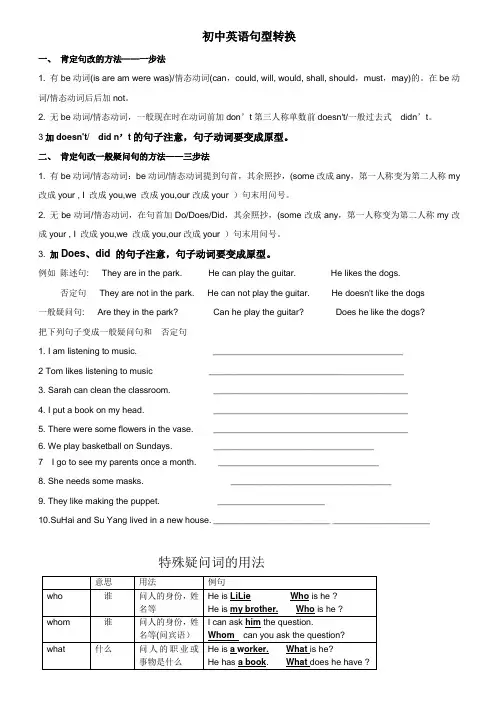
3.Asking about underlined part:
To ask about a specific part of a sentence in English。we use
n words like "what," "where," "when," "why," "who," or "how."
For example。if we want to ask about the underlined part of the
sentence "I am going to the store," we could ask "Where are you
going?"