新视野大学英语3第6单元答案
- 格式:docx
- 大小:175.16 KB
- 文档页数:11
Unit 6 Here are tips for finding a job.
Done with this task. Your current score: 11%
Unit 6 test
Next
Directions: Click on the speaker to the left to start playing the audio recordings
Parts I, II and III. They will be played continuously. Once the recording starts playiplease do NOT click on either the speaker icon or the 'Unit Quiz' link in the menu
above. Otherwise, you may lose the chance of hearing the complete recording.
Part I
Script
Directions: Listen to the short dialogs, and then choose the correct answers
to the questions. You will hear the recording twice. After the first playing,
there will be time for you to choose the correct answers. Use the second playing
to check your answers.
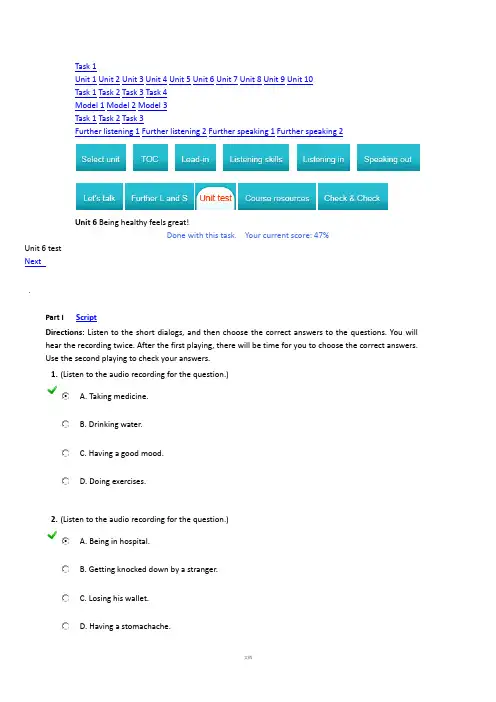
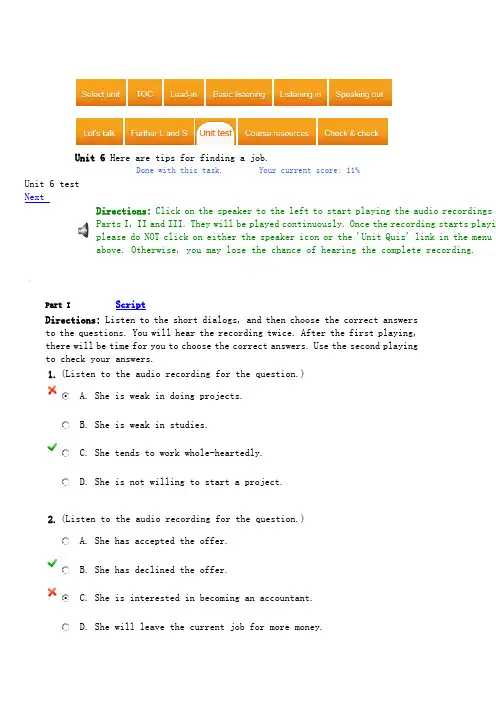
1. (Listen to the audio recording for the question.)
A. She is weak in doing projects.
B. She is weak in studies.
C. She tends to work whole-heartedly.
D. She is not willing to start a project.
2. (Listen to the audio recording for the question.)
A. She has accepted the offer.
B. She has declined the offer.
C. She is interested in becoming an accountant.
D. She will leave the current job for more money.
3. (Listen to the audio recording for the question.)
A. A teacher.
B. A salesman.
C. A project manager.
D. An architect.
4. (Listen to the audio recording for the question.)
A. The company's business model and corporate philosophy.
B. The products and services the company provides.
C. The background the man has.
D. The promising salary.
5. (Listen to the audio recording for the question.)
A. The man failed the interview.
B. There's no position available in the company.
C. The man may apply for sales manager.
D. The man will have an interview next week.
Part II Script
Directions: Listen to the passage three times. When the passage is read for
the first time, listen for the general idea. When the passage is read the second
time, fill in the blanks numbered from S1 to S7 with the exact words you hear.
For blanks numbered from S8 to S10, write down either the exact words you hear
or the main points in your own words. When the passage is read the third time, check your answers. There are various types of questions asked at a job interview. Most job
interviews start with chit-chat type of questions. They are designed to break
the (1) and get the conversation flowing. (2) are questions
like "Did it take you long to get here?", "Did you find the place all right?",
"Were you able to find (3)?" Most of these just require a "yes, no
problem" type of (4); you can elaborate if you wish. However, ensure
that you don't (5) information that will give them a bad
(6). If you say something like "It took me (7) to get here. The
traffic was so bad; I hate traveling to this side of town", it would not do you
good.
(8).
More questions will be asked to find out a bit more about you.
(9), or they
may be hypothetical questions starting with "What if...?". These are aimed at
finding out how you would handle a situation or at finding out your personal
views in certain areas.
Whenever answering a job interview question, give as much information as you
can. Tell them why, where, when and how. In other words use samples to prove
what you are saying.
(10).
Your answer
Correct answer
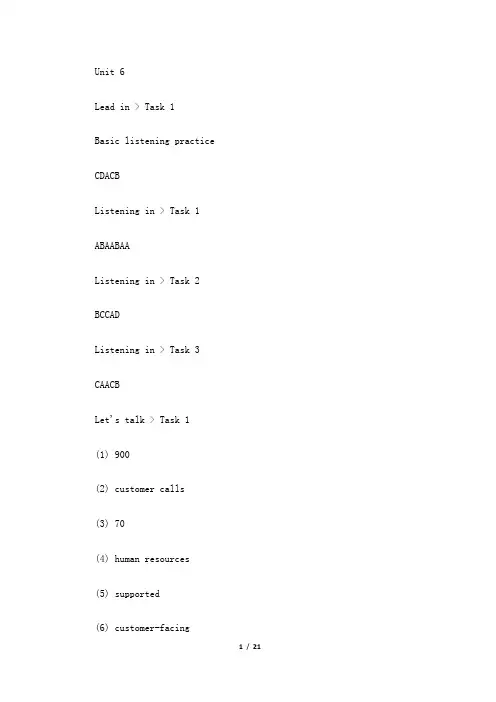
(1) ice
(2) Examples
(3) parking
(4) response
(5) provide
(6) impression
(7) ages
(8) If this is the place where you would be working, they would
automatically be worried that you will be late for work everyday
(9) They might be historical questions regarding your previous employment or education
(10)
Make a statement, then support it by giving an example of a
situation and how you handled it
Part III Script
Directions: Listen to the following recording, and then choose the correct
answers to the questions. You will hear the recording twice. After the first
playing, there will be time for you to choose the correct answers. Use the second
playing to check your answers.
1. Which of the following would be the best title for the passage?
A. The significance of exact numbers in a résumé.
B. The role of three techniques in an interview.
C. How to write a résumé.
D. The importance of a résumé.
2. Which of the following is better in a résumé, according to the speaker?
A. Lots of teaching experience.
B. 7,300 teaching hours.
C. Teaching for many years.
D. Thousands of teaching hours.
3. According to the speaker, which of the following does a holiday company NOT
sell?
A. Holidays.
B. Adventure.
C. Relaxation.
D. Sand.